





Myntra pvt ltd interview experience Real time questions & tips from candidates to crack your interview
Software Developer
Myntra pvt ltd


4 rounds | 5 Coding
problems

 Selected
 Interview preparation journey

Preparation
Duration: 6 months
Topics: Data Structures, Algorithms, System Design, Aptitude, OOPS

Tip 1 : Must do Previously asked Interview as well as Online Test Questions.
Tip 2 : Go through all the previous interview experiences from Codestudio and Leetcode.
Tip 3 : Do at-least 2 good projects and you must know every bit of them.
Application process
Where: Campus
Eligibility: Above 7 CGPA
Tip 1 : Have at-least 2 good projects explained in short with all important points covered.
Tip 2 : Every skill must be mentioned.
Tip 3 : Focus on skills, projects and experiences more.

Interview rounds
01
Round
Medium
Online Coding Interview
Duration120 minutes
Interview date4 Aug 2015
Coding problem2
The Entire Test is held in HackerRank Platform. It has:
2 coding questions (one easy and one medium)
2 output questions(medium)
2 Aptitude(easy)
1 general Computer science(medium)
It took me 30 min for each coding questions. I did not know that general question is related to bash commands.
Tips: Practice the Warmup questions in Hacker Rank.
Do some Basic aptitude questions.
Thorough with the basic C and C++ concepts
1. Convert A Given Binary Tree To Doubly Linked List
Moderate
15m average time
80% success

0/80
Asked in companies



Given a Binary Tree, convert this binary tree to a Doubly Linked List.
A Binary Tree (BT) is a data structure in which each node has at most two children.
A Doubly Linked List contains a previous pointer, along with the next pointer and data.
The order of nodes in Doubly Linked List must be the same as Inorder of the given Binary Tree.
The doubly linked list should be returned by taking the next pointer as right and the previous pointer as left.
You need to return the head of the Doubly Linked List.
For the given binary tree :
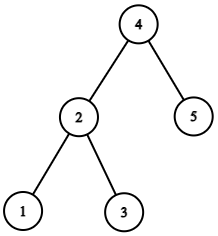
You need to return the head to the doubly linked list.
The doubly linked list would be: 1 2 3 4 5 and can be represented as:

Problem approach
If the left subtree exists, recursively convert the left subtree to Doubly Linked List. If the right subtree exists, recursively convert the right subtree to Doubly Linked List. When in the left subtree, find the inorder predecessor of the root, make this as the previous of the root and its next as the root. Similarly, when in the right subtree, find the inorder successor of the root, make this as the next of the root and its previous as the root. Finally, return the leftmost node and return it since this would be the head of the Doubly Linked List.
2. Element that appears once
Easy
15m average time
85% success
0/40
Asked in companies



You are given an arbitrary array ‘arr’ consisting of N non-negative integers, where every element appears thrice except one. You need to find the element that appears only once.
Problem approach
A simple approach is to sort the array. Next, traverse the array and maintain a count of the occurrence of the current element. As soon as an element with count = 3 is found, that element is the desired answer. Using sorting, the time complexity will be O(nlogn).
To solve the question in O(N) complexity, concept of XOR can be applied.
The property of XOR is :
a) XOR of a number with itself is 0.
b) XOR of a number with 0 is number itself.
So, XOR of all array elements will return us the number with thrice occurrence in the array.
02
Round
Medium
Video Call
Duration60 minutes
Interview date6 Aug 2015
Coding problem2
It's completely around the data structures. The questions are a bit tricky but once u think without any tension u can get through easily. The interviewer is helpful and gives u few hints if u catch them at the right point of time u got it.
Tips: got through Data Structures and Algorithms Made Easy by Narasimha Karumanchi. It's a best book for the interviews.
1. Tree Traversals
Easy
15m average time
85% success
0/40
Asked in companies



You have been given a Binary Tree of 'N'
nodes, where the nodes have integer values.
Your task is to return the ln-Order, Pre-Order, and Post-Order traversals of the given binary tree.
For example :
For the given binary tree:
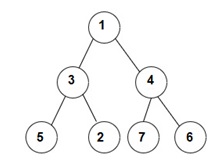
The Inorder traversal will be [5, 3, 2, 1, 7, 4, 6].
The Preorder traversal will be [1, 3, 5, 2, 4, 7, 6].
The Postorder traversal will be [5, 2, 3, 7, 6, 4, 1].
Problem approach
Inorder traversal requires that we print the leftmost node first and the right most node at the end.
So basically for each node we need to go as far as down and left as possible and then we need to come back and go right. So the steps would be :
1.Start with the root node.
2. Push the node in the stack and visit it's left child.
3. Repeat step 2 while node is not NULL, if it's NULL then pop the topmost node from the stack and print it.
4. Now move to node's right child and repeat step 1
5. Repeat the above steps while node is not NULL and stack is not empty
2. Delete N nodes after M nodes of a linked list
Moderate
30m average time
65% success
0/80
Asked in companies


You have given a singly linked list and two integers 'N' and 'M'. Delete 'N' nodes after every 'M' node, or we can say more clearly that traverse the linked list such that you retain 'M' nodes then delete next 'N' nodes, continue the same till the end of the linked list.
Follow Up:
Try to solve this problem in O(N) time complexity and O(1) space complexity.
Problem approach
The idea to solve this problem is to traverse the given list, skip the first M nodes, delete the next N nodes and recur for the remaining nodes till the end of the list is reached. This solution will have a O(N) time complexity where N = length of the list.
03
Round
Easy
Video Call
Duration60 minutes
Interview date7 Aug 2015
Coding problem1
The interviewer asked to put everything on the blackboard and write down the code of each and everything.
Question : Explain all the search algorithm you know with space and Time complexities.
Answer : Linear search : It is a sequential search algorithm where the entire array is traversed till the desired element is not found. Time complexity is O(N) and auxiliary space is O(1).
Binary search : In this algorithm, a sorted array is searched by repeatedly dividing the search interval in half.
Steps :
1. Initially the interval covers the whole array.
2. If the value to be searched is less than the item in the middle of the interval, narrow the interval to the lower half. Otherwise, narrow it to the upper half.
3. The process is repeated until the value is found or the interval is empty.
Time complexity is O(log n) and auxiliary space is O(1) in case of iterative implementation.
1. Maximum Frequency Number
Easy
10m average time
90% success
0/40
Asked in companies



Ninja is given an array of integers that contain numbers in random order. He needs to write a program to find and return the number which occurs the maximum times in the given input. He needs your help to solve this problem.
If two or more elements contend for the maximum frequency, return the element which occurs in the array first i.e. whose index is lowest.
For example,
For 'arr' = [ 1, 2, 3, 1, 2]. you need to return 1.
Problem approach
The problem can be solved using the concept of hashing. Create a hash map and store elements with their frequencies in it. Next, traverse the hash map and print the key with the maximum value as its frequency. The time and space complexity of this solution would be O(N).
04
Round
Easy
HR Round
Duration45 minutes
Interview date7 Aug 2015
Coding problem0
It's Technical+ HR interview all the technical questions went around resume. It went around 45 minutes they are very particular about what you wrote in the resume.
HR questions are general. For example :
1. What are your future plans?
2. Where will u see yourself in the office after 5 years?
Tips: Please make sure that whatever you write in resume should be known to you very well. Don't write false things about yourself. And make sure you know completely about the projects you are going to write in resume(at least the part you worked)


Here's your problem of the day 
Solving this problem will increase your chance to get selected in this company
Skill covered: Programming
How do you remove whitespace from the start of a string?
Choose another skill to practice
Similar interview experiences
Software Developer
3 rounds | 9 problems
Interviewed by Myntra pvt ltd
Selected 
2287 views

1 comments

0 upvotes
Software Developer
3 rounds | 5 problems
Interviewed by Myntra pvt ltd
Rejected
1961 views
1 comments
0 upvotes
Software Developer
3 rounds | 3 problems
Interviewed by Myntra pvt ltd
Selected 2069 views
0 comments
0 upvotes
Software Developer
4 rounds | 5 problems
Interviewed by Myntra pvt ltd
Selected 1779 views
0 comments
0 upvotes
Companies with similar interview experiences
Software Developer
5 rounds | 14 problems
Interviewed by Microsoft
 Selected
 4030 views
1 comments
0 upvotes

Software Developer
6 rounds | 12 problems
Interviewed by SAP Labs
Selected 2912 views
0 comments
0 upvotes
Software Developer
3 rounds | 3 problems
Interviewed by Amazon
 Selected
 1271 views
0 comments
0 upvotes