





Myntra pvt ltd interview experience Real time questions & tips from candidates to crack your interview
SDE - 1
Myntra pvt ltd


4 rounds | 11 Coding
problems

Rejected
Interview preparation journey

Preparation
Duration: 6 months
Topics: Data Structures, Algorithms, System Design, Aptitude, OOPS

Tip 1 : Must do Previously asked Interview as well as Online Test Questions.
Tip 2 : Go through all the previous interview experiences from Codestudio and Leetcode.
Tip 3 : Do at-least 2 good projects and you must know every bit of them.
Application process
Where: Campus
Eligibility: Above 7 CGPA
Tip 1 : Have at-least 2 good projects explained in short with all important points covered.
Tip 2 : Every skill must be mentioned.
Tip 3 : Focus on skills, projects and experiences more

Interview rounds
01
Round
Medium
Online Coding Interview
Duration120 minutes
Interview date12 May 2015
Coding problem2
This was a 2 hour round consisting of 5 mcqs and 2 codes. The mcqs were pretty much simple based on DS, DBMS, OS, OOP, and C.
1. Rabbit Jumping
Easy
20m average time
80% success

0/40
Asked in companies



You are given ‘n’ carrots numbered from 1 to ‘n’. There are k rabbits. Rabbits can jump to carrots only with the multiples of Aj(Aj,2Aj,3Aj…) for all rabbits from 1 to k.
Whenever Rabbit reaches a carrot it eats a little carrot. All rabbits start from the same beginning point. You have to determine the remaining carrots(i.e., carrots which are not eaten by any rabbit) after all rabbits reach the end.
Problem approach
The direct approach would be to mark all the carrots which are visited for each jumping factor. And print the number of non-visited carrots at the end.
So, we create an array of size N+1 (range 1-N).
Next, traverse the list of jumping factors and check which carrots are eatable for that particular factor. Mark all those carrots as visited.
Repeat this for all jumping factors and calculate the remaining uneaten carrots.
2. Flip Bits
Easy
15m average time
85% success
0/40
Asked in companies



You are given an array of integers ARR[] of size N consisting of zeros and ones. You have to select a subset and flip bits of that subset. You have to return the count of maximum one’s that you can obtain by flipping chosen sub-array at most once.
A flip operation is one in which you turn 1 into 0 and 0 into 1.
For example:
If you are given an array {1, 1, 0, 0, 1} then you will have to return the count of maximum one’s you can obtain by flipping anyone chosen sub-array at most once, so here you will clearly choose sub-array from the index 2 to 3 and then flip it's bits. So, the final array comes out to be {1, 1, 1, 1, 1} which contains five ones and so you will return 5.
Problem approach
Property of XOR can be used to solve this problem. 1^0 = 1 and 1^1 = 0
First, we calculate the number of digits in the given number using log.
Next, generate a number with digits equal to the digits in the given number and all bits set to 1.
The last step is to take the xor of the given number with the generated number.
The time complexity of this solution is O(log n).
02
Round
Medium
Video Call
Duration60 minutes
Interview date14 May 2015
Coding problem2
Started with a brief discussion on my projects and internships. A thorough discussion on whichever languages, frameworks I had used in my projects. Followed by discussion on coding questions. Apart from the codes there were some questions on OS, process stack, heap memory in Java, Garbage collection, OOP principles and comparison based sorting
1. Sum Of Max And Min
Easy
10m average time
90% success
0/40
Asked in companies



You are given an array “ARR” of size N. Your task is to find out the sum of maximum and minimum elements in the array.
Follow Up:
Can you do the above task in a minimum number of comparisons?
Problem approach
The direct solution would be to do a linear search and sequentially compare each element with the maximum and minimum element and keep updating accordingly. However, this approach takes ~2n comparisons.
To further reduce the number of comparisons, we can compare in pairs.
1. Traverse the array and pick 2 elements(a, b) at once.
2. Next, compare the two elements and update the min and max accordingly.
Let's say a>b, then : Update min by comparing (min, b) and max by comparing (max, a)
This approach would take ~ 3N/2 comparisons.
2. Invert a Binary Tree
Moderate
45m average time
55% success
0/80
Asked in companies



You are provided with a Binary Tree and one of its leaf nodes. You have to invert this binary tree. Inversion must be done by following all the below guidelines:
• The given leaf node becomes the root after the inversion.

• For a node (say, ‘x’)
    ○ If there exists the left child that is not yet taken then this child must become the right child of ‘x’.
    ○ If the left child is already taken then the right child is still on the right side of ‘x’.

• The parent of ‘x’ must be the left child of ‘x’.
For Example:
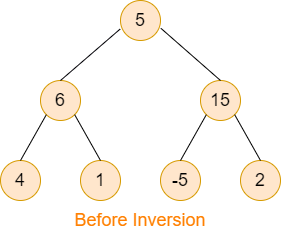
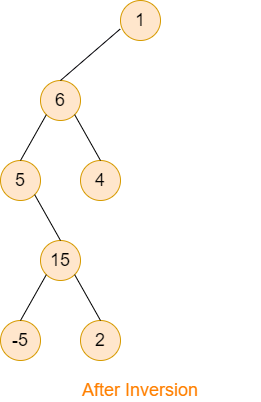
Consider the above binary tree (image- before inversion), if the given leaf node is ‘1’ then the binary tree after inversion becomes exactly the same as given in the image representing after inversion.
Note:
The given binary tree will only have distinct values of nodes.
03
Round
Medium
Video Call
Duration60 minutes
Interview date14 May 2015
Coding problem4
Questions based on programming, DBMS and puzzles were asked in this round.
1. Rearrange Array Numbers to form Largest Possible Number
Moderate
35m average time
65% success
0/80
Asked in companies

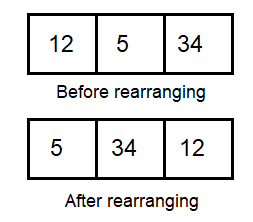
You are given an array(ARR) of length 'N', consisting of non-negative integers. Using only these given numbers, rearrange the numbers in such a way that the resultant number thus formed is the largest possible. You cannot change the order of digits of a number.
For Example:
Given array numbers 12, 5, 34, the largest number you can form with them is 53412. There are other possible arrangements like 51234 or 34125, but they are both less than 53412.
Note:
As the final number formed after concatenation can be very large, print it as a string.
Problem approach
Sorting can be used to solve this problem.
First, we convert all the numbers to string type and insert them in a list.
Next, Sort the list of strings.
At last, concatenate all the strings to form the largest number.
This approach would take O(nlogn) time complexity.
2. Puzzle
Two boys A and B enter a tunnel . At 2/3rd of the tunnel, they see a train coming towards the tunnel ,the train is still at a distance from the tunnel . A runs back to that end of the tunnel from which they entered the tunnel, B runs towards the other end of the tunnel. Both of them just make it without being run over by the train . The train is travelling at a speed of 60kmph.Find the length of the tunnel
Problem approach
Tip 1: We need one more variable to solve this question. But that wont be told at the beginning,. We have to find out which variable that is.
3. DBMS Question
What is indexing?
Problem approach
Indexing is a data structure technique which is used to efficiently locate and access records from a database based on some attributes.
4. DBMS Question
Advantages of B+ Tree
Problem approach
1. Faster search queries as the data is stored only on the leaf nodes.
2. Records can be fetched in equal number of disk accesses.
3. We can access the data stored in a B+ tree sequentially as well as directly.
04
Round
Medium
Video Call
Duration45 minutes
Interview date15 May 2015
Coding problem3
Puzzles and HR based questions were asked in this round.
He asked questions like : what are my career goals, what do you look forward to in a boss , how do you see yourself in 5 years ,etc etc .
1. Puzzle
Given a biased coin, how would you take an unbiased decision .You don’t know whether it is biased towards heads or tails.
2. Puzzle
Given a cylindrical glass of water, how would you conclude whether it is more than half filled ,or less than half filled. The glass is not transparent and you do not have any measuring instrument. And you cannot spill out or add anything.
3. Puzzle
A man lives on the 12th floor . Everyday he uses the lift ,comes to the ground floor and goes to office. On his return ,three cases are seen:
1.Whenever he is with someone in the elevator he takes the lift directly to the 12th floor.
2.Whenever its raining he takes the elevator to the 12th floor.
3. On any non-rainy day when he is alone ,he takes the elevator to the 10th floor and walks up the stairs 2 floors.
Explain the situation.


Here's your problem of the day 
Solving this problem will increase your chance to get selected in this company
Skill covered: Programming
How do you remove whitespace from the start of a string?
Choose another skill to practice
Similar interview experiences
SDE - 1
2 rounds | 3 problems
Interviewed by Myntra pvt ltd
Rejected

5216 views

0 comments

0 upvotes
SDE - 1
2 rounds | 4 problems
Interviewed by Myntra pvt ltd
Rejected
2261 views
0 comments
0 upvotes
SDE - 1
3 rounds | 5 problems
Interviewed by Myntra pvt ltd
 Selected
 2701 views
0 comments
0 upvotes
SDE - 1
3 rounds | 3 problems
Interviewed by Myntra pvt ltd
 Selected
 3051 views
0 comments
0 upvotes
Companies with similar interview experiences
SDE - 1
5 rounds | 12 problems
Interviewed by Amazon
 Selected
 117552 views
24 comments
0 upvotes
SDE - 1
4 rounds | 5 problems
Interviewed by Microsoft
Selected 60143 views
5 comments
0 upvotes
SDE - 1
3 rounds | 7 problems
Interviewed by Amazon
 Selected
 36138 views
7 comments
0 upvotes