





Nagarro pvt limited interview experience Real time questions & tips from candidates to crack your interview
Fullstack Developer
Nagarro pvt limited


2 rounds | 9 Coding
problems
Rejected
Interview preparation journey

Application story
I applied for the position through LinkedIn. The HR contacted me and scheduled an aptitude test, which I successfully cleared. After that, a face-to-face virtual interview was conducted. The entire process was smooth and well-coordinated.
Why selected/rejected for the role?
I was rejected because I lacked sufficient hands-on experience with FastAPI and ReactJS, which were key requirements for the role. However, the experience helped me identify my weak areas and motivated me to learn new technologies to strengthen my backend and full-stack development skills.
Preparation
Duration: 1 month
Topics: Python, Django, DSA, REST API, DBMS, FastAPI, ReactJS

Tip 1: Focus on building a strong foundation in core concepts like Python, Django, and SQL before moving to advanced topics.
Tip 2: Practice implementing real-world projects to gain hands-on experience.
Tip 3: Revise key interview topics like OOPs, APIs, and database queries regularly.
Application process
Where: Linkedin
Eligibility: Prior knowledge of Python and Django framework, (Salary Package: 14 LPA)
Tip 1: Include relevant projects that showcase your technical skills and problem-solving ability.
Tip 2: Keep your resume concise and highlight technologies or frameworks mentioned in the job description.

Interview rounds
01
Round
Easy
Online Coding Interview
Duration30 minutes
Interview date22 Oct 2025
Coding problem2
I had to complete this round before 22nd October, as it was an online aptitude test conducted on the Mettle platform. It was a good experience, and I successfully cleared the round.
1. Search In Rotated Sorted Array
Easy
12m average time
85% success

0/40
Asked in companies



You have been given a sorted array/list 'arr' consisting of ‘n’ elements. You are also given an integer ‘k’.
Now the array is rotated at some pivot point unknown to you.
For example, if 'arr' = [ 1, 3, 5, 7, 8], then after rotating 'arr' at index 3, the array will be 'arr' = [7, 8, 1, 3, 5].
Now, your task is to find the index at which ‘k’ is present in 'arr'.
Note :
1. If ‘k’ is not present in 'arr', then print -1.
2. There are no duplicate elements present in 'arr'.
3. 'arr' can be rotated only in the right direction.
Example:
Input: 'arr' = [12, 15, 18, 2, 4] , 'k' = 2

Output: 3

Explanation:
If 'arr' = [12, 15, 18, 2, 4] and 'k' = 2, then the position at which 'k' is present in the array is 3 (0-indexed).
Problem approach
Step 1: I first thought about using a normal binary search, but it didn’t work properly because the array was rotated and not fully sorted.
Step 2: Then I realized that even after rotation, one half of the array (either left or right) remains sorted.
Step 3: I modified the binary search logic — in every iteration, I checked which half is sorted and then decided whether to search in that half or the other one based on the target’s value.
Step 4: This way, I was able to reduce the search space by half in each step and finally find the target in O(log n) time complexity.
2. Container With Most Water
Moderate
15m average time
90% success
0/80
Asked in companies



Given a sequence of ‘N’ space-separated non-negative integers A[1],A[2],A[3],......A[i]…...A[n]. Where each number of the sequence represents the height of the line drawn at point 'i'. Hence on the cartesian plane, each line is drawn from coordinate ('i',0) to coordinate ('i', 'A[i]'), here ‘i’ ranges from 1 to ‘N’. Find two lines, which, together with the x-axis forms a container, such that the container contains the most area of water.
Note :
1. You can not slant the container i.e. the height of the water is equal to the minimum height of the two lines which define the container.

2. Do not print anything, you just need to return the area of the container with maximum water.
Example
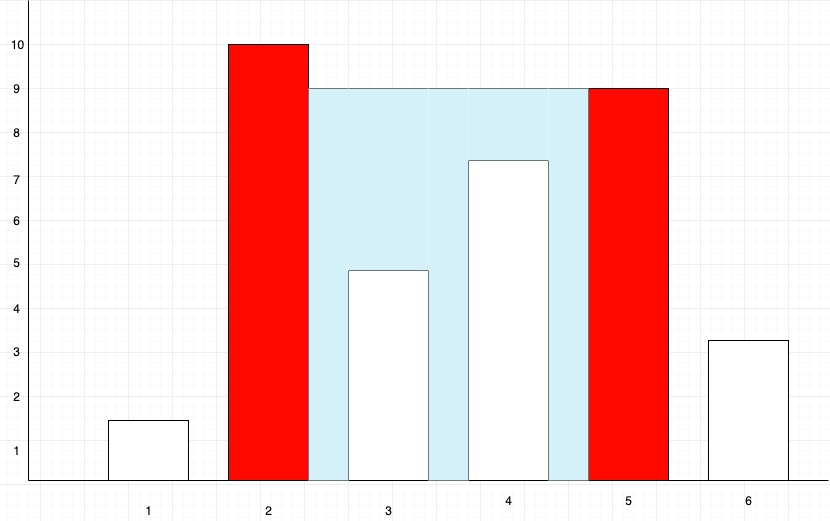
For the above Diagram, the first red marked line is formed between coordinates (2,0) and (2,10), and the second red-marked line is formed between coordinates (5,0) and (5,9). The area of water contained between these two lines is (height* width) = (5-2)* 9 = 27, which is the maximum area contained between any two lines present on the plane. So in this case, we will return 3* 9=27.
Problem approach
Step 1: I first thought of using a brute-force approach by checking every possible pair of lines to calculate the area, but that gave an O(n²) solution and wasn’t efficient.
Step 2: To optimize it, I used the two-pointer approach — one pointer at the start (left) and one at the end (right).
Step 3: I calculated the area using the formula area = min(height[left], height[right]) * (right - left), and then moved the pointer which had the smaller height inward.
Step 4: I repeated this process until both pointers met. This gave the maximum area in O(n) time.
02
Round
Easy
Face to Face
Duration45 minutes
Interview date29 Oct 2025
Coding problem7
The second round was a face-to-face virtual interview conducted during the daytime. The environment was quite comfortable and professional. The interviewer was polite and made me feel at ease before starting the technical questions.
Most of the discussion revolved around Python, Django, REST APIs, and FastAPI, along with some questions about ReactJS and overall project experience. The interviewer also asked a few scenario-based questions to understand my problem-solving approach.
Even though I wasn’t able to answer a few questions related to FastAPI and ReactJS, it was a good learning experience. The interviewer was friendly and gave helpful feedback during the conversation.
1. Django ORM
Explain how Django ORM works and write a query for fetching data using filters and annotations. (Learn)
The interviewer also asked about the difference between select_related and prefetch_related.
2. REST API
Explain how do you create REST APIs using Django REST Framework — including serializers, viewsets, and how to handle authentication. I also had to describe how I handle validation and error responses.
3. Database Design
I was given a small scenario to design a database schema for a hotel booking system. The interviewer wanted to check my understanding of relationships like one-to-many and many-to-many (Learn), along with how to optimize queries.
5. String Reverse
Easy
10m average time
90% success
0/40
Asked in companies


You are having a string ‘S’ containing ASCII characters.
You are required to reverse the input string.
Output the reverse of the string ‘S’.
Example :
S = “hello”

Explanation :

The reverse of the string ‘S’ is “olleh”.
6. FastAPI
Since the project involved FastAPI, I was asked how FastAPI differs from Django, how routing and dependency injection work, and how I would handle async requests.
7. Project Discussion
They asked me to explain one of my past projects in detail — including its architecture, what challenges I faced, how I implemented APIs, and how I optimized performance in the backend.


Here's your problem of the day 
Solving this problem will increase your chance to get selected in this company
Skill covered: Programming
How do you remove whitespace from the start of a string?
Choose another skill to practice
Similar interview experiences
Associate Software Developer
4 rounds | 7 problems
Interviewed by Nagarro pvt limited

 Selected
455 views

0 comments

0 upvotes
Software Engineer
3 rounds | 8 problems
Interviewed by Nagarro pvt limited
 Selected
 308 views
0 comments
0 upvotes
Senior Software Engineer
2 rounds | 5 problems
Interviewed by Nagarro pvt limited
Rejected
1103 views
0 comments
0 upvotes
Associate Software Engineer
3 rounds | 4 problems
Interviewed by Nagarro pvt limited
Selected 125 views
0 comments
0 upvotes
Companies with similar interview experiences

Fullstack Developer
6 rounds | 5 problems
Interviewed by Microsoft
Rejected
2527 views
0 comments
0 upvotes

Fullstack Developer
2 rounds | 2 problems
Interviewed by Samsung
Selected 2478 views
0 comments
0 upvotes

Fullstack Developer
2 rounds | 2 problems
Interviewed by Amdocs
Selected 2105 views
0 comments
0 upvotes