





Nagarro Software Pvt Ltd interview experience Real time questions & tips from candidates to crack your interview
Associate Software Engineer
Nagarro Software Pvt Ltd


3 rounds | 4 Coding
problems

 Selected
 Interview preparation journey

Journey
My journey to cracking the Nagarro interview started with strengthening my fundamentals in Core Java, OOP, SQL, and data structures. Instead of focusing only on theory, I worked on practical projects and assignments that helped me truly understand concepts like multithreading, file handling, and problem-solving approaches.
There were moments of self-doubt, especially while preparing for DSA, but I stayed consistent and practiced daily. I focused on clarity, writing clean code, and explaining concepts confidently. By the time the interview came, I wasn’t just memorizing answers—I genuinely understood what I had learned. Consistency and self-belief made all the difference.
Application story
It was an on-campus opportunity at my college. The company visited our campus for placements, and I applied through the college placement cell. After the initial shortlisting process, I was invited to participate in the selection rounds conducted by the company. The entire process was smooth and well coordinated by the placement team until the interview stage.
Why selected/rejected for the role?
I believe I was selected because I had a strong understanding of my fundamentals and could confidently explain my projects and technical concepts. Instead of giving memorized answers, I focused on understanding the logic behind everything I learned. I also maintained a calm and positive attitude throughout the process. My consistency in preparation and my ability to communicate my thoughts clearly made a strong impression.
Preparation
Duration: 3 Months
Topics: Core Java, Object-Oriented Programming (OOP), data structures and algorithms, multithreading, exception handling, Collections Framework, file handling, SQL and DBMS concepts

Tip 1: Strengthen your fundamentals before jumping to advanced topics.
Tip 2: Practice coding consistently and focus on writing clean, optimized solutions.
Tip 3: Build at least 1–2 practical projects to confidently explain your concepts in interviews.
Application process
Where: Campus
Eligibility: Above 7 CGPA, (Salary Package: 4.5 LPA)
Tip 1: Mention only the skills and technologies you have actually worked on and can confidently explain.
Tip 2: Highlight practical projects and clearly describe your contributions and impact instead of just listing technologies.

Interview rounds
01
Round
Medium
Online Coding Interview
Duration90 minutes
Interview date3 Feb 2025
Coding problem2
The online assessment consisted of an aptitude (MCQ) section and a coding section, with a total duration of 90 minutes. It was conducted during the day in a well-managed and calm environment. The instructions were clear, and the platform ran smoothly without any technical issues. The aptitude section tested logical reasoning and basic quantitative skills, while the coding section focused on problem-solving and implementation. Overall, the experience was structured and time-bound, requiring good speed and accuracy.
1. Search In Rotated Sorted Array
Easy
12m average time
85% success

0/40
Asked in companies



You have been given a sorted array/list 'arr' consisting of ‘n’ elements. You are also given an integer ‘k’.
Now the array is rotated at some pivot point unknown to you.
For example, if 'arr' = [ 1, 3, 5, 7, 8], then after rotating 'arr' at index 3, the array will be 'arr' = [7, 8, 1, 3, 5].
Now, your task is to find the index at which ‘k’ is present in 'arr'.
Note :
1. If ‘k’ is not present in 'arr', then print -1.
2. There are no duplicate elements present in 'arr'.
3. 'arr' can be rotated only in the right direction.
Example:
Input: 'arr' = [12, 15, 18, 2, 4] , 'k' = 2

Output: 3

Explanation:
If 'arr' = [12, 15, 18, 2, 4] and 'k' = 2, then the position at which 'k' is present in the array is 3 (0-indexed).
Problem approach
Step 1:
Initially, I considered using linear search. That would take O(n) time, but since the problem required O(log n), this approach was not optimal.
Step 2:
Since the array was originally sorted, I realized that binary search could be used. However, due to rotation, the array is split into two sorted halves.
Step 3:
During binary search, I calculated mid = (low + high) / 2.
Then, I checked which half (left or right) was sorted:
If nums[low] ≤ nums[mid], then the left half is sorted.
Otherwise, the right half is sorted.
Step 4:
If the target lies within the sorted half, I moved the search to that half.
Otherwise, I searched in the other half.
Step 5:
I repeated this process until I found the target or the search space became empty.
This approach maintains O(log n) time complexity.
2. Container With Most Water
Moderate
15m average time
90% success
0/80
Asked in companies



Given a sequence of ‘N’ space-separated non-negative integers A[1],A[2],A[3],......A[i]…...A[n]. Where each number of the sequence represents the height of the line drawn at point 'i'. Hence on the cartesian plane, each line is drawn from coordinate ('i',0) to coordinate ('i', 'A[i]'), here ‘i’ ranges from 1 to ‘N’. Find two lines, which, together with the x-axis forms a container, such that the container contains the most area of water.
Note :
1. You can not slant the container i.e. the height of the water is equal to the minimum height of the two lines which define the container.

2. Do not print anything, you just need to return the area of the container with maximum water.
Example
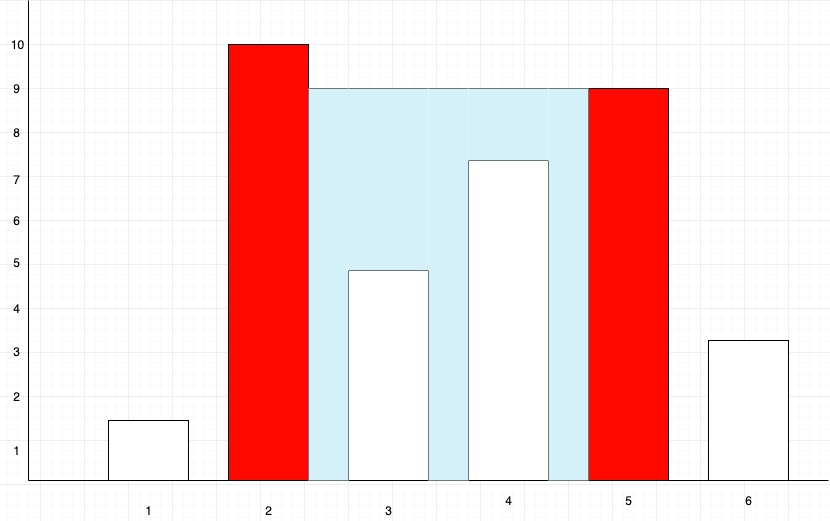
For the above Diagram, the first red marked line is formed between coordinates (2,0) and (2,10), and the second red-marked line is formed between coordinates (5,0) and (5,9). The area of water contained between these two lines is (height* width) = (5-2)* 9 = 27, which is the maximum area contained between any two lines present on the plane. So in this case, we will return 3* 9=27.
Problem approach
Step 1:
Initially, I considered checking all possible pairs of lines using two nested loops. This brute-force approach would take O(n²) time, which is inefficient for large inputs.
Step 2:
Then, I observed that the width is determined by the distance between two pointers, and the height is determined by the minimum of the two heights.
Area = min(height[left], height[right]) × (right - left)
Step 3:
I applied the two-pointer approach:
Initialize left = 0
Initialize right = n - 1
Step 4:
Calculate the area for the current pointers. Then move the pointer with the smaller height inward because:
- The area is limited by the smaller height.
- Moving the taller one will not help increase the area.
Step 5:
Repeat this process while left < right, and keep updating the maximum area.
This reduces the time complexity to O(n).
02
Round
Medium
Video Call
Duration20 minutes
Interview date6 Feb 2025
Coding problem1
The technical interview was conducted during the day in a smooth and professional environment. The discussion was interactive and focused mainly on core concepts, problem-solving approaches, and project understanding. The interviewer was calm and supportive and provided hints whenever required. It felt more like a technical discussion than a rapid-fire round, which helped me stay confident and explain my thoughts clearly.
1. Cycle Detection in a Singly Linked List
Moderate
15m average time
80% success
0/80
Asked in companies


You are given a Singly Linked List of integers. Return true if it has a cycle, else return false.
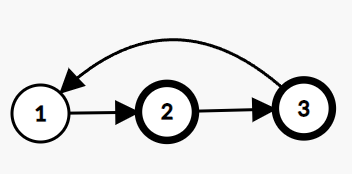
A cycle occurs when a node's next points back to a previous node in the list.
Example:
In the given linked list, there is a cycle, hence we return true.
Problem approach
Step 1:
Initially, I considered storing visited nodes in a HashSet. While traversing the linked list, if a node was already present in the set, it indicates a cycle. This approach works but requires O(n) extra space.
Step 2:
Then, I optimized the solution using Floyd’s Cycle Detection Algorithm (the Tortoise and Hare approach), which works in O(1) space.
Step 3:
I used two pointers:
- The slow pointer moves one step at a time.
- The fast pointer moves two steps at a time.
Step 4:
If there is a cycle, the fast pointer will eventually meet the slow pointer.
If the fast pointer reaches null, then there is no cycle.
This optimized approach runs in O(n) time and O(1) space.
03
Round
Easy
HR Round
Duration15 minutes
Interview date10 Feb 2025
Coding problem1
The HR round was conducted during the day in a comfortable and friendly environment. It was more of a conversational discussion rather than a formal interrogation. The HR representative was polite, approachable, and focused on understanding my background, strengths, career goals, and cultural fit for the organization. The overall atmosphere was positive and stress-free, which helped me express myself confidently and honestly.
1. HR Questions
The questions were mainly HR and personality-based. Some of them included:
- What are your strengths and weaknesses?
- Tell me about yourself.
- Why do you want to join this company?
- Where do you see yourself in the next 3–5 years?
- How do you handle pressure or challenging situations?
The focus was on understanding my personality, mindset, communication skills, and cultural fit.
Problem approach
I answered honestly and kept my responses structured and concise. For strengths and weaknesses, I provided practical examples instead of generic answers. I focused on demonstrating a growth mindset, a willingness to learn, and consistency in my efforts. Most importantly, I maintained confidence, clarity, and a positive attitude throughout the conversation.


Here's your problem of the day 
Solving this problem will increase your chance to get selected in this company
Skill covered: Programming
Which collection class forbids duplicates?
Choose another skill to practice
Similar interview experiences

SDE - 1
4 rounds | 8 problems
Interviewed by Amazon
Selected 
10308 views

0 comments

0 upvotes
Analytics Consultant
3 rounds | 10 problems
Interviewed by ZS
Selected 1135 views
0 comments
0 upvotes
SDE - Intern
1 rounds | 3 problems
Interviewed by Amazon
Selected 4015 views
0 comments
0 upvotes

SDE - 2
4 rounds | 6 problems
Interviewed by Expedia Group
 Selected
 3129 views
0 comments
0 upvotes
Companies with similar interview experiences

Associate Software Engineer
3 rounds | 10 problems
Interviewed by Amdocs
Selected 2525 views
0 comments
0 upvotes

Associate Software Engineer
3 rounds | 2 problems
Interviewed by Ernst & Young (EY)
 Selected
 2979 views
0 comments
0 upvotes
Associate Software Engineer
3 rounds | 15 problems
Interviewed by Ernst & Young (EY)
Selected 2546 views
0 comments
0 upvotes