





Nagarro Software interview experience Real time questions & tips from candidates to crack your interview

SDE - 1
Nagarro Software


4 rounds | 7 Coding
problems

 Selected
 Interview preparation journey

Journey
My journey to getting selected at Nagarro was truly a roller coaster. In the beginning, I focused on building my fundamentals in programming, data structures, and web development. There were times when things did not go as planned, and I faced multiple rejections, which was discouraging at first.
However, instead of giving up, I treated those moments as learning opportunities. I continued improving my problem-solving skills, worked on projects, and practiced consistently. With each attempt, I gained more confidence and clarity about where I needed to improve.
Eventually, all the effort paid off, and I got the opportunity to join Nagarro. This journey taught me the importance of persistence, patience, and continuous learning.
Application story
My journey to getting selected at Nagarro started when one of my school friends told me about their off-campus hiring. Based on his suggestion, I applied via email and decided to give it a try. Fortunately, I received an OA link.
The selection process consisted of four rounds. The first round was an online assessment of around two hours that included computer science fundamentals and four coding questions. After clearing this round, I had two technical interview rounds. The first technical interview lasted about 30 minutes, and the second one was around 20 minutes. In these rounds, the focus was mainly on understanding my technical knowledge and problem-solving approach (primarily array-based and graph-based questions, including graph traversal).
The final round was the HR interview. After completing all the rounds, I waited for about a week for the result. Fortunately, I received the good news that I had been selected at Nagarro. I am really grateful for the opportunity, and the whole experience taught me the importance of staying prepared and giving your best at every step of the process.
Why selected/rejected for the role?
I believe I was selected for this role because of my consistency and belief in the process. During my preparation, I focused on strengthening my fundamentals and practicing regularly instead of rushing things. I tried to stay patient and keep improving step by step.
At the same time, I am very grateful for the support and blessings of my parents and my faith in God, which kept me motivated even during difficult moments. Their encouragement helped me stay positive and confident throughout the journey.
Overall, this experience taught me that consistent effort, patience, and a positive mindset play a very important role in achieving our goals.
Preparation
Duration: 9 Months
Topics: DSA (Trees, Arrays – all types of problems, DP – moderate level, Bit-based problems, Graphs – moderate, Linked Lists, Queue, Stack, etc.), OOPS, DBMS, OS (Operating System), Computer Networks

Tip 1: Consistency is key.
Tip 2: Revise concepts at least two to three times a week.
Tip 3: Practice DSA and basic system design concepts.
Application process
Where: Email Approach
Eligibility: CGPA > 7. (Salary Details: 7 LPA)
Tip 1: Build good projects.
Tip 2: Mention measurable achievements in your resume, such as improvements reflected in numbers. Also, include your competitive programming platform rating, as it can create a strong impact.

Interview rounds
01
Round
Medium
Online Coding Interview
Duration120 minutes
Interview date17 Jun 2025
Coding problem4
1. Maximum Subarray Sum
Moderate
35m average time
81% success

0/80
Asked in companies



You are given an array 'arr' of length 'n', consisting of integers.
A subarray is a contiguous segment of an array. In other words, a subarray can be formed by removing 0 or more integers from the beginning and 0 or more integers from the end of an array.
Find the sum of the subarray (including empty subarray) having maximum sum among all subarrays.
The sum of an empty subarray is 0.
Example :
Input: 'arr' = [1, 2, 7, -4, 3, 2, -10, 9, 1]

Output: 11

Explanation: The subarray yielding the maximum sum is [1, 2, 7, -4, 3, 2].
Problem approach
So basically, I applied Kadane’s algorithm to solve this problem; there were slight modifications.
2. Merge Sort
Easy
15m average time
85% success
0/40
Asked in companies



Given a sequence of numbers ‘ARR’. Your task is to return a sorted sequence of ‘ARR’ in non-descending order with help of the merge sort algorithm.
Example :
Merge Sort Algorithm -

Merge sort is a Divide and Conquer based Algorithm. It divides the input array into two-parts, until the size of the input array is not ‘1’. In the return part, it will merge two sorted arrays a return a whole merged sorted array.
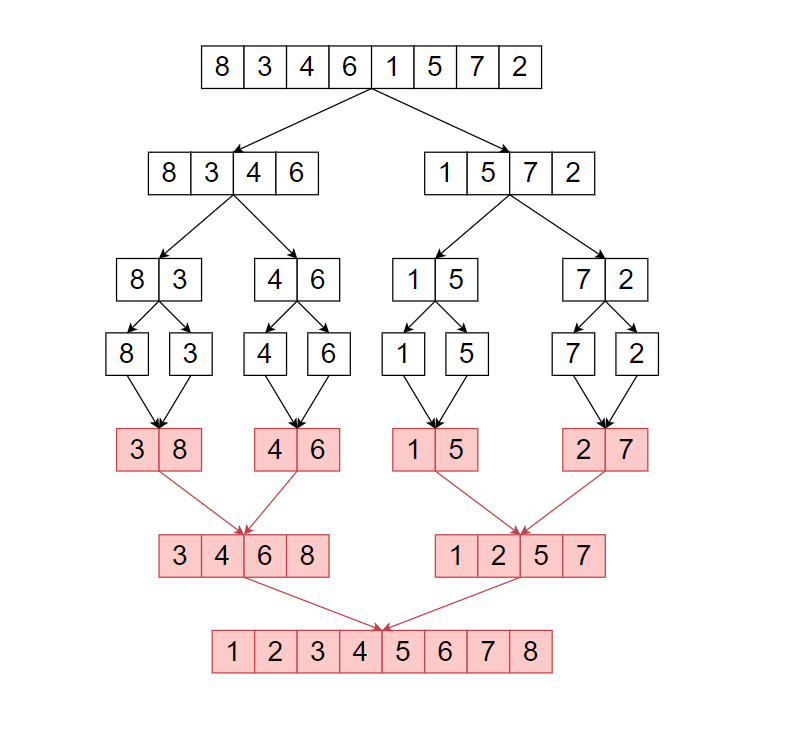
The above illustrates shows how merge sort works.
Note :
It is compulsory to use the ‘Merge Sort’ algorithm.
Problem approach
I knew merge sort and I wrote it , it was pretty straight forward problem.
3. Bottom View Of Binary Tree
Moderate
10m average time
90% success
0/80
Asked in companies


You are given a 'Binary Tree'.
Return the bottom view of the binary tree.
Note :
1. A node will be in the bottom-view if it is the bottom-most node at its horizontal distance from the root.

2. The horizontal distance of the root from itself is 0. The horizontal distance of the right child of the root node is 1 and the horizontal distance of the left child of the root node is -1.

3. The horizontal distance of node 'n' from root = horizontal distance of its parent from root + 1, if node 'n' is the right child of its parent.

4. The horizontal distance of node 'n' from root = horizontal distance of its parent from the root - 1, if node 'n' is the left child of its parent.

5. If more than one node is at the same horizontal distance and is the bottom-most node for that horizontal distance, including the one which is more towards the right.
Example:
Input: Consider the given Binary Tree:
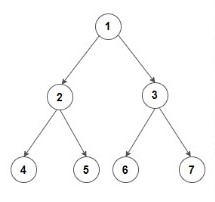
Output: 4 2 6 3 7

Explanation:
Below is the bottom view of the binary tree.

1 is the root node, so its horizontal distance = 0.
Since 2 lies to the left of 0, its horizontal distance = 0-1= -1
3 lies to the right of 0, its horizontal distance = 0+1 = 1
Similarly, horizontal distance of 4 = Horizontal distance of 2 - 1= -1-1=-2
Horizontal distance of 5 = Horizontal distance of 2 + 1=  -1+1 = 0
Horizontal distance of 6 = 1-1 =0
Horizontal distance of 7 = 1+1 = 2

The bottom-most node at a horizontal distance of -2 is 4.
The bottom-most node at a horizontal distance of -1 is 2.
The bottom-most node at a horizontal distance of 0 is 5 and 6. However, 6 is more towards the right, so 6 is included.
The bottom-most node at a horizontal distance of 1 is 3.
The bottom-most node at a horizontal distance of 2 is 7.

Hence, the bottom view would be 4 2 6 3 7
Problem approach
To solve this problem, I used a queue of pairs to perform a level-order traversal of the binary tree. The queue helped me process nodes in BFS order. In each pair, one value represented the node, and the other represented the horizontal distance from the root.
I started by assigning the root node a horizontal distance of 0. Whenever I moved to the left child, I decreased the horizontal distance by 1, and when I moved to the right child, I increased it by 1. While traversing the tree, I kept updating the value corresponding to each horizontal distance. Since BFS processes nodes level by level, the last node encountered at a particular horizontal distance represents the bottom view for that position.
4. DFS Traversal
Moderate
35m average time
65% success
0/80
Asked in companies



Given an undirected and disconnected graph G(V, E), containing 'V' vertices and 'E' edges, the information about edges is given using 'GRAPH' matrix, where i-th edge is between GRAPH[i][0] and GRAPH[i][1]. print its DFS traversal.
V is the number of vertices present in graph G and vertices are numbered from 0 to V-1.

E is the number of edges present in graph G.
Note :
The Graph may not be connected i.e there may exist multiple components in a graph.
Problem approach
Basically, this problem can be solved using either BFS or DFS.
02
Round
Medium
Face to Face
Duration30 minutes
Interview date20 Jun 2025
Coding problem1
1. Palindromic Substrings
Moderate
20m average time
80% success
0/80
Asked in companies


You have been given a string STR. Your task is to find the total number of palindromic substrings of STR.
Example :
If the input string is "abbc", then all the possible palindromic substrings would be: ["a", "b", "b", c", "bb"] and hence, the output will be 5 since we have 5 substrings in total which form a palindrome.
Note :
A string is said to be a 'Palindrome' if it is read the same forwards and backwards.
For example, “abba” is a palindrome, but “abbc” is not.

A 'Substring' is a contiguous sequence of characters within a string.
For example, "a", "b", "c", "ab", "bc", "abc" are substrings of "abc".
Problem approach
Use dynamic programming by checking every substring. A substring is a palindrome if its first and last characters match and the inner substring is also a palindrome. Build results for shorter substrings first.
03
Round
Easy
Face to Face
Duration20 minutes
Interview date25 Jun 2025
Coding problem1
1. Merge Complexity
Prove the time complexity of Merge Sort.
Problem approach
I explained, using an example, how we get the average time complexity as (O(n \log n)).
04
Round
Medium
HR Round
Duration20 minutes
Interview date27 Jun 2025
Coding problem1
1. HR Questions
Basic HR questions included why I wanted to join Nagarro, what my next 5-year goals are, and what kind of projects Nagarro is working on.
Problem approach
Tip 1: Prepare for basic HR questions.
Tip 2: Read about the company and its current projects.
Tip 3: Stay calm and confident during the HR round.


Here's your problem of the day 
Solving this problem will increase your chance to get selected in this company
Skill covered: Programming
Which SQL keyword removes duplicate records from a result set?
Choose another skill to practice
Similar interview experiences
SDE - 1
3 rounds | 3 problems
Interviewed by Nagarro Software
 Selected
0 views

0 comments

0 upvotes
SDE - 1
3 rounds | 7 problems
Interviewed by Nagarro Software
 Selected
 995 views
0 comments
0 upvotes
SDE - 1
2 rounds | 4 problems
Interviewed by Nagarro Software
Rejected
1258 views
0 comments
0 upvotes
SDE - 1
2 rounds | 4 problems
Interviewed by Nagarro Software
Selected 795 views
0 comments
0 upvotes
Companies with similar interview experiences
SDE - 1
5 rounds | 12 problems
Interviewed by Amazon
 Selected
 115680 views
24 comments
0 upvotes
SDE - 1
4 rounds | 5 problems
Interviewed by Microsoft
Selected 58691 views
5 comments
0 upvotes
SDE - 1
3 rounds | 7 problems
Interviewed by Amazon
 Selected
 35366 views
7 comments
0 upvotes