





Nagarro Software interview experience Real time questions & tips from candidates to crack your interview

SDE - 1
Nagarro Software


2 rounds | 7 Coding
problems

Rejected
Interview preparation journey

Preparation
Duration: 3 Months
Topics: Data Structures, Pointers, OOPS, Algorithms, Dynamic Programming, My SQL, Database, Operating System

Tip 1 : Practice Atleast 250 Questions on Leetcode
Tip 2 : For DSA questions in interviews, start explaining from the brute force approach and then move to the optimal one. Convey your thought process to the interviewers, so that they can help you out if you get stuck.
Tip 3 : Do not write anything that you are not confident of in resume
Tip 4 : Do atleast 2 projects
Application process
Where: Campus
Eligibility: 7 CGPA
Tip 1 : Try to include at least one development project in your resume.
Tip 2 : Interviewer will ask anything from your resume so be prepared for it.
Tip 3 : Don't mention some random projects which you are not sure about or copied from Google or somewhere else.

Interview rounds
01
Round
Hard
Online Coding Interview
Duration240 Minutes
Interview date10 Sep 2021
Coding problem5
Aptitude + Technical Mcq Test + Coding Round on Mettl Platform
1. 0 1 Knapsack
Easy
15m average time
85% success

0/40
Asked in companies



A thief is robbing a store and can carry a maximal weight of W into his knapsack. There are N items and the ith item weighs wi and is of value vi. Considering the constraints of the maximum weight that a knapsack can carry, you have to find and return the maximum value that a thief can generate by stealing items.
2. Minimum Jumps
Moderate
25m average time
75% success
0/80
Asked in companies



Bob lives with his wife in a city named Berland. Bob is a good husband, so he goes out with his wife every Friday to ‘Arcade’ mall.
‘Arcade’ is a very famous mall in Berland. It has a very unique transportation method between shops. Since the shops in the mall are laying in a straight line, you can jump on a very advanced trampoline from the shop i, and land in any shop between (i) to (i + Arr[i]), where Arr[i] is a constant given for each shop.
There are N shops in the mall, numbered from 0 to N-1. Bob's wife starts her shopping journey from shop 0 and ends it in shop N-1. As the mall is very crowded on Fridays, unfortunately, Bob gets lost from his wife. So he wants to know, what is the minimum number of trampoline jumps from shop 0 he has to make in order to reach shop N-1 and see his wife again. If it is impossible to reach the last shop, return -1.
Problem approach
I used Dynamic Programming :-
In this method, we build jumps[] array from right to left such that jumps[i] indicates the minimum number of jumps needed to reach arr[n-1] from arr[i]. Finally, we return jumps[0].
3. Partition to K equal sum subsets
Moderate
40m average time
70% success
0/80
Asked in companies



You are given an array of 'N' integers, and a positive integer 'K'. You need to determine if it is possible to divide the array into 'K' non-empty subsets such that the sum of elements of each subset is equal.
Note:
1. The array can have duplicate elements.

2. Each of the array elements must belong to exactly one of the 'K' subsets.

3. The elements chosen for a subset may not be contiguous in the array.
Problem approach
We can solve this problem by computing modulo of array numbers with K. if sum of two numbers is divisible by K, then if one of them gives remainder i, other will give remainder (K – i). First we store frequencies of numbers giving specific remainder in a frequency array of size K. Then we loop for all remainders i and include max(f[i], f[K – i]). Why? a subset with no pair sum divisible by K must include either elements with remainder f[i] or with remainder f[K – i]. Since we want to maximize the size of subset, we pick maximum of two sizes.
In below code array numbers with remainder 0 and remainder K/2 are handled separately. If we include more than 2 numbers with remainder 0 then their sum will be divisible by K, so we have taken at max 1 number in our consideration, same is the case with array numbers giving remainder K/2.
4. Make It Palindrome
Easy
25m average time
70% success
0/40
Asked in companies



You are given an array ‘A’ of length ‘N’ consisting only of positive integers. Your task is to make the given array a palindrome by using a minimum number of operations. In one operation, you can select two adjacent indexes and merge them by adding their values. After every operation, the length of the array decreases by one.
Note: An array of length ‘1’ is a palindrome.
For example:
Let’s say the array ‘A’ = [1, 2, 3, 4, 5], then after merging indexes 2 and 3, the array ‘A’ will look like [1, 5, 4, 5].
5. K Turns Allowed
Moderate
25m average time
70% success
0/80
Asked in companies


Ninja has been given the dimensions of a matrix, count the number of paths to reach the bottom right from top left with maximum k turns allowed.
A valid turn :
There are two possible scenarios when a turn can occur at point (i, j):

Turns Right: (i - 1, j)  ->  (i, j)  ->  (i, j + 1)

Turns Down:  (i, j-1)  ->  (i, j)  ->  (i+1, j)
02
Round
Easy
Face to Face
Duration45 minutes
Interview date18 Sep 2021
Coding problem2
It was a technical interview round where I was asked questions based on DSA.
1. Cycle Detection in a Singly Linked List
Moderate
15m average time
80% success
0/80
Asked in companies

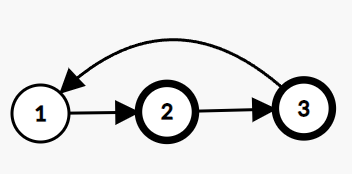
You are given a Singly Linked List of integers. Return true if it has a cycle, else return false.
A cycle occurs when a node's next points back to a previous node in the list.
Example:
In the given linked list, there is a cycle, hence we return true.
Problem approach
Floyd’s Cycle-Finding Algorithm
1. Traverse linked list using two pointers.
2. Move one pointer(slow_p) by one and another pointer(fast_p) by two.
3. If these pointers meet at the same node then there is a loop. If pointers do not meet then linked list doesn’t have a loop.
2. Sort 0 1 2
Easy
22m average time
0/40
Asked in companies


You have been given an integer array/list(ARR) of size 'N'. It only contains 0s, 1s and 2s. Write a solution to sort this array/list.
Note :
Try to solve the problem in 'Single Scan'. ' Single Scan' refers to iterating over the array/list just once or to put it in other words, you will be visiting each element in the array/list just once.


Here's your problem of the day 
Solving this problem will increase your chance to get selected in this company
Skill covered: Programming
How do you remove whitespace from the start of a string?
Choose another skill to practice
Similar interview experiences
SDE - 1
3 rounds | 3 problems
Interviewed by Nagarro Software

 Selected
0 views

0 comments

0 upvotes
SDE - 1
3 rounds | 7 problems
Interviewed by Nagarro Software
Selected 936 views
0 comments
0 upvotes
SDE - 1
2 rounds | 4 problems
Interviewed by Nagarro Software
Rejected
1221 views
0 comments
0 upvotes
SDE - 1
2 rounds | 4 problems
Interviewed by Nagarro Software
Selected 758 views
0 comments
0 upvotes
Companies with similar interview experiences
SDE - 1
5 rounds | 12 problems
Interviewed by Amazon
 Selected
 115096 views
24 comments
0 upvotes
SDE - 1
4 rounds | 5 problems
Interviewed by Microsoft
Selected 58237 views
5 comments
0 upvotes
SDE - 1
3 rounds | 7 problems
Interviewed by Amazon
 Selected
 35146 views
7 comments
0 upvotes