





Nagarro Software interview experience Real time questions & tips from candidates to crack your interview

SDE
Nagarro Software


3 rounds | 5 Coding
problems
 Selected
 Interview preparation journey

Journey
I am amit mishra From lovely Professional University. I started coding in my 2nd year of b.tech first I learn C++ some of my seniors suggest me to learn c++ and along with i was practice questions on Hackerrank consistently. I consistently did coding for 1.5 year and got this offer along with that i learned OOPS, DBMS, OS, Networking.
Application story
Nagarro came to my college and applied through my college itself. Around 400 students resume got shortlisted for online round. out of them 40 students got shortlisted for interview and i was one of them.
Why selected/rejected for the role?
I was able to clear all the rounds as I had prepared well . And found the work from home opportunity lifetime so i found it very good..
Preparation
Duration: 6 months
Topics: Data structures, OOPS, DBMS, Dynamic programming, OS

Tip 1 :Prepare your resume with good projects and keep it short , add project links, and keep it simple
Tip 2 : Practice daily will increase your confidence and skill as well
Tip 3 : Give daily contest on leetcode, CodeStudio will Introduce you new questions
Application process
Where: Campus
Eligibility: 6.5 CGPA
Tip 1: Keep it genuine and simple
Tip 2: Atleast 2 projects .

Interview rounds
01
Round
Hard
Online Coding Interview
Duration90` mins
Interview date22 Jul 2022
Coding problem2
It was on 12 pm around. I have to attend the test with camera and microphone on in online mode.
1. Maximum Sum
Moderate
35m average time
70% success

0/80
Asked in companies



You are given an array “ARR” of N integers. You are required to perform an operation on the array each time until it becomes empty. The operation is to select an element from the array(let’s say at ith index i.e ARR[i]) and remove one occurrence of the selected element from the array and remove all the occurrences of (ARR[i]-1) and (ARR[i]+1) from the array(if present). Your task is to maximize the sum of selected elements from the array.
For example, let’s say the given array is [2, 3, 3, 3, 4, 5].
The maximum possible sum for the given array would be 14. Because if we select one of the 3’s from the array, then one 3 and all occurrences of (3-1) and (3+1) i.e 2 and 4 will be deleted from the array. Now we left with {3,3,5} elements in the array. Then again we select 3 in the next two steps and in both steps 3 will be deleted also (3-1) and (3+1) doesn't exist in the array so nothing extra to delete in both steps. Now we left with only {5} and in the next step, we select the 5 and delete it. Then the array becomes empty. Thus the sum of selected elements will be 3+3+3+5 = 14.
Problem approach
I Calculate the MAX value in the array.
I Create an array of size MAX and store the occurrences of each element in it.
Since we want to maximize our answer, we will start iterating from the MAX value to 0.
If the occurrence of the ith element is greater than 0, then add it to our answer decrease the occurrences of the i-1th element by 1, and also decrease the occurrence of ith by 1 since we have added it to our answer.
We don’t have to decrease the occurrence of the i+1th element because we are already starting from the end so i+1th is already processed.
There might be multiple occurrences of the ith element that’s why do not decrease i yet, to stay on the same element.
2. Maximum Sum Path Of A Binary Tree.
Hard
25m average time
75% success
0/120
Asked in companies



You are given a binary tree having 'n' nodes. Each node of the tree has an integer value.
Your task is to find the maximum possible sum of a simple path between any two nodes (possibly the same) of the given tree.
A simple path is a path between any two nodes of a tree, such that no edge in the path is repeated twice. The sum of a simple path is defined as the summation of all node values in a path.
Problem approach
For each node there can be four ways that the max path goes through the node:
Node only
Max path through Left Child + Node
Max path through Right Child + Node
Max path through Left Child + Node + Max path through Right Child
The idea is to keep track of four paths and pick up the max one in the end. An important thing to note is, that the root of every subtree needs to return the maximum path sum such that at most one child of the root is involved. This is needed for the parent function call. In the below code, this sum is stored in ‘max_single’ and returned by the recursive function.
02
Round
Medium
Video Call
Duration20 mins
Interview date24 Jul 2022
Coding problem2
1. Reverse Linked List
Moderate
15m average time
85% success
0/80
Asked in companies



Given a singly linked list of integers. Your task is to return the head of the reversed linked list.
For example:
The given linked list is 1 -> 2 -> 3 -> 4-> NULL. Then the reverse linked list is 4 -> 3 -> 2 -> 1 -> NULL and the head of the reversed linked list will be 4.
Follow Up :
Can you solve this problem in O(N) time and O(1) space complexity?
Problem approach
Initialize three pointers prev as NULL, curr as head, and next as NULL.
Iterate through the linked list. In a loop, do the following:
Before changing the next of curr, store the next node
next = curr -> next
Now update the next pointer of curr to the prev
curr -> next = prev
Update prev as curr and curr as next
prev = curr
curr = next
I have done this by reversing its pointers.
2. Level Order Traversal
Easy
15m average time
85% success
0/40
Asked in companies



You have been given a Binary Tree of integers. You are supposed to return the level order traversal of the given tree.
For example:
For the given binary tree
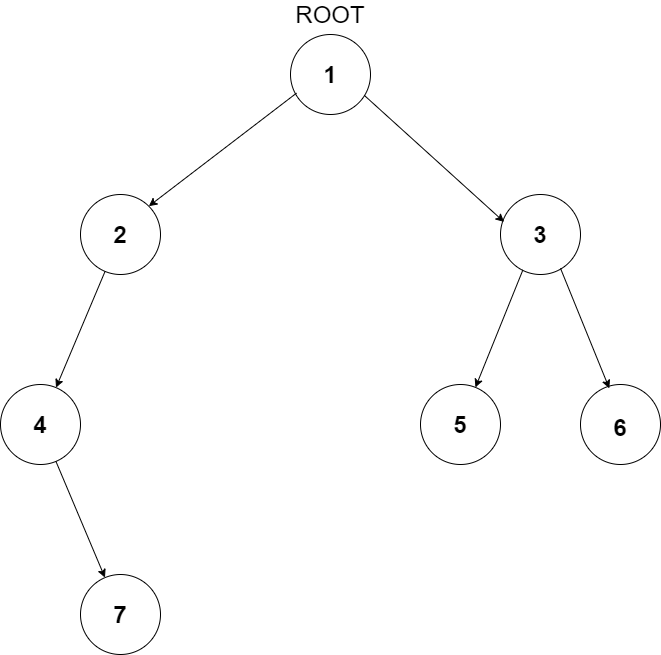
The level order traversal will be {1,2,3,4,5,6,7}.
Problem approach
I just use bfs to solve the problem.
Create an empty queue q and push root in q.
Run While loop until q is not empty.
Initialize temp_node = q.front() and print temp_node->data.
Push temp_node’s children i.e. temp_node -> left then temp_node -> right to q
Pop front node from q.
03
Round
Easy
HR Round
Duration10 mins
Interview date25 Jul 2022
Coding problem1
It was an Hr round of 10 minutes
1. Basic HR Questions
Why should we hire you?
Why you want to join Nagarro?
Rate yourself on scale of 10 about your confidence ?
Problem approach
Tip 1:Always keep calm and confident


Here's your problem of the day 
Solving this problem will increase your chance to get selected in this company
Skill covered: Programming
How do you remove whitespace from the start of a string?
Choose another skill to practice
Similar interview experiences
SDE
3 rounds | 10 problems
Interviewed by Nagarro Software
 Selected
916 views

0 comments

0 upvotes
SDE
3 rounds | 4 problems
Interviewed by Nagarro Software
 Selected
 1207 views
0 comments
0 upvotes
SDE - 1
2 rounds | 4 problems
Interviewed by Nagarro Software
Rejected
1222 views
0 comments
0 upvotes
SDE - 1
2 rounds | 4 problems
Interviewed by Nagarro Software
Selected 758 views
0 comments
0 upvotes
Companies with similar interview experiences

SDE
3 rounds | 6 problems
Interviewed by PhonePe
Selected 0 views
0 comments
0 upvotes

SDE
5 rounds | 8 problems
Interviewed by Mathworks
Selected 1223 views
0 comments
0 upvotes
SDE
4 rounds | 7 problems
Interviewed by PhonePe
Selected 0 views
0 comments
0 upvotes