





Nagarro Software interview experience Real time questions & tips from candidates to crack your interview

SDE - Intern
Nagarro Software


2 rounds | 10 Coding
problems

Rejected
Interview preparation journey

Preparation
Duration: 4 months
Topics: Data Structures, DBMS , OOPS, System Design, Algorithms, Dynamic Programming.

Tip 1 : Practice At least 250 Questions of DS algo
Tip 2 : Do at least 2 application based projects
Tip 3 : Practice questions with optimized approaches
Application process
Where: Campus
Eligibility: 7 cgpa plus
Tip 1 : Have some applicayion based projects on resume.
Tip 2 : Do not put false things on resume.
Tip 3 : Project should clear and crisp

Interview rounds
01
Round
Easy
Online Coding Interview
Duration120 minutes
Interview date15 Mar 2022
Coding problem5
Aptitude questions + 3 medium level Coding Problem + 2 hard level Coding problem
1. Jump Game
Moderate
15m average time
85% success

0/80
Asked in companies



You have been given an array 'ARR' of ‘N’ integers. You have to return the minimum number of jumps needed to reach the last index of the array i.e ‘N - 1’.
From index ‘i’, we can jump to an index ‘i + k’ such that 1<= ‘k’ <= ARR[i] .
'ARR[i]' represents the maximum distance you can jump from the current index.
If it is not possible to reach the last index, return -1.
Note:
Consider 0-based indexing.
Example:
Consider the array 1, 2, 3, 4, 5, 6
We can Jump from index 0 to index 1
Then we jump from index 1 to index 2
Then finally make a jump of 3 to reach index N-1

There is also another path where
We can Jump from index 0 to index 1
Then we jump from index 1 to index 3
Then finally make a jump of 2 to reach index N-1

So multiple paths may exist but we need to return the minimum number of jumps in a path to end which here is 3.
Problem approach
Approach: A naive approach is to start from the first element and recursively call for all the elements reachable from first element. The minimum number of jumps to reach end from first can be calculated using minimum number of jumps needed to reach end from the elements reachable from first.
2. Minimum steps to reach target by a Knight
Moderate
25m average time
60% success
0/80
Asked in companies



You have been given a square chessboard of size ‘N x N’. The position coordinates of the Knight and the position coordinates of the target are also given.
Your task is to find out the minimum steps a Knight will take to reach the target position.
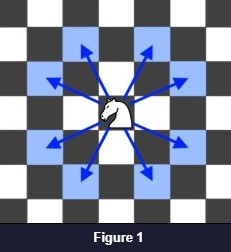
Example:
knightPosition: {3,4}
targetPosition: {2,1}
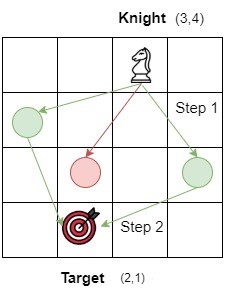
The knight can move from position (3,4) to positions (1,3), (2,2) and (4,2). Position (4,2) is selected and the ‘stepCount’ becomes 1. From position (4,2), the knight can directly jump to the position (2,1) which is the target point and ‘stepCount’ becomes 2 which is the final answer.
Note:
1. The coordinates are 1 indexed. So, the bottom left square is (1,1) and the top right square is (N, N).

2. The knight can make 8 possible moves as given in figure 1.

3. A Knight moves 2 squares in one direction and 1 square in the perpendicular direction (or vice-versa).
3. Maximum Subarray Sum
Moderate
25m average time
75% success
0/80
Asked in companies



Given an array of numbers, find the maximum sum of any contiguous subarray of the array.
For example, given the array [34, -50, 42, 14, -5, 86], the maximum sum would be 137, since we would take elements 42, 14, -5, and 86.
Given the array [-5, -1, -8, -9], the maximum sum would be -1.
Follow up: Do this in O(N) time.
Problem approach
The simple idea of Kadane’s algorithm is to look for all positive contiguous segments of the array (max_ending_here is used for this). And keep track of the maximum sum contiguous segment among all positive segments (max_so_far is used for this). Each time we get a positive-sum compare it with max_so_far and update max_so_far if it is greater than max_so_far
4. 0 1 Knapsack
Easy
15m average time
85% success
0/40
Asked in companies


A thief is robbing a store and can carry a maximal weight of W into his knapsack. There are N items and the ith item weighs wi and is of value vi. Considering the constraints of the maximum weight that a knapsack can carry, you have to find and return the maximum value that a thief can generate by stealing items.
Problem approach
This question is a type of 0-1 knapsack problem.
In the Dynamic programming we will work considering the same cases as mentioned in the recursive approach. In a DP[][] table let’s consider all the possible weights from ‘1’ to ‘W’ as the columns and weights that can be kept as the rows.
The state DP[i][j] will denote maximum value of ‘j-weight’ considering all values from ‘1 to ith’. So if we consider ‘wi’ (weight in ‘ith’ row) we can fill it in all columns which have ‘weight values > wi’. Now two possibilities can take place:
Fill ‘wi’ in the given column.
Do not fill ‘wi’ in the given column.
Now we have to take a maximum of these two possibilities, formally if we do not fill ‘ith’ weight in ‘jth’ column then DP[i][j] state will be same as DP[i-1][j] but if we fill the weight, DP[i][j] will be equal to the value of ‘wi’+ value of the column weighing ‘j-wi’ in the previous row. So we take the maximum of these two possibilities to fill the current state
5. Ways To Make Coin Change
Moderate
20m average time
80% success
0/80
Asked in companies


You are given an infinite supply of coins of each of denominations D = {D0, D1, D2, D3, ...... Dn-1}. You need to figure out the total number of ways W, in which you can make a change for value V using coins of denominations from D. Print 0, if a change isn't possible.
Problem approach
See, here each coin of a given denomination can come an infinite number of times. (Repetition allowed), this is what we call UNBOUNDED KNAPSACK. We have 2 choices for a coin of a particular denomination, either i) to include, or ii) to exclude. But here, the inclusion process is not for just once; we can include any denomination any number of times until sum<0.
Basically, If we are at coins[n-1], we can take as many instances of that coin ( unbounded inclusion ) i.e count(coins, n, sum – coins[n-1] ); then we move to coins[n-2]. After moving to coins[n-2], we can’t move back and can’t make choices for coins[n-1] i.e count(coins, n-1, sum ).
Finally, as we have to find the total number of ways, so we will add these 2 possible choices, i.e count(coins, n, sum – coins[n-1] ) + count(coins, n-1, sum ); which will be our required answer.
02
Round
Easy
Video Call
Duration60 minutes
Interview date18 Mar 2022
Coding problem5
1. Count Derangements
Moderate
25m average time
75% success
0/80
Asked in companies


Given a number ‘N', the task is to find the total number of derangements of a set of ‘N’ elements.
A ‘Derangement’ is a permutation of 'N' elements, such that no element appears in its original position. For example, a derangement of {0, 1, 2, 3} is {2, 3, 1, 0}.
For example, 'N' = 2 , {0, 1} and {1, 0} are the only derangement therefore output will be 1.
Problem approach
There are n – 1 way for element 0 (this explains multiplication with n – 1).
Let 0 be placed at index i. There are now two possibilities, depending on whether or not element i is placed at 0 in return.
i is placed at 0: This case is equivalent to solving the problem for n-2 elements as two elements have just swapped their positions.
i is not placed at 0: This case is equivalent to solving the problem for n-1 elements as now there are n-1 elements, n-1 positions and every element has n-2 choices
2. Alien Dictionary
Easy
10m average time
70% success
0/40
Asked in companies


Ninja is learning a new but strange language known as Alien Language. Alien language possesses the same alphabets as of English language, but their order is different. The order of letters are given as ‘ORDER’ string. Ninja has ‘N’ words in the ‘WORDS’ array. Ninja’s task is to check whether the words of ‘WORDS’ are sorted lexicographically in this alien language or not.
Note: ‘ORDER’ consists of all 26 letters of English alphabet.
For Example
If ‘WORDS’ = ["word","world","row"], ‘ORDER’ = "worldabcefghijkmnpqstuvxyz",the answer will be ‘NO’ as first and second words are not lexicographically sorted as ‘l’ comes before ‘d’ in alien language.
Problem approach
The idea is to create a graph of characters and then find topological sorting of the created graph. Following are the detailed steps.
1) Create a graph g with number of vertices equal to the size of alphabet in the given alien language. For example, if the alphabet size is 5, then there can be 5 characters in words. Initially there are no edges in graph.
2) Do following for every pair of adjacent words in given sorted array.
…..a) Let the current pair of words be word1 and word2. One by one compare characters of both words and find the first mismatching characters.
…..b) Create an edge in g from mismatching character of word1 to that of word2.
3) Print topological sorting of the above created graph.
3. Topological Sorting
Moderate
30m average time
60% success
0/80
Asked in companies


Given a DAG(direct acyclic graph), return the Topological Sorting of a given graph.
4. DBMS Question
What are the types of joins?
5. OS Question
What is RTOS ?


Here's your problem of the day 
Solving this problem will increase your chance to get selected in this company
Skill covered: Programming
How do you remove whitespace from the start of a string?
Choose another skill to practice
Similar interview experiences
SDE - Intern
2 rounds | 4 problems
Interviewed by Nagarro Software
 Selected
1008 views

1 comments

0 upvotes
SDE - Intern
4 rounds | 4 problems
Interviewed by Nagarro Software
Selected 1006 views
0 comments
0 upvotes
SDE - Intern
3 rounds | 4 problems
Interviewed by Nagarro Software
 Selected
 0 views
0 comments
0 upvotes
SDE - Intern
2 rounds | 3 problems
Interviewed by Nagarro Software
Selected 869 views
0 comments
0 upvotes
Companies with similar interview experiences
SDE - Intern
3 rounds | 6 problems
Interviewed by Amazon

Rejected
15605 views
4 comments
0 upvotes
SDE - Intern
4 rounds | 7 problems
Interviewed by Microsoft
 Selected
 15499 views
1 comments
0 upvotes
SDE - Intern
2 rounds | 4 problems
Interviewed by Amazon
Selected 10216 views
2 comments
0 upvotes