





Nagarro Software interview experience Real time questions & tips from candidates to crack your interview

System Engineer
Nagarro Software


3 rounds | 6 Coding
problems

Rejected
Interview preparation journey

Journey
My journey started when I was in class 12th, and my teacher guided me to take part in the coding competitions. After that, I started participating in them and developed a habit of doing coding questions.
Application story
I applied to this company through the on-campus opportunity as my college is a tier 1 college. This company always visits my college for hiring.
Why selected/rejected for the role?
I was rejected because I could not explain all the concepts with the correct accuracy.
Preparation
Duration: 5 months
Topics: Data Structures, Pointers, OOPS, System Design, Algorithms, Dynamic Programming

Tip 1 : Regarding DSA preparation, I have a theory. 20 percent of the questions will be asked in 80 percent of the interviews, and 80 percent will be asked in 20 percent. In short, some questions have a high chance of coming up during the interviews, and some have a very low probability. We should focus more on the questions that have more chance of coming up in the interview.
Application process
Where: Campus
Eligibility: Above 7 CGPA
Tip 1: Incorporate keywords from the job description naturally throughout your resume. This can improve the chances of your resume getting past applicant tracking systems (ATS) and reaching the hands of hiring managers.
Tip 2: Use action verbs that are relevant to the specific role you are applying for. For example, if you are applying for a leadership position, use verbs like "mentored," "guided," or "empowered" to showcase your leadership abilities.

Interview rounds
01
Round
Easy
Video Call
Duration60
Interview date10 Nov 2022
Coding problem2
The technical interview also included questions related to algorithms and problem-solving techniques beyond DSA. We encountered puzzles, logical reasoning problems, or scenario-based questions that assessed our ability to think critically, apply problem-solving strategies, and come up with efficient solutions.
1. Lowest Common Ancestor of a Binary Tree III
Moderate
25m average time
75% success

0/80
Asked in companies



The node structure of a binary tree is modified such that each node has the reference to its parent node.
You are given two nodes: ‘N1’ and ‘N2’, of the above binary tree. Your task is to return the lowest common ancestor (LCA) of the given nodes.
Note:
Let ‘TREE’ be a binary tree. The lowest common ancestor of two nodes, ‘N1’ and ‘N2’, is defined as the lowest node in ‘TREE’ with ‘N1’ and ‘N2’ as descendants (where we allow a node to be a descendant of itself).
Problem approach
The node structure of a binary tree is modified such that each node has the reference to its parent node.
2. Next Greater Element
Easy
10m average time
90% success
0/40
Asked in companies

You are given an array 'a' of size 'n'.
Print the Next Greater Element(NGE) for every element.
The Next Greater Element for an element 'x' is the first element on the right side of 'x' in the array, which is greater than 'x'.
If no greater elements exist to the right of 'x', consider the next greater element as -1.
For example:
Input: 'a' = [7, 12, 1, 20]

Output: NGE = [12, 20, 20, -1]

Explanation: For the given array,

- The next greater element for 7 is 12.

- The next greater element for 12 is 20.

- The next greater element for 1 is 20.

- There is no greater element for 20 on the right side. So we consider NGE as -1.
Problem approach
For a given array/list of integers of size N, print the Next Greater Element(NGE) for every element. The Next Greater Element for an element X is the first element on the right side of X in the array, which is greater than X. If no greater elements exist to the right of X, consider the next greater element as -1.
02
Round
Easy
Video Call
Duration60 minutes
Interview date10 Nov 2022
Coding problem2
The technical interview also included questions related to algorithms and problem-solving techniques beyond DSA. We encountered puzzles, logical reasoning problems, or scenario-based questions that assessed our ability to think critically, apply problem-solving strategies, and come up with efficient solutions.
1. Trapping Rain Water
Moderate
15m average time
80% success
0/80
Asked in companies



You have been given a long type array/list 'arr’ of size 'n’.
It represents an elevation map wherein 'arr[i]’ denotes the elevation of the 'ith' bar.
Print the total amount of rainwater that can be trapped in these elevations.
Note :
The width of each bar is the same and is equal to 1.
Example:
Input: ‘n’ = 6, ‘arr’ = [3, 0, 0, 2, 0, 4].

Output: 10

Explanation: Refer to the image for better comprehension:

Note :
You don't need to print anything. It has already been taken care of. Just implement the given function.
Problem approach
You have been given a long type array/list 'ARR' of size 'N'. It represents an elevation map wherein 'ARR[i]' denotes the elevation of the 'ith' bar. Print the total amount of rainwater that can be trapped in these elevations.
2. Shortest path in an unweighted graph
Moderate
25m average time
70% success
0/80
Asked in companies


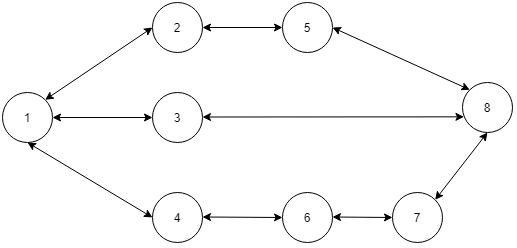
The city of Ninjaland is analogous to the unweighted graph. The city has ‘N’ houses numbered from 1 to ‘N’ respectively and are connected by M bidirectional roads. If a road is connecting two houses ‘X’ and ‘Y’ which means you can go from ‘X’ to ‘Y’ or ‘Y’ to ‘X’. It is guaranteed that you can reach any house from any other house via some combination of roads. Two houses are directly connected by at max one road.
A path between house ‘S’ to house ‘T’ is defined as a sequence of vertices from ‘S’ to ‘T’. Where starting house is ‘S’ and the ending house is ‘T’ and there is a road connecting two consecutive houses. Basically, the path looks like this: (S , h1 , h2 , h3 , ... T). you have to find the shortest path from ‘S’ to ‘T’.
For example
In the below map of Ninjaland let say you want to go from S=1 to T=8, the shortest path is (1, 3, 8). You can also go from S=1 to T=8 via (1, 2, 5, 8) or (1, 4, 6, 7, 8) but these paths are not shortest.
Problem approach
The city of Ninjaland is analogous to the unweighted graph. The city has ‘N’ houses numbered from 1 to ‘N’ respectively and are connected by M bidirectional roads. If a road is connecting two houses ‘X’ and ‘Y’ which means you can go from ‘X’ to ‘Y’ or ‘Y’ to ‘X’. It is guaranteed that you can reach any house from any other house via some combination of roads. Two houses are directly connected by at max one road.
03
Round
Easy
Video Call
Duration60 minutes
Interview date10 Nov 2022
Coding problem2
1. Dijkstra's shortest path
Moderate
25m average time
65% success
0/80
Asked in companies



You have been given an undirected graph of ‘V’ vertices (labeled 0,1,..., V-1) and ‘E’ edges. Each edge connecting two nodes (‘X’,’Y’) will have a weight denoting the distance between node ‘X’ and node ‘Y’.
Your task is to find the shortest path distance from the source node, which is the node labeled as 0, to all vertices given in the graph.
Example:
Input:
4 5
0 1 5
0 2 8
1 2 9
1 3 2
2 3 6
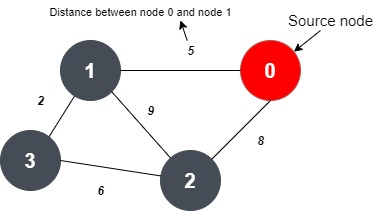
In the given input, the number of vertices is 4, and the number of edges is 5.

In the input, following the number of vertices and edges, three numbers are given. The first number denotes node ‘X’, the second number denotes node ‘Y’ and the third number denotes the distance between node ‘X’ and ‘Y’.

As per the input, there is an edge between node 0 and node 1 and the distance between them is 5.

The vertices 0 and 2 have an edge between them and the distance between them is 8.
The vertices 1 and 2 have an edge between them and the distance between them is 9.
The vertices 1 and 3 have an edge between them and the distance between them is 2.
The vertices 2 and 3 have an edge between them and the distance between them is 6.
Note:
1. There are no self-loops(an edge connecting the vertex to itself) in the given graph.

2. There can be parallel edges i.e. two vertices can be directly connected by more than 1 edge.
Problem approach
You have been given an undirected graph of ‘V’ vertices (labeled 0,1,..., V-1) and ‘E’ edges. Each edge connecting two nodes (‘X’,’Y’) will have a weight denoting the distance between node ‘X’ and node ‘Y’.
2. Letter Combinations of a Phone Number
Moderate
35m average time
65% success
0/80
Asked in companies

Given a string S containing digits from 2 to 9 inclusive. Your task is to find all possible letter combinations that the number could represent.
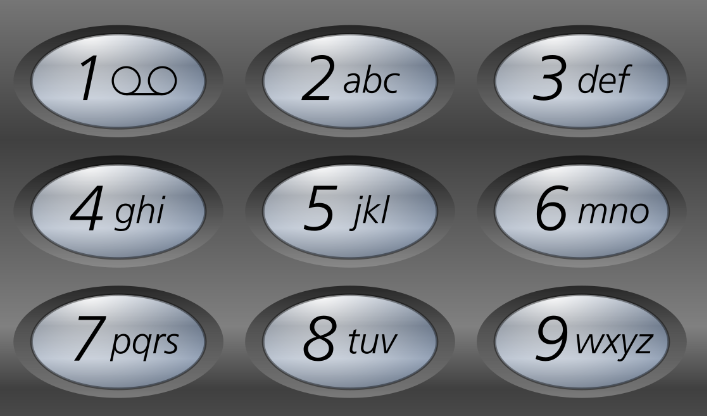
A mapping from Digits to Letters (just like in Nokia 1100) is shown below. Note that 1 does not map to any letter.
Problem approach
This can be solved using recursion. It can be observed that each digit can represent 3 to 4 different alphabets (apart from 0 and 1). Map the number with its string of probable alphabets, i.e 2 with “abc”, 3 with “def” etc. Now the recursive function will try all the alphabets, mapped to the current digit in alphabetic order, and again call the recursive function for the next digit and will pass on the current output string.


Here's your problem of the day 
Solving this problem will increase your chance to get selected in this company
Skill covered: Programming
How do you remove whitespace from the start of a string?
Choose another skill to practice
Similar interview experiences
CSD
2 rounds | 3 problems
Interviewed by Nagarro Software
Rejected

1379 views

0 comments

0 upvotes
SDE - 1
3 rounds | 7 problems
Interviewed by Nagarro Software
 Selected
 937 views
0 comments
0 upvotes
SDE - 1
2 rounds | 4 problems
Interviewed by Nagarro Software
Rejected
1221 views
0 comments
0 upvotes
SDE - 1
2 rounds | 4 problems
Interviewed by Nagarro Software
Selected 758 views
0 comments
0 upvotes
Companies with similar interview experiences
System Engineer
2 rounds | 4 problems
Interviewed by HCL Technologies
 Selected
 1425 views
0 comments
0 upvotes
System Engineer
1 rounds | 3 problems
Interviewed by Microsoft
Rejected
0 views
0 comments
0 upvotes
System Engineer
3 rounds | 6 problems
Interviewed by HCL Technologies
Rejected
942 views
0 comments
0 upvotes