





Nosh technologies interview experience Real time questions & tips from candidates to crack your interview
SDE - 1
Nosh technologies


3 rounds | 6 Coding
problems

Rejected
Interview preparation journey

Journey
My journey started when I was in my 2nd year of college, and I saw my friends practicing coding questions, learning new coding languages, and developing individual projects. After seeing them, I started to think that I should also begin learning more and practicing coding questions. While practicing coding questions on coding platforms, I realized that I needed to think more to solve difficult problems, which led me to develop a habit of solving them.
Application story
I started preparing for the companies since 2nd year of my college and when I heard that this company is coming to our college I wanted to get selected in it.
Why selected/rejected for the role?
I was rejected because i was not able to perform well during the interview process.
Preparation
Duration: 4 months
Topics: Data Structures, Pointers, OOPS, System Design, Algorithms, Dynamic Programming

Tip 1 : OOPS - You should be well versed with basic OOPS principles.
Tip 2 : You should be confident and have profound knowledge about the projects you worked on.
Tip 3 : Basic DB concepts like joins, normalization.
Application process
Where: Campus
Eligibility: Above 7 CGPA
Tip 1 : Have some projects on resume.
Tip 2 : Do not put false things on resume.

Interview rounds
01
Round
Medium
Video Call
Duration60 minutes
Interview date15 Apr 2023
Coding problem2
1. Excel Column Number
Easy
23m average time

0/40
Asked in companies



You have been given a column title as appears in an Excel sheet, return its corresponding column number.
For example:
A -> 1
B -> 2
C -> 3
...
Z -> 26
AA -> 27
AB -> 28
...
Problem approach
Approach :
The process is very much similar to binary to decimal conversion. In this case, the base of the given system is to be taken as 26. Also, in this system 1 is represented as ‘A’, 2 is represented as ‘B’ and so on till 26 is represented as ‘Z’
For example-
CDA can be converted as 3*26*26 + 4*26 + 1
= 26(3*26 + 4) + 1
= 26(0*26 + 3*26 + 4) + 1
AB can be converted as 1*26 + 2
TC : O(N), where N = length of the input string.
SC : O(1)
2. Maximize the sum
Moderate
15m average time
85% success
0/80
Asked in companies



You are given two sorted arrays of distinct integers, ‘ARR1’ and ‘ARR2’. If you find a common element in both arrays, you can switch from one array to another.
Your task is to find a path through the intersections i.e common integers of ‘ARR1’ and ‘ARR2’, that produces maximum sum and return that maximum sum as the answer.
For example:
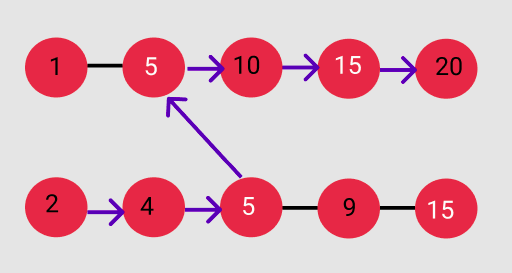
Let ‘ARR1’ = [1, 5, 10, 15, 20]  and ‘ARR2’ = [2, 4, 5, 9, 15]
In this example, common points are 5, 15.

First, we start with ARR2 and take the sum till 5 (i.e. sum = 11). Then we will switch to ‘ARR1’ at element 10 and take the sum till 15. So sum = 36. Now no element is left in ‘ARR2’ after 15, so we will continue in array 1. Hence sum is 56. And the path is 2 -> 4 -> 5 -> 10 -> 15 -> 20.
02
Round
Easy
Video Call
Duration60 minutes
Interview date15 Apr 2023
Coding problem2
1. Height of Binary Tree
Easy
15m average time
80% success
0/40
Asked in companies



The height of a tree is equal to the number of nodes on the longest path from the root to a leaf.
You are given an arbitrary binary tree consisting of 'n' nodes where each node is associated with a certain value.
Find out the height of the tree.
Example :
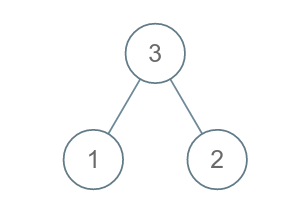
Input: Let the binary tree be:
Output: 2

Explanation: The root node is 3, and the leaf nodes are 1 and 2.

There are two nodes visited when traversing from 3 to 1.
There are two nodes visited when traversing from 3 to 2.

Therefore the height of the binary tree is 2.
2. Puzzle
The question was that there are n bombs of varying sizes. Over time, the top two stones collide with each other; the smaller stone is completely destroyed, and the size of the bigger stone is reduced by the size of the smaller stone. What will be the size of the last remaining stone?
03
Round
Easy
Video Call
Duration60 minutes
Interview date15 Apr 2023
Coding problem2
1. Square Root
Easy
10m average time
90% success
0/40
Asked in companies



You have been given two integers 'N' and 'D', Your task is to find the square root of the number 'N' with precision up to 'D' decimal places i.e. the difference between your answer and the correct answer should be less than 10 ^ (-D).
For example if N = 10 and D = 3, then your answer will be 3.162.
2. Reverse the String
Easy
15m average time
85% success
0/40
Asked in companies


You are given a string 'STR'. The string contains [a-z] [A-Z] [0-9] [special characters]. You have to find the reverse of the string.
For example:
If the given string is: STR = "abcde". You have to print the string "edcba".
follow up:
Try to solve the problem in O(1) space complexity.


Here's your problem of the day 
Solving this problem will increase your chance to get selected in this company
Skill covered: Programming
How do you remove whitespace from the start of a string?
Choose another skill to practice
Similar interview experiences
SDE - 1
3 rounds | 6 problems
Interviewed by Nosh technologies
Rejected

438 views

0 comments

0 upvotes
SDE - 1
2 rounds | 4 problems
Interviewed by Nosh technologies
Rejected
536 views
0 comments
0 upvotes
SDE - 1
2 rounds | 4 problems
Interviewed by Nosh technologies
Rejected
442 views
0 comments
0 upvotes
SDE - 1
3 rounds | 6 problems
Interviewed by Nosh technologies
Rejected
435 views
0 comments
0 upvotes
Companies with similar interview experiences
SDE - 1
5 rounds | 12 problems
Interviewed by Amazon

 Selected
 117552 views
24 comments
0 upvotes
SDE - 1
4 rounds | 5 problems
Interviewed by Microsoft
Selected 60142 views
5 comments
0 upvotes
SDE - 1
3 rounds | 7 problems
Interviewed by Amazon
 Selected
 36138 views
7 comments
0 upvotes