





Nosh technologies interview experience Real time questions & tips from candidates to crack your interview
SDE - 1
Nosh technologies


2 rounds | 4 Coding
problems

Rejected
Interview preparation journey

Journey
My personal journey has been very challenging. Coming from a middle-class family, I did not have access to a computer for a long time. I first learned about computers when I joined college, but from that point on, I never looked back again.
Application story
This is an on-campus placement opportunity, the company visited my campus for the placement.
Why selected/rejected for the role?
This was a great experience for me. I was able to perform well, and I am satisfied with the effort I have put forward.
Preparation
Duration: 4 months
Topics: Data Structures, Pointers, OOPS, System Design, Algorithms, Dynamic Programming

Tip 1: Prepare your resume well.
Tip 2: Deploy your projects so that the interviewer can view them. Also, provide a hyperlink in your resume.
Tip 3: Be thorough with Data Structures and Algorithms. Also, prepare well on topics such as OS and DBMS.
Application process
Where: Campus
Eligibility: Above 6 CGPA
Tip 1: Deploy your projects so that the interviewer can view them. Also, provide a hyperlink on your resume.
Tip 2: It's not important to have fancy projects. Only mention those on which you're confident.

Interview rounds
01
Round
Easy
Video Call
Duration60 minutes
Interview date17 Dec 2022
Coding problem2
1. Find Duplicates in Array
Easy
15m average time
90% success

0/40
Asked in companies



You are given an array/list 'ARR' consisting of N integers, which contains elements only in the range 0 to N - 1. Some of the elements may be repeated in 'ARR'. Your task is to find all such duplicate elements.
Note:
1. All the elements are in the range 0 to N - 1.
2. The elements may not be in sorted order.
3. You can return the duplicate elements in any order.
4. If there are no duplicates present then return an empty array.
2. Convert String
Easy
15m average time
85% success
0/40
Asked in companies



You are given a string 'STR'. You have to convert the first alphabet of each word in a string to UPPER CASE.
For example:
If the given string 'STR' = ”I am a student of the third year” so you have to transform this string to ”I Am A Student Of The Third Year"
Note:
'STR' will contains only space and alphabets both uppercase and lowercase. The words will be separated by space.
02
Round
Easy
Video Call
Duration60 minutes
Interview date17 Dec 2022
Coding problem2
1. BFS in Graph
Easy
10m average time
90% success
0/40
Asked in companies



Given an adjacency list representation of a directed graph with ‘n’ vertices and ‘m’ edges. Your task is to return a list consisting of Breadth-First Traversal (BFS) starting from vertex 0.
In this traversal, one can move from vertex 'u' to vertex 'v' only if there is an edge from 'u' to 'v'. The BFS traversal should include all nodes directly or indirectly connected to vertex 0.
Note:
The traversal should proceed from left to right according to the input adjacency list.
Example:
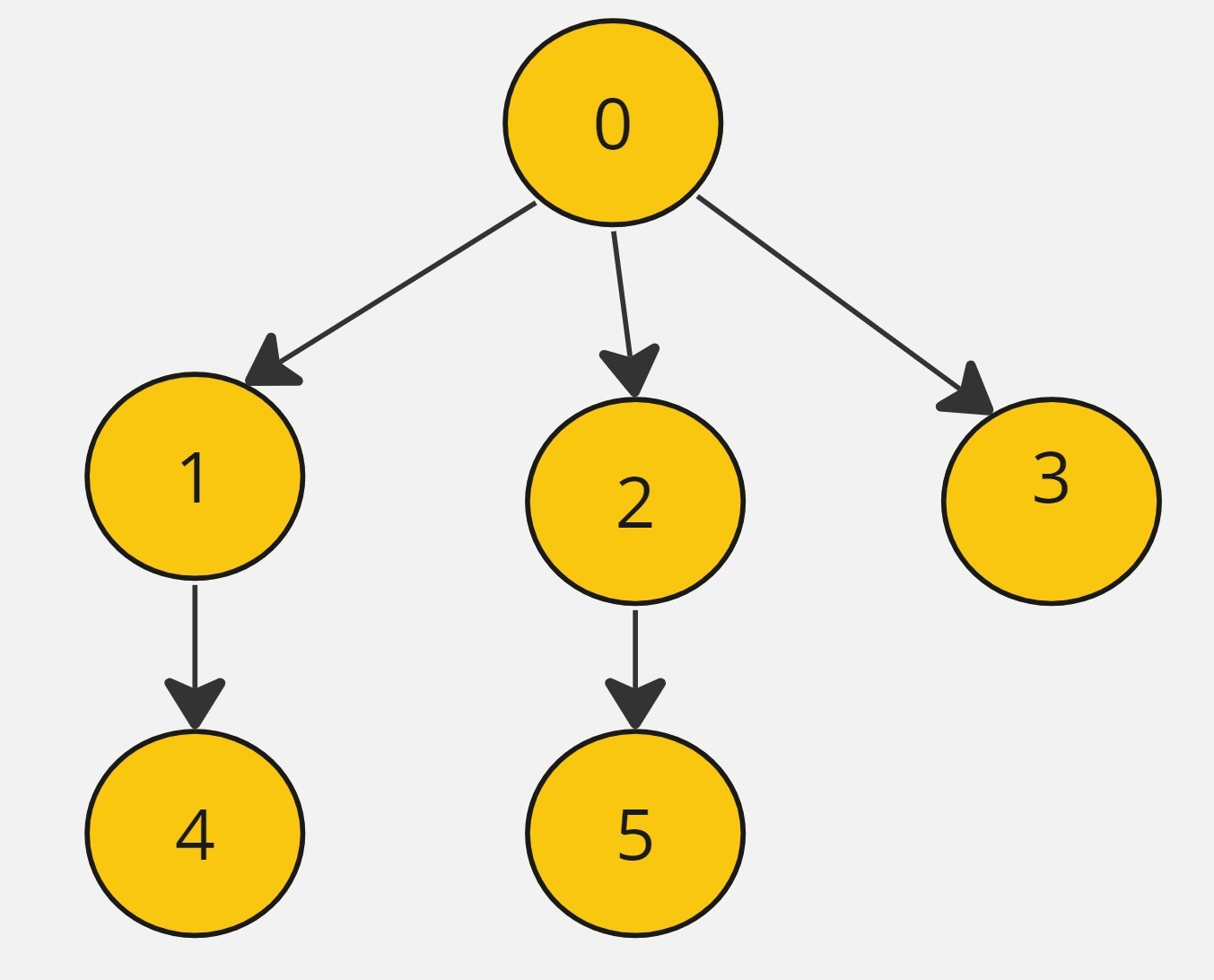
Adjacency list: { {1,2,3},{4}, {5}, {},{},{}}

The interpretation of this adjacency list is as follows:
Vertex 0 has directed edges towards vertices 1, 2, and 3.
Vertex 1 has a directed edge towards vertex 4.
Vertex 2 has a directed edge towards vertex 5.
Vertices 3, 4, and 5 have no outgoing edges.

We can also see this in the diagram below.

BFS traversal: 0 1 2 3 4 5
Problem approach
1. At various levels of the data, you can mark any node as the starting or initial node to begin traversing.
2. The BFS will visit the node, mark it as visited, and place it in the queue.
3. Now, the BFS will visit the nearest unvisited nodes and mark them. These values are also added to the queue. The queue operates on the FIFO model.
4. Similarly, the remaining nearest unvisited nodes on the graph are analyzed, marked, and added to the queue. These items are deleted from the queue as they are received and printed as the result.
2. Find prime numbers
Easy
15m average time
80% success
0/40
Asked in companies



You are given a positive integer ‘N’. Your task is to print all prime numbers less than or equal to N.
Note: A prime number is a natural number that is divisible only by 1 and itself. Example - 2, 3, 17, etc.
You can assume that the value of N will always be greater than 1. So, the answer will always exist.
Problem approach
Step 1 : Loop through all the elements in the given range.
Step 2 : Check for each number if it has any factor between 1 and itself.
Step 3 : If yes, then the number is not prime, and it will move to the next number.
Step 4 : If no, it is the prime number, and the program will print it and check for the next number.
Step 5 : The loop will break when it is reached the upper value.


Here's your problem of the day 
Solving this problem will increase your chance to get selected in this company
Skill covered: Programming
How do you remove whitespace from the start of a string?
Choose another skill to practice
Similar interview experiences
SDE - 1
3 rounds | 6 problems
Interviewed by Nosh technologies
Rejected

438 views

0 comments

0 upvotes
SDE - 1
3 rounds | 6 problems
Interviewed by Nosh technologies
Rejected
423 views
0 comments
0 upvotes
SDE - 1
2 rounds | 4 problems
Interviewed by Nosh technologies
Rejected
443 views
0 comments
0 upvotes
SDE - 1
3 rounds | 6 problems
Interviewed by Nosh technologies
Rejected
436 views
0 comments
0 upvotes
Companies with similar interview experiences
SDE - 1
5 rounds | 12 problems
Interviewed by Amazon

 Selected
 117552 views
24 comments
0 upvotes

SDE - 1
4 rounds | 5 problems
Interviewed by Microsoft
Selected 60143 views
5 comments
0 upvotes
SDE - 1
3 rounds | 7 problems
Interviewed by Amazon
 Selected
 36138 views
7 comments
0 upvotes