





Okcredit interview experience Real time questions & tips from candidates to crack your interview

Software Engineer Intern
Okcredit


4 rounds | 8 Coding
problems

 Selected
 Interview preparation journey

Preparation
Duration: 5 months
Topics: Data Structures, Algorithms, System Design, Aptitude, OOPS.

Tip 1 : Must do Previously asked Interviews as well as Online Test Questions.
Tip 2 : Must have good knowledge of DSA
Tip 3 : Do at least 2 good projects and you must know every bit of them.
Application process
Where: Coding Ninjas
Eligibility: Above 7 CGPA, Good knowledge of backend
Tip 1 : Have at least 2 good projects explained in short with all important points covered.
Tip 2 : Every skill must be mentioned.
Tip 3 : Focus on skills, projects, and experiences more.

Interview rounds
01
Round
Easy
Online Coding Test
Duration90 minutes
Interview date15 Nov 2021
Coding problem2
It was a proctored test. Did not have any start or end date. only duration was given of 90 minutes
1. Alice and her love for Strings.
Easy
10m average time
90% success

0/40
Asked in companies


Alice loves string and Bob being her best friend wants to gift a beautiful string to Alice on her birthday. He knows that Alice loves her childhood string ‘A’ and would love to get a new string similar to the string ‘A’.
Somehow Bob convinced one of his friends to send him a random string ‘B’. Now Bob will have to change the random string ‘B’ to make it equal to string ‘A’ so that he can gift this string to Alice on her birthday. But changing the string is a very tedious process. He can change one character of the string to any other character in a single step.
Now he wonders if it is even possible to change the string ‘B’ to string ‘A’ by using at most ‘K’ steps? Can you help Bob figure out if it is even possible to do so under given constraints?
Problem approach
ALL BASIC CASES NEED TO BE COVERED AND LOGIC WAS MADE ACCORDING TO THAT
2. Sort an array in wave form
Easy
10m average time
85% success
0/40
Asked in companies



You have been given an unsorted array ‘ARR’.
Your task is to sort the array in such a way that the array looks like a wave array.
Example:
If the given sequence ‘ARR’ has ‘N’ elements then the sorted wave array looks like -
‘ARR[0] >= ARR[1]’ and ‘ARR[1] <= ARR[2]’
‘ARR[2] >= ARR[3]’ and ‘ARR[3] <= ARR[4]’
‘ARR[4] >= ARR[5]’ and ‘ARR[5] <= ARR[6]’  And so on.
Note:
1. ‘ARR[0]’ must be greater than or equal to ‘ARR[1]’.

2. There can be multiple arrays that look like a wave array but you have to return only one.

3. We have an internal function that will check your solution and return 'True' in case your array is one of the solutions otherwise return 'False'.
Explanation
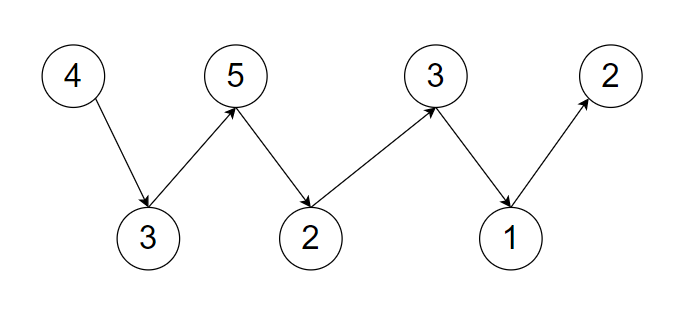
The given array ‘ ARR = { 4, 3, 5, 2, 3, 1, 2 } ’
The below figure is a visual representation of the given ‘ARR’ and you can see we can express ‘ARR’ in a waveform array because
4>3 and 3<5
5>2 and 2<3
3>1 and 1<2
And it follows the condition of wave array.
Follow up:
Try to solve this problem in linear time complexity.
02
Round
Easy
Video Call
Duration60 minutes
Interview date3 Dec 2021
Coding problem2
The interview was taken on google meet. timings were 6 to 7 interviewer was very friendly helped whenever i got stuck. there were 2 dsa questions asked. 2 one was the variation of first
1. Best Time to Buy and Sell Stock
Moderate
20m average time
80% success
0/80
Asked in companies



You are given an array/list 'prices' where the elements of the array represent the prices of the stock as they were yesterday and indices of the array represent minutes. Your task is to find and return the maximum profit you can make by buying and selling the stock. You can buy and sell the stock only once.
Note:
You can’t sell without buying first.
For Example:
For the given array [ 2, 100, 150, 120],
The maximum profit can be achieved by buying the stock at minute 0 when its price is Rs. 2 and selling it at minute 2 when its price is Rs. 150.
So, the output will be 148.
Problem approach
The logic to solve this problem is same as "max subarray problem" using Kadane's Algorithm. Since no body has mentioned this so far, I thought it's a good thing for everybody to know.
All the straight forward solution should work, but if the interviewer twists the question slightly by giving the difference array of prices, Ex: for {1, 7, 4, 11}, if he gives {0, 6, -3, 7}, you might end up being confused.
Here, the logic is to calculate the difference (maxCur += prices[i] - prices[i-1]) of the original array, and find a contiguous subarray giving maximum profit. If the difference falls below 0, reset it to zero.
2. Best Time to Buy and Sell Stock II
Moderate
22m average time
0/80
Asked in companies


You have been given stock values/prices for N number of days. Every i-th day signifies the price of a stock on that day. Your task is to find the maximum profit which you can make by buying and selling the stocks.
Note :
You may make as many transactions as you want but can not have more than one transaction at a time i.e, if you have the stock, you need to sell it first, and then only you can buy it again.
Problem approach
The profit is the sum of sub-profits. Each sub-profit is the difference between selling at day j, and buying at day i (with j > i). The range [i, j] should be chosen so that the sub-profit is maximum:
sub-profit = prices[j] - prices[i]
We should choose j that prices[j] is as big as possible, and choose i that prices[i] is as small as possible (of course in their local range).
Let's say, we have a range [3, 2, 5], we will choose (2,5) instead of (3,5), because 2<3.
Now, if we add 8 into this range: [3, 2, 5, 8], we will choose (2, 8) instead of (2,5) because 8>5.
From this observation, from day X, the buying day will be the last continuous day that the price is smallest. Then, the selling day will be the last continuous day that the price is biggest.
Take another range [3, 2, 5, 8, 1, 9], though 1 is the smallest, but 2 is chosen, because 2 is the smallest in a consecutive decreasing prices starting from 3.
Similarly, 9 is the biggest, but 8 is chosen, because 8 is the biggest in a consecutive increasing prices starting from 2 (the buying price).
Actually, the range [3, 2, 5, 8, 1, 9] will be splitted into 2 sub-ranges [3, 2, 5, 8] and [1, 9].
03
Round
Easy
Face to Face
Duration60 minutes
Interview date10 Jan 2022
Coding problem3
The interview was held on google meet and the time duration was 60 minutes. the interviewer started with an introduction and told me he was technical lead in the company After that he started with basic oops, DBMS, and cn questions and moved on to 1 dsa problem
1. Operating System Questions
What is demand paging?
What are the advantages of a multiprocessor system?
What are the advantages of a multiprocessor system
Problem approach
Tip 1 : Be clear with the explanation
Tip 2 : If any question requires explanation use the resource that is provided for explaining
Tip 3 : Study the most important questions
2. DBMS Questions
What is normalization?
Describe the types of keys?
What is the Deadlock situation?
Problem approach
Tip 1 : Be clear with the explanation
Tip 2 : If any question requires explanation use the resource that is provided for explaining
Tip 3 : Study the most important questions
3. Sum or Product
Easy
15m average time
80% success
0/40
Asked in companies

You are given a number ‘N’ and a query ‘Q.’ If ‘Q’ is 1, then you have to return the sum of all integers from 1 to ‘N,’ else if ‘Q’ is equal to 2 then you have to return the product of all integers from 1 to ‘N.’ Since the product can be very large, return it modulo 10 ^ 9 + 7.
For example
Given ‘N’ = 4, ‘Q’ = 1.
Then the answer is 10 because the sum of all integers between 1 and 4 are 1, 2, 3, and 4. Hence 1 + 2 + 3 + 4 is equal to 10.
04
Round
Easy
HR Round
Duration10 minutes
Interview date11 Jan 2022
Coding problem1
Asked Basic Hr questions, Compensation and previous offers
1. Basic HR Questions
Why do you want to join us?
What motivates you the most?
Discussion About the location, any other offers, and compensation.
Problem approach
Tip 1 : Be confident
Tip 2 : Read what the Company is working on and it's products
Tip 3 : Prepare Standard Hr questions


Here's your problem of the day 
Solving this problem will increase your chance to get selected in this company
Skill covered: Programming
How do you remove whitespace from the start of a string?
Choose another skill to practice
Similar interview experiences

SDE - 1
3 rounds | 7 problems
Interviewed by OYO
Selected 
6182 views

0 comments

0 upvotes
Backend developer intern
2 rounds | 5 problems
Interviewed by Okcredit
Rejected
1029 views
0 comments
0 upvotes
SDE - 1
2 rounds | 5 problems
Interviewed by Meesho
Rejected
7245 views
0 comments
0 upvotes

SDE - 1
3 rounds | 9 problems
Interviewed by Salesforce
 Selected
 4551 views
0 comments
0 upvotes
Companies with similar interview experiences

Software Engineer Intern
4 rounds | 4 problems
Interviewed by Microsoft
 Selected
 1496 views
0 comments
0 upvotes