





OLX Group interview experience Real time questions & tips from candidates to crack your interview

SDE - 1
OLX Group


3 rounds | 6 Coding
problems

Rejected
Interview preparation journey

Journey
I completed my BTech during which I started doing coding questions and participating in interview mocks. Since then, I have worked on a number of questions across various practice websites.
Application story
This is an on-campus opportunity for me, company visited to my campus for the placement. They have given a CGPA-wise cutoff also
Why selected/rejected for the role?
I was rejected because i was not able to provide the accurate solution for the question given to me.
Preparation
Duration: 4 months
Topics: Data Structures and Algorithms, Object-Oriented Programming System, Operating system, Database Management System

Try to do Data Structures and Algorithms-based questions, and first attempt them yourself before referring to the solution. Also, try to solve them as quickly as you can. Additionally, prepare for theoretical subjects like Operating Systems, Database Management Systems, etc., which I studied using Coding Ninjas' subjective notes; they are very accurate and up-to-date.
Application process
Where: Campus
Eligibility: Above 7 CGPA
Tip 1 : Have some projects on resume.
Tip 2 : Do not put false things on resume.

Interview rounds
01
Round
Medium
Video Call
Duration90 minutes
Interview date8 Feb 2023
Coding problem2
1. Longest Substring Without Repeating Characters
Moderate
30m average time
65% success

0/80
Asked in companies



Given a string input of length n, find the length of the longest substring without repeating characters i.e return a substring that does not have any repeating characters.
Substring is the continuous sub-part of the string formed by removing zero or more characters from both ends.
2. Convert a binary tree to its sum tree
Easy
15m average time
85% success
0/40
Asked in companies



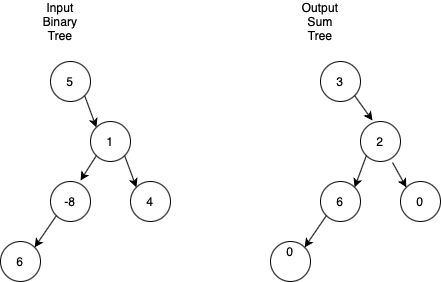
Given a binary tree of integers, you are supposed to modify the given binary tree to a sum tree where each node value is replaced by the sum of the values of both left and right subtrees in the given tree. The value of leaf nodes is changed to zero.
Example:
Below is the example showing the input tree and its sum tree.
02
Round
Medium
Video Call
Duration90 minutes
Interview date8 Feb 2023
Coding problem2
1. Symmetric Tree
Easy
20m average time
82% success
0/40
Asked in companies



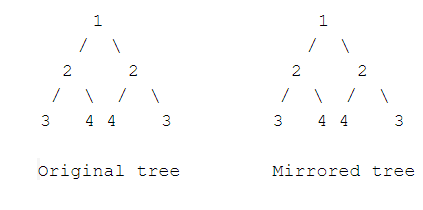
You are given a binary tree, where the data present in each node is an integer. You have to find whether the given tree is symmetric or not.
Symmetric tree is a binary tree, whose mirror image is exactly the same as the original tree.
For Example:
2. Maximum Sum BST
Hard
50m average time
55% success
0/120
Asked in companies
You are given a Binary Tree ‘root’. The given Binary Tree may or may not be a Binary Search Tree(BST) itself. Your task is to find the maximum sum of node values of any subtree that is a Binary Search Tree(BST).
Binary Search Tree is defined as follows:
1) If the left subtree exists it should contain only nodes with values less than the current node's value.

2) If the right subtree exists it should contain only nodes with values greater than the current node's value.

3) Both the left and right subtrees should also be Binary Search Tree.
Example :
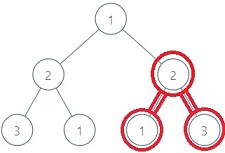
For the above binary tree, the BST with the maximum possible sum is marked with RED colour, the sum of this BST is equal to 6.
03
Round
Easy
Video Call
Duration60 minutes
Interview date8 Feb 2023
Coding problem2
1. Pair with Given Sum in a Balanced BST
Moderate
25m average time
65% success
0/80
Asked in companies



You are given the ‘root’ of a Balanced Binary Search Tree and an integer ‘target,’ you have to tell if there exists any pair of nodes such that the sum of their value is equal to the target.
More formally check if there exist any two distinct nodes, whose sum is equal to ‘target.’
Note:
A binary search tree, also called an ordered or sorted binary tree, is a rooted binary tree whose internal nodes each store a key greater than all the keys in the node's left subtree and less than those in its right subtree.

A balanced binary search tree is a tree in which each node has either 0 or 2 children.
Example:
For Example, the root node is given as follows :
‘ROOT’ = 5 2 6 -1 -1 -1 -1 and ‘target’ = 8, The answer will be true since the sum of both leaf nodes is equal to 8.
Problem approach
I first tried to convert the tree to a doubly linked list, but the interviewer asked me to do it without conversion. Then, I created a function to traverse the tree in inorder and reverse inorder traversal, and the interviewer was satisfied with this approach.
2. Remove BST keys outside the given range
Easy
15m average time
85% success
0/40
Asked in companies



Given a Binary Search Tree (BST) and a range [min, max], remove all keys which are outside the given range. The modified tree should also be BST.
Problem approach
If the root node is less than low, then return the right subtree, and if the root node is greater than max, then return the left subtree.


Here's your problem of the day 
Solving this problem will increase your chance to get selected in this company
Skill covered: Programming
What does dict.keys() return?
Choose another skill to practice
Similar interview experiences
SDE - 1
3 rounds | 3 problems
Interviewed by OLX Group
 Selected
1952 views

0 comments

0 upvotes
SDE - 1
3 rounds | 6 problems
Interviewed by OLX Group
Rejected
928 views
0 comments
0 upvotes
SDE - 1
3 rounds | 5 problems
Interviewed by OLX Group
Rejected
1114 views
0 comments
0 upvotes
SDE - 1
3 rounds | 6 problems
Interviewed by OLX Group
Rejected
901 views
0 comments
0 upvotes
Companies with similar interview experiences
SDE - 1
5 rounds | 12 problems
Interviewed by Amazon
 Selected
 117625 views
24 comments
0 upvotes
SDE - 1
4 rounds | 5 problems
Interviewed by Microsoft
Selected 60211 views
5 comments
0 upvotes
SDE - 1
3 rounds | 7 problems
Interviewed by Amazon
 Selected
 36160 views
7 comments
0 upvotes