





OLX Group interview experience Real time questions & tips from candidates to crack your interview

System Engineer
OLX Group


3 rounds | 6 Coding
problems

Rejected
Interview preparation journey

Journey
I was not good at coding at the start of my career, but I practised a lot of questions from Code Studio, which helped me excel in life and also in coding exams.
Application story
This company visited our campus to hire for full-time employment (FTE). I applied for this job opportunity there.
Why selected/rejected for the role?
I was rejected because I was not able to provide a proper explanation for the questions that were asked.
Preparation
Duration: 6 months
Topics: Data Structures, Pointers, OOPS, System Design, Algorithms, Dynamic Programming

Tip 1: Practice implementing basic data structures from scratch.
Tip 2: Participate in contests on coding platforms.
Tip 3: Focus on writing code for operations such as insertion, deletion, search, and traversal.
Application process
Where: Campus
Eligibility: Above 7 CGPA
Tip 1: Focus on creating a clear and concise format for your resume. Use a clean design, consistent fonts, and appropriate headings to make it easy to navigate. Use bullet points to present information in a concise and organized manner.
Tip 2: Customize the content of your resume to suit the job you're applying for. Highlight experiences, achievements, and skills that directly relate to the position. Tailoring your resume shows that you have taken the time to understand the role and makes you a more compelling candidate.

Interview rounds
01
Round
Easy
Video Call
Duration60 minutes
Interview date26 Nov 2022
Coding problem2
The interviewers posed questions related to database indexing techniques, query optimization, and transaction management. We were expected to demonstrate our understanding of concepts like primary keys, foreign keys, normalization forms, and join operations.
1. Vertical Sum in BST
Moderate
25m average time
75% success

0/80
Asked in companies

Given a binary tree having a positive integer written on each of its nodes. Your task is to find the vertical sum of node values i.e. the sum of nodes that can be connected by a vertical line.
A binary tree is a tree in which each parent node has at most two children.
You are required to print the sum along vertical lines from the leftmost node and moving to the rightmost node.
For Example :
Consider the following Binary Tree:
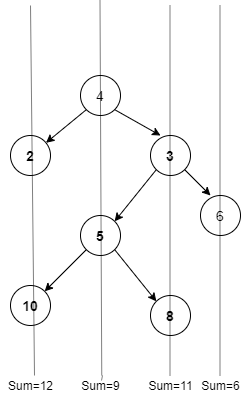
So the final answer is
12 9 11 6
2. Anagram Pairs
Moderate
30m average time
60% success
0/80
Asked in companies



You are given two strings 'str1' and 'str1'.
You have to tell whether these strings form an anagram pair or not.
The strings form an anagram pair if the letters of one string can be rearranged to form another string.
Pre-requisites:
Anagrams are defined as words or names that can be formed by rearranging the letters of another word. Such as "spar" can be formed by rearranging letters of "rasp". Hence, "spar" and "rasp" are anagrams.
Other examples include:
'triangle' and 'integral'
'listen' and 'silent'
Note:
Since it is a binary problem, there is no partial marking. Marks will only be awarded if you get all the test cases correct.
Problem approach
I simply used hashing to solve this problem by checking the frequency of characters in both strings.
02
Round
Easy
Video Call
Duration60 minutes
Interview date26 Nov 2022
Coding problem2
1. Transform The Matrix
Easy
10m average time
90% success
0/40
Asked in companies


You are given an N * N binary matrix 'MAT'. You can do two operations in the matrix:
i) Swap any two rows.
ii) Swap any two columns.
Your task is to find the minimum number of operations needed to convert this matrix into a chessboard matrix.
If the task is impossible print -1.
Note:
A chessboard matrix is a binary matrix where there are no two 0’s and no two 1’s who are adjacent to each other.
For example:
[ [1, 0], [0, 1] ] and [ [0, 1], [1, 0] ] are chessboard matrix whereas [ [1,0], [1, 1] ] isn’t.
2. Count derangements
Moderate
35m average time
60% success
0/80
Asked in companies


A Derangement is a permutation of ‘N’ elements, such that no element appears in its original position. For example, an instance of derangement of {0, 1, 2, 3} is {2, 3, 1, 0}, because 2 present at index 0 is not at its initial position which is 2 and similarly for other elements of the sequence.
Given a number ‘N’, find the total number of derangements possible of a set of 'N’ elements.
Note:
The answer could be very large, output answer %(10 ^ 9 + 7).
03
Round
Easy
Video Call
Duration60 minutes
Interview date26 Nov 2022
Coding problem2
1. Maximum Subarray Sum
Moderate
35m average time
81% success
0/80
Asked in companies


You are given an array 'arr' of length 'n', consisting of integers.
A subarray is a contiguous segment of an array. In other words, a subarray can be formed by removing 0 or more integers from the beginning and 0 or more integers from the end of an array.
Find the sum of the subarray (including empty subarray) having maximum sum among all subarrays.
The sum of an empty subarray is 0.
Example :
Input: 'arr' = [1, 2, 7, -4, 3, 2, -10, 9, 1]

Output: 11

Explanation: The subarray yielding the maximum sum is [1, 2, 7, -4, 3, 2].
Problem approach
1. I explained the Naive approach which was taking 2 loops and considering every subarray once. It was an O(N^2 ) approach.
2. I optimised my approach to one loop making it O(N), by applying Kadane's algorithm.
2. Maximum sum of non-adjacent elements
Moderate
15m average time
85% success
0/80
Asked in companies



You are given an array/list of ‘N’ integers. You are supposed to return the maximum sum of the subsequence with the constraint that no two elements are adjacent in the given array/list.
Note:
A subsequence of an array/list is obtained by deleting some number of elements (can be zero) from the array/list, leaving the remaining elements in their original order.
Problem approach
1. I solved it in O(N) time.
2. The interviewer asked me to dry-run it to rectify a few mistakes I made.
3. I resolved the issues.


Here's your problem of the day 
Solving this problem will increase your chance to get selected in this company
Skill covered: Programming
How do you remove whitespace from the start of a string?
Choose another skill to practice
Similar interview experiences
SDE - 1
3 rounds | 6 problems
Interviewed by OLX Group
Rejected

793 views

0 comments

0 upvotes
SDE - 1
3 rounds | 5 problems
Interviewed by OLX Group
Rejected
961 views
0 comments
0 upvotes
SDE - 1
3 rounds | 6 problems
Interviewed by OLX Group
Rejected
803 views
0 comments
0 upvotes
SDE - 1
3 rounds | 6 problems
Interviewed by OLX Group
Rejected
708 views
0 comments
0 upvotes
Companies with similar interview experiences

System Engineer
1 rounds | 3 problems
Interviewed by Microsoft
Rejected
0 views
0 comments
0 upvotes