





One97 Communication Limited interview experience Real time questions & tips from candidates to crack your interview
SDE - Intern
One97 Communication Limited


3 rounds | 7 Coding
problems
 Selected
 Interview preparation journey

Preparation
Duration: 6 months
Topics: Data Structures, OOPS, Algorithms, C++, Development

Tip 1 : Do at least 1 project in any technology
Tip 2 : Learn DSA at least these topics Array, LL, Tree, DP
Application process
Where: Referral
Eligibility: No criteria
Tip 1 : At least mention the projects and internships on your resume.
Tip 2 : Avoid unnecessary details like Hobbies, declaration, date.

Interview rounds
01
Round
Easy
Online Coding Test
Duration60 minutes
Interview date24 Nov 2020
Coding problem3
Coding round with 3 coding questions.
1. Print Nodes at distance K from a given node
Hard
20m average time
80% success

0/120
Asked in companies



You are given an arbitrary binary tree, a node of the tree, and an integer 'K'. You need to find all such nodes which have a distance K from the given node and return the list of these nodes.
Distance between two nodes in a binary tree is defined as the number of connections/edges in the path between the two nodes.
Note:
1. A binary tree is a tree in which each node has at most two children.
2. The given tree will be non-empty.
3. The given tree can have multiple nodes with the same value.
4. If there are no nodes in the tree which are at distance = K from the given node, return an empty list.
5. You can return the list of values of valid nodes in any order. For example if the valid nodes have values 1,2,3, then you can return {1,2,3} or {3,1,2} etc.
Example :
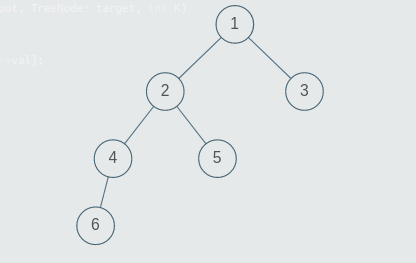
Consider this tree above. The target node is 5 and K = 3. The nodes at distance 1 from node 5 are {2}, nodes at distance 2 from node 5 are {1, 4} and nodes at distance 3 from node 5 are {6, 3}.
2. Rahul And Minimum Subarray
Moderate
0/80
Asked in companies



Rahul is a programming enthusiast. He is currently learning about arrays/lists. One day his teacher asked him to solve a very difficult problem. The problem was to find the length of the smallest subarray(subarray is a contiguous part of an array/list) in a given array/list ‘ARR’ of size ‘N’ with its sum greater than a given value. If there is no such subarray return 0.
Example: Given an ‘ARR’: [1, 2, 21, 7, 6, 12] and a number ‘X’: 23. The length of the smallest subarray is 2 as the subarray is [21, 7].
Note: Here are multiple subarrays whose sum is greater than ‘X’ such as [1, 2, 21] or [7, 6, 12] but we have to choose the minimum length subarray.
3. Encrypt The Digits
Easy
10m average time
90% success
0/40
Asked in company

Given a numeric string ‘STR’ which is a string containing numeric characters from ‘0’ to ‘9’, you have to encrypt the string by changing each numeric character as shown below:
‘0’ -> ‘9’
‘1’ -> ‘8’
‘2’ -> ‘7’ and so on till ‘9’ -> ‘0’
For Example :
If ‘STR’ = “8034”, then the encrypted string will be “1965”.
02
Round
Medium
Video Call
Duration50 minutes
Interview date9 Dec 2020
Coding problem2
The nature of the interviewer was very kind. The test was proctored, our webcam and mic were on, and shared my screen.
1. Diagonal Traversal of a binary tree.
Easy
10m average time
90% success
0/40
Asked in companies



You have been given a binary tree of integers. You are supposed to find the diagonal traversal(refer to Example) of the given binary tree.
Example:
Consider lines at an angle of 135 degrees(with respect to standard X- axis) in between nodes. Then, all nodes between two consecutive lines belong to the same diagonal
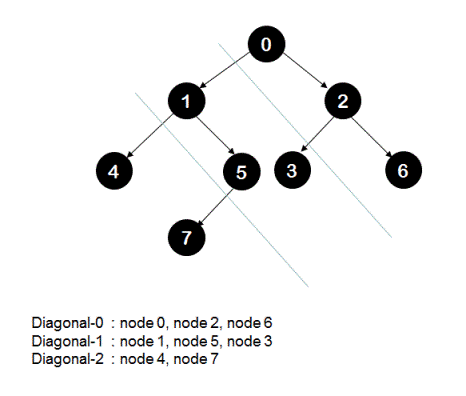
The diagonal traversal for the above tree is:

0 2 6 1 5 3 4 7
2. Parth And His OCD
Easy
0/40
Parth is a nerd programmer. He has started learning array/list programming. Parth has received an array/list ‘ARR’ of ‘N’ positive integers as a gift. Parth’s OCD gets triggered every time he sees an array/list having an odd value at even index or even value at odd index. Help Parth to make ‘ARR’ good before his OCD gets triggered.
Example: Given an ‘ARR’: [ 7, 4, 21, 1, 8, 18]. The output array/list which would be shown to Parth can be [ 4, 7, 8, 21, 18, 1 ].
Note: There might be many different output arrays possible like [ 4, 7, 8, 21, 18, 1 ], [ 18, 1, 8, 21, 4, 21 ] and you can show any one of these which does not trigger Parth’s OCD. Also, the ‘ARR’ provided to you would have the same number of odd elements as odd index positions and vice versa. Assume ‘ARR’ as 0-based indexing.
03
Round
Easy
Video Call
Duration50 minutes
Interview date9 Dec 2020
Coding problem2
The nature of the interviewer was very kind. The test was proctored, our webcam and mic were on, and shared my screen.
1. Subset Sum Equal To K
Moderate
30m average time
65% success
0/80
Asked in companies



You are given an array/list ‘ARR’ of ‘N’ positive integers and an integer ‘K’. Your task is to check if there exists a subset in ‘ARR’ with a sum equal to ‘K’.
Note: Return true if there exists a subset with sum equal to ‘K’. Otherwise, return false.
For Example :
If ‘ARR’ is {1,2,3,4} and ‘K’ = 4, then there exists 2 subsets with sum = 4. These are {1,3} and {4}. Hence, return true.
2. Next Greater Element
Easy
10m average time
90% success
0/40
Asked in companies


You are given an array 'a' of size 'n'.
Print the Next Greater Element(NGE) for every element.
The Next Greater Element for an element 'x' is the first element on the right side of 'x' in the array, which is greater than 'x'.
If no greater elements exist to the right of 'x', consider the next greater element as -1.
For example:
Input: 'a' = [7, 12, 1, 20]

Output: NGE = [12, 20, 20, -1]

Explanation: For the given array,

- The next greater element for 7 is 12.

- The next greater element for 12 is 20.

- The next greater element for 1 is 20.

- There is no greater element for 20 on the right side. So we consider NGE as -1.


Here's your problem of the day 
Solving this problem will increase your chance to get selected in this company
Skill covered: Programming
Which data structure is used in the implementation of recursion?
Choose another skill to practice
Similar interview experiences
SDE - Intern
3 rounds | 7 problems
Interviewed by One97 Communication Limited
 Selected
1309 views

0 comments

0 upvotes
SDE - Intern
2 rounds | 4 problems
Interviewed by One97 Communication Limited
Selected 766 views
0 comments
0 upvotes
SDE - Intern
4 rounds | 10 problems
Interviewed by One97 Communication Limited
Selected 923 views
0 comments
0 upvotes
SDE - Intern
2 rounds | 4 problems
Interviewed by One97 Communication Limited
Rejected
811 views
0 comments
0 upvotes
Companies with similar interview experiences
SDE - Intern
3 rounds | 6 problems
Interviewed by Amazon

Rejected
16015 views
4 comments
0 upvotes
SDE - Intern
4 rounds | 7 problems
Interviewed by Microsoft
 Selected
 16006 views
1 comments
0 upvotes
SDE - Intern
2 rounds | 4 problems
Interviewed by Amazon
Selected 10435 views
2 comments
0 upvotes