





OYO interview experience Real time questions & tips from candidates to crack your interview

SDE - 1
OYO


3 rounds | 7 Coding
problems

 Selected
 Interview preparation journey

Preparation
Duration: 3 Months
Topics: Data Structures, Pointers, OOPS, System Design, Algorithms, Dynamic Programming

Tip 1 : Practice Atleast 250 Questions
Tip 2 : Ex- Do atleast 2 projects
Application process
Where: Campus
Eligibility: 7.5
Tip 1 : Have some projects on resume.
Tip 2 : Do not put false things on resume.

Interview rounds
01
Round
Medium
Online Coding Test
Duration60 Minutes
Interview date16 Aug 2021
Coding problem3
3 coding questions
1. Rotting Oranges
Moderate
20m average time
78% success

0/80
Asked in companies



Given a matrix of dimension m*n where each cell in the matrix can have values 0, 1 or 2 which has the following meaning:
0: Empty cell
1: Cells have fresh oranges
2: Cells have rotten oranges
Determine what is the minimum time required so that all the oranges become rotten. A rotten orange at index [i,j] can rot other fresh orange at indexes [i-1,j], [i+1,j], [i,j-1], [i,j+1] (up, down, left and right). If it is impossible to rot every orange then simply return -1.
Problem approach
Approach: The idea is to use Breadth First Search. The condition of oranges getting rotten is when they come in contact with other rotten oranges. This is similar to breadth-first search where the graph is divided into layers or circles and the search is done from lower or closer layers to deeper or higher layers. In the previous approach, the idea was based on BFS but the implementation was poor and inefficient. To find the elements whose values are no the whole matrix had to be traversed. So that time can be reduced by using this efficient approach of BFS.
2. Bottom View Of Binary Tree
Moderate
10m average time
90% success
0/80
Asked in companies


You are given a 'Binary Tree'.
Return the bottom view of the binary tree.
Note :
1. A node will be in the bottom-view if it is the bottom-most node at its horizontal distance from the root.

2. The horizontal distance of the root from itself is 0. The horizontal distance of the right child of the root node is 1 and the horizontal distance of the left child of the root node is -1.

3. The horizontal distance of node 'n' from root = horizontal distance of its parent from root + 1, if node 'n' is the right child of its parent.

4. The horizontal distance of node 'n' from root = horizontal distance of its parent from the root - 1, if node 'n' is the left child of its parent.

5. If more than one node is at the same horizontal distance and is the bottom-most node for that horizontal distance, including the one which is more towards the right.
Example:
Input: Consider the given Binary Tree:
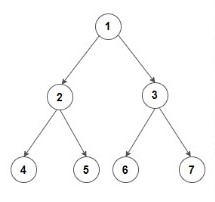
Output: 4 2 6 3 7

Explanation:
Below is the bottom view of the binary tree.

1 is the root node, so its horizontal distance = 0.
Since 2 lies to the left of 0, its horizontal distance = 0-1= -1
3 lies to the right of 0, its horizontal distance = 0+1 = 1
Similarly, horizontal distance of 4 = Horizontal distance of 2 - 1= -1-1=-2
Horizontal distance of 5 = Horizontal distance of 2 + 1=  -1+1 = 0
Horizontal distance of 6 = 1-1 =0
Horizontal distance of 7 = 1+1 = 2

The bottom-most node at a horizontal distance of -2 is 4.
The bottom-most node at a horizontal distance of -1 is 2.
The bottom-most node at a horizontal distance of 0 is 5 and 6. However, 6 is more towards the right, so 6 is included.
The bottom-most node at a horizontal distance of 1 is 3.
The bottom-most node at a horizontal distance of 2 is 7.

Hence, the bottom view would be 4 2 6 3 7
Problem approach
The following are steps to print Bottom View of Binary Tree.
1. We put tree nodes in a queue for the level order traversal.
2. Start with the horizontal distance(hd) 0 of the root node, keep on adding left child to queue along with the horizontal distance as hd-1 and right child as hd+1.
3. Also, use a TreeMap which stores key value pair sorted on key.
4. Every time, we encounter a new horizontal distance or an existing horizontal distance put the node data for the horizontal distance as key. For the first time it will add to the map, next time it will replace the value. This will make sure that the bottom most element for that horizontal distance is present in the map and if you see the tree from beneath that you will see that element.
3. Find Number Of Islands
Moderate
34m average time
60% success
0/80
Asked in companies


You are given a 2-dimensional array/list having N rows and M columns, which is filled with ones(1) and zeroes(0). 1 signifies land, and 0 signifies water.
A cell is said to be connected to another cell, if one cell lies immediately next to the other cell, in any of the eight directions (two vertical, two horizontal, and four diagonals).
A group of connected cells having value 1 is called an island. Your task is to find the number of such islands present in the matrix.
Problem approach
The problem can be easily solved by applying DFS() on each component. In each DFS() call, a component or a sub-graph is visited. We will call DFS on the next un-visited component. The number of calls to DFS() gives the number of connected components. BFS can also be used.
02
Round
Medium
Video Call
Duration40 Minutes
Interview date18 Aug 2021
Coding problem3
Coding questions along with some DBMS and OS concepts .
1. Implement a priority queue
Moderate
0/80
Asked in companies

You have to implement the pop function of Max Priority Queue and implement using a heap.
Functions :
a) push(int x) : 'x' has to be inserted in the priority queue. This has been implemented already

b) pop() : return the maximum element in the priority queue, if priority queue is empty then return '-1'.
Example:
We perform the following operations on an empty priority queue:

When operation push(5) is performed, we insert 1 in the priority queue.

When operation push(2) is performed, we insert 2 in the priority queue.

When operation pop() is performed, we remove the maximum element from the priority queue and print which is 5.

When operation push(3) is performed, we insert 1 in the priority queue.

When operation pop() is performed, we remove the maximum element from the priority queue and print which is 3.
2. Row Of A Matrix With Maximum Ones
Moderate
20m average time
80% success
0/80
Asked in companies

You are given a 2D matrix 'ARR' (containing either ‘0’ or ‘1’) of size 'N' x 'M', where each row is in sorted order.
Find the 0-based index of the first row with the maximum number of 1's.
Note :
If two rows have the same number of 1’s, return the row with a lower index.

If no row exists where at-least one '1' is present, return -1.
Example:
Input: ‘N’ = 3, 'M' = 3
'ARR' =
[     [ 1,  1,  1 ],
      [ 0,  0,  1 ],
      [ 0,  0,  0 ]   ]

Output: 0

Explanation: The 0th row of the given matrix has the maximum number of ones.
Problem approach
Since each row is sorted, we can use Binary Search to count of 1s in each row. We find the index of first instance of 1 in each row. The count of 1s will be equal to total number of columns minus the index of first 1.
3. DBMS Questions
What is meant by ACID properties in DBMS?
What you mean by normalisation and it's types?
03
Round
Easy
HR Round
Duration15 Minutes
Interview date18 Aug 2021
Coding problem1
1. Basic HR questions
Which is your dream company other than Oyo?
Why do you want to join Oyo?
Tell me about your projects.


Here's your problem of the day 
Solving this problem will increase your chance to get selected in this company
Skill covered: Programming
How do you remove whitespace from the start of a string?
Choose another skill to practice
Similar interview experiences
SDE - 1
3 rounds | 9 problems
Interviewed by OYO
Selected 
0 views

0 comments

0 upvotes
SDE - 1
1 rounds | 3 problems
Interviewed by OYO
Rejected
0 views
0 comments
0 upvotes
SDE - 1
2 rounds | 4 problems
Interviewed by OYO
Rejected
1063 views
0 comments
0 upvotes
SDE - 1
2 rounds | 5 problems
Interviewed by OYO
Rejected
837 views
0 comments
0 upvotes
Companies with similar interview experiences
SDE - 1
5 rounds | 12 problems
Interviewed by Amazon
 Selected
 115096 views
24 comments
0 upvotes
SDE - 1
4 rounds | 5 problems
Interviewed by Microsoft
Selected 58237 views
5 comments
0 upvotes
SDE - 1
3 rounds | 7 problems
Interviewed by Amazon
 Selected
 35146 views
7 comments
0 upvotes