





Park+ interview experience Real time questions & tips from candidates to crack your interview
SDE - Intern
Park+


3 rounds | 5 Coding
problems

 Selected
 Interview preparation journey

Preparation
Duration: 3 months
Topics: OOP, Data Structures, Algorithms, DP, college project

Tip 1 : Have in-depth knowledge of at least one OOPs-based language and practice DSA.
Tip 2 : Prepare for questions on your projects and at least 1 project is a must.
Application process
Where: Referral
Tip 1 : Avoid putting false stuff in resume
Tip 2 : Have a good project and try to mention your coding profiles

Interview rounds
01
Round
Medium
Face to Face
Duration60 minutes
Interview date16 Feb 2021
Coding problem2
It was a Data Structure round which consisted of 2 coding questions of medium difficulty.
1. Add One To Linked List
Easy
23m average time

0/40
Asked in companies


You're given a positive integer represented in the form of a singly linked-list of digits. The length of the number is 'n'.
Add 1 to the number, i.e., increment the given number by one.
The digits are stored such that the most significant digit is at the head of the linked list and the least significant digit is at the tail of the linked list.
Example:
Input: Initial Linked List: 1 -> 5 -> 2

Output: Modified Linked List: 1 -> 5 -> 3

Explanation: Initially the number is 152. After incrementing it by 1, the number becomes 153.
Problem approach
I gave the interviewer two approaches to solve the problem recursive approach/ reversing the LinkedList and adding 1 and then reversing that back.
He asked me to code out the recursive approach that I did and ran over test cases given by him and that worked.
Simple recursion would help
Just there's an edge case where if 9 is the number then adding 1 will need to be 1->0 so you will need to create new node
2. Search In Rotated Sorted Array
Moderate
30m average time
65% success
0/80
Asked in companies



Aahad and Harshit always have fun by solving problems. Harshit took a sorted array consisting of distinct integers and rotated it clockwise by an unknown amount. For example, he took a sorted array = [1, 2, 3, 4, 5] and if he rotates it by 2, then the array becomes: [4, 5, 1, 2, 3].
After rotating a sorted array, Aahad needs to answer Q queries asked by Harshit, each of them is described by one integer Q[i]. which Harshit wanted him to search in the array. For each query, if he found it, he had to shout the index of the number, otherwise, he had to shout -1.
For each query, you have to complete the given method where 'key' denotes Q[i]. If the key exists in the array, return the index of the 'key', otherwise, return -1.
Note:
Can you solve each query in O(logN) ?
Problem approach
Instead of two or more passes of binary search the result can be found in one pass of binary search. The binary search needs to be modified to perform the search. The idea is to create a recursive function that takes l and r as a range in input and the key.
02
Round
Medium
Face to Face
Duration90 minutes
Interview date17 Feb 2021
Coding problem2
Interviewer was good and was helping by giving proper hints
1. Rotting Oranges
Moderate
20m average time
78% success
0/80
Asked in companies



You have been given a grid containing some oranges. Each cell of this grid has one of the three integers values:
Every second, any fresh orange that is adjacent(4-directionally) to a rotten orange becomes rotten.
Your task is to find out the minimum time after which no cell has a fresh orange. If it's impossible to rot all the fresh oranges then print -1.
Note:
1. The grid has 0-based indexing.
2. A rotten orange can affect the adjacent oranges 4 directionally i.e. Up, Down, Left, Right.
Problem approach
This is a standard algorithm multisource bfs using queue
2. Reverse A LL
Moderate
30m average time
65% success
0/80
Asked in companies



Ninjas is practicing problems on the linked list. He came across a problem in which he has given a linked list of ‘N’ nodes and two integers, ‘LOW’ and ‘HIGH’. He has to return the linked list ‘HEAD’ after reversing the nodes between ‘LOW’ and ‘HIGH’, including the nodes at positions ‘LOW’ and ‘HIGH’.
Problem approach
Create two pointers and traverse the linked list from both ends. At every step swap nodes by interchanging the links of the nodes
03
Round
Medium
Video Call
Duration60 minutes
Interview date17 Feb 2021
Coding problem1
This was the CTO Round has good discussion with the CTO
1. Snake and Ladder
Moderate
30m average time
60% success
0/80
Asked in companies



You have been given a Snake and Ladder Board with 'N' rows and 'N' columns with the numbers written from 1 to (N*N) starting from the bottom left of the board, and alternating direction each row.
For example
For a (6 x 6) board, the numbers are written as follows:
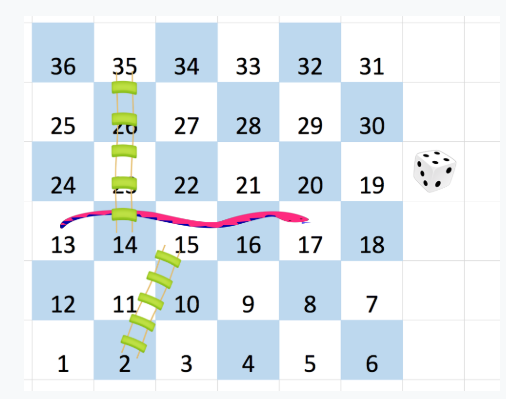
You start from square 1 of the board (which is always in the last row and first column). On each square say 'X', you can throw a dice which can have six outcomes and you have total control over the outcome of dice throw and you want to find out the minimum number of throws required to reach the last cell.
Some of the squares contain Snakes and Ladders, and these are possibilities of a throw at square 'X':
You choose a destination square 'S' with number 'X+1', 'X+2', 'X+3', 'X+4', 'X+5', or 'X+6', provided this number is <= N*N.
If 'S' has a snake or ladder, you move to the destination of that snake or ladder.  Otherwise, you move to S.
A board square on row 'i' and column 'j' has a "Snake or Ladder" if board[i][j] != -1. The destination of that snake or ladder is board[i][j].
Note :
You can only take a snake or ladder at most once per move: if the destination to a snake or ladder is the start of another snake or ladder, you do not continue moving - you have to ignore the snake or ladder present on that square.

For example, if the board is:
-1 1 -1
-1 -1 9
-1 4 -1
Let's say on the first move your destination square is 2  [at row 2, column 1], then you finish your first move at 4 [at row 1, column 2] because you do not continue moving to 9 [at row 0, column 0] by taking the ladder from 4.

A square can also have a Snake or Ladder which will end at the same cell.
For example, if the board is:
-1 3 -1
-1 5 -1
-1 -1 9
Here we can see Snake/Ladder on square 5 [at row 1, column 1] will end on the same square 5.
Problem approach
Implemented this using python dictionary by initiating that with values like {99:3, 10:30} and just generate random number (dice) and 1 to 100 if counter reaches 100 game stops else roll dice and check the number in the dict for snake or ladder.


Here's your problem of the day 
Solving this problem will increase your chance to get selected in this company
Skill covered: Programming
How do you remove whitespace from the start of a string?
Choose another skill to practice
Similar interview experiences
SDE - Intern
4 rounds | 7 problems
Interviewed by Park+
Selected 
3498 views

0 comments

0 upvotes
QA Engineer
3 rounds | 6 problems
Interviewed by Park+
Selected 1356 views
0 comments
0 upvotes
SDE - 1
3 rounds | 7 problems
Interviewed by Park+
Selected 1286 views
0 comments
0 upvotes
SDE - 1
3 rounds | 7 problems
Interviewed by Park+
Rejected
628 views
0 comments
0 upvotes
Companies with similar interview experiences

SDE - Intern
2 rounds | 4 problems
Interviewed by Arcesium
 Selected
 3916 views
0 comments
0 upvotes
SDE - Intern
3 rounds | 5 problems
Interviewed by Arcesium
Selected 2888 views
0 comments
0 upvotes

SDE - Intern
3 rounds | 5 problems
Interviewed by BNY Mellon
 Selected
 2484 views
0 comments
0 upvotes