





PayPal interview experience Real time questions & tips from candidates to crack your interview

Software Engineer
PayPal


4 rounds | 7 Coding
problems

 Selected
 Interview preparation journey

Preparation
Duration: 6 months
Topics: Data Structures, Algorithms, System Design, Aptitude, OOPS

Tip 1 : Must do Previously asked Interview as well as Online Test Questions.
Tip 2 : Go through all the previous interview experiences from Codestudio and Leetcode.
Tip 3 : Do at-least 2 good projects and you must know every bit of them.:
Application process
Where: Campus
Eligibility: Above 7 CGPA
Tip 1 : Have at-least 2 good projects explained in short with all important points covered.
Tip 2 : Every skill must be mentioned.
Tip 3 : Focus on skills, projects and experiences more.

Interview rounds
01
Round
Medium
Online Coding Interview
Duration90 minutes
Interview date2 Dec 2016
Coding problem2
This was an online test for 90 minutes. 2 programming questions and MCQs related to CS fundamentals were asked.
1. Cycle Detection in a Singly Linked List
Moderate
15m average time
80% success

0/80
Asked in companies



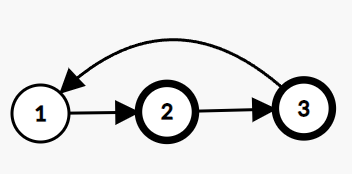
You are given a Singly Linked List of integers. Return true if it has a cycle, else return false.
A cycle occurs when a node's next points back to a previous node in the list.
Example:
In the given linked list, there is a cycle, hence we return true.
Problem approach
Floyd's algorithm can be used to solve this question.
Define two pointers slow and fast. Both point to the head node, fast is twice as fast as slow. There will be no cycle if it reaches the end. Otherwise, it will eventually catch up to the slow pointer somewhere in the cycle.
Let X be the distance from the first node to the node where the cycle begins, and let X+Y be the distance the slow pointer travels. To catch up, the fast pointer must travel 2X + 2Y. L is the cycle size. The total distance that the fast pointer has travelled over the slow pointer at the meeting point is what we call the full cycle.
X+Y+L = 2X+2Y
L=X+Y
Based on our calculation, slow pointer had already traveled one full cycle when it met fast pointer, and since it had originally travelled A before the cycle began, it had to travel A to reach the cycle's beginning!
After the two pointers meet, fast pointer can be made to point to head. And both slow and fast pointers are moved till they meet at a node. The node at which both the pointers meet is the beginning of the loop.
Pseudocode :
detectCycle(Node *head) {
Node *slow=head,*fast=head;
while(slow!=NULL && fast!=NULL && fast->next!=NULL) {
slow = slow->next;
fast = fast->next->next;
if(slow==fast)
{
fast = head;
while(slow!=fast)
{
slow = slow->next;
fast=fast->next;
}
return slow;
}
}
return NULL;
}
2. Palindrome Partitioning ll
Hard
40m average time
60% success
0/120
Asked in companies


You are given a string 'str' of length 'n'.
Find the minimum number of partitions in the string so that no partition is empty and every partitioned substring is a palindrome.
Example :
Input: 'str' = "aaccb"

Output: 2

Explanation: We can make a valid partition like aa | cc | b.
Problem approach
The problem can be solved using recursion. If the given string is a palindrome, 0 cuts are needed. Otherwise, try making cuts at all possible positions and calculate the cost for each cut recursively and take the minimum of all costs.
// i is the starting index and j is the ending index. Initially, i=0 and j=n-1
minCuts(str, i, j) = 0 if i == j // When string is of length 1.
minCuts(str, i, j) = 0 if str[i..j] is palindrome.
// If the above conditions are not true, then minimum cuts needed can be calculated recursively using the following formula.
minCuts(str, i, j) = min { minCuts(str, i, k) + 1 + minCuts(str, k+1, j) } where k varies from i to j-1
The above approach can be optimized using dynamic programming. A 2-d array can be used to store the intermittent results calculated in recursive functions. The time complexity of this approach would be O(N^3).
02
Round
Medium
Face to Face
Duration60 minutes
Interview date2 Dec 2016
Coding problem2
Technical round that lasted for around 60 minutes. The interviewer asked questions related to data structures and algorithms.
1. DFS Traversal
Moderate
35m average time
65% success
0/80
Asked in companies



Given an undirected and disconnected graph G(V, E), containing 'V' vertices and 'E' edges, the information about edges is given using 'GRAPH' matrix, where i-th edge is between GRAPH[i][0] and GRAPH[i][1]. print its DFS traversal.
V is the number of vertices present in graph G and vertices are numbered from 0 to V-1.

E is the number of edges present in graph G.
Note :
The Graph may not be connected i.e there may exist multiple components in a graph.
Problem approach
The DFS algorithm is a recursive algorithm based on the idea of backtracking. It starts with the initial node of the graph G, and then goes to deeper and deeper until we find the goal node or the node which has no children.
Pseudocode :
DFS(G, s):
mark s as visited
for all neighbors v of s in Graph G:
if v is not visited:
DFS-recursive(G, v)
2. Cycle Detection In Undirected Graph
Moderate
0/80
Asked in companies
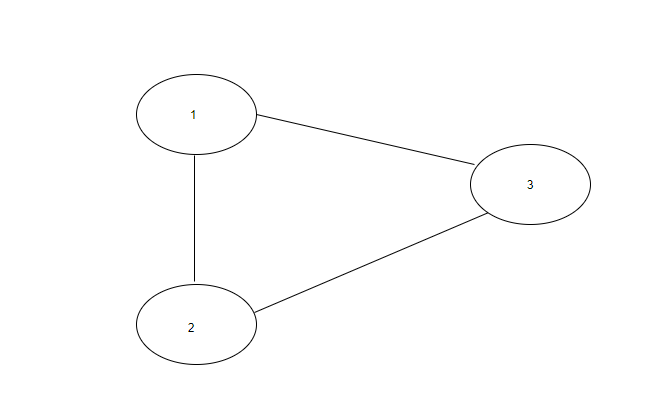
You have been given an undirected graph with 'N' vertices and 'M' edges. The vertices are labelled from 1 to 'N'.
Your task is to find if the graph contains a cycle or not.
A path that starts from a given vertex and ends at the same vertex traversing the edges only once is called a cycle.
Example :
In the below graph, there exists a cycle between vertex 1, 2 and 3.
Note:
1. There are no parallel edges between two vertices.

2. There are no self-loops(an edge connecting the vertex to itself) in the graph.

3. The graph can be disconnected.
For Example :
Input: N = 3 , Edges =  [[1, 2], [2, 3], [1, 3]].
Output: Yes

Explanation : There are a total of 3 vertices in the graph. There is an edge between vertex 1 and 2, vertex 2 and 3 and vertex 1 and 3. So, there exists a cycle in the graph.
Problem approach
DFS can be used to detect cycle in an undirected graph. Do a DFS traversal of the given graph. For every visited vertex ‘v’, if there is an adjacent ‘u’ such that u is already visited and u is not parent of v, then there is a cycle in graph.
If we don’t find such an adjacent for any vertex, we say that there is no cycle.
Pseudocode :
DetectCycle(graph, v, visited[], parent)
{
// mark the current node as visited
visited[v] = true;
// do for every edge (v, w)
for (w: graph[v])
{
// if `w` is not visited yet
if (!visited[w])
{
if (DetectCycle(graph, w, visited, v)) {
return true;
}
}
// if `w` is visited, and `w` is not a parent
else if (w != parent)
{
// back-edge (cycle) found
return true;
}
}
// No back-edges were found in the graph
return false;
}
03
Round
Medium
Face to Face
Duration60 minutes
Interview date2 Dec 2016
Coding problem3
Technical round that lasted for around 60 minutes. The interviewer asked questions related to data structures and algorithms.
1. Merge Sort
Easy
15m average time
85% success
0/40
Asked in companies



Given a sequence of numbers ‘ARR’. Your task is to return a sorted sequence of ‘ARR’ in non-descending order with help of the merge sort algorithm.
Example :
Merge Sort Algorithm -

Merge sort is a Divide and Conquer based Algorithm. It divides the input array into two-parts, until the size of the input array is not ‘1’. In the return part, it will merge two sorted arrays a return a whole merged sorted array.
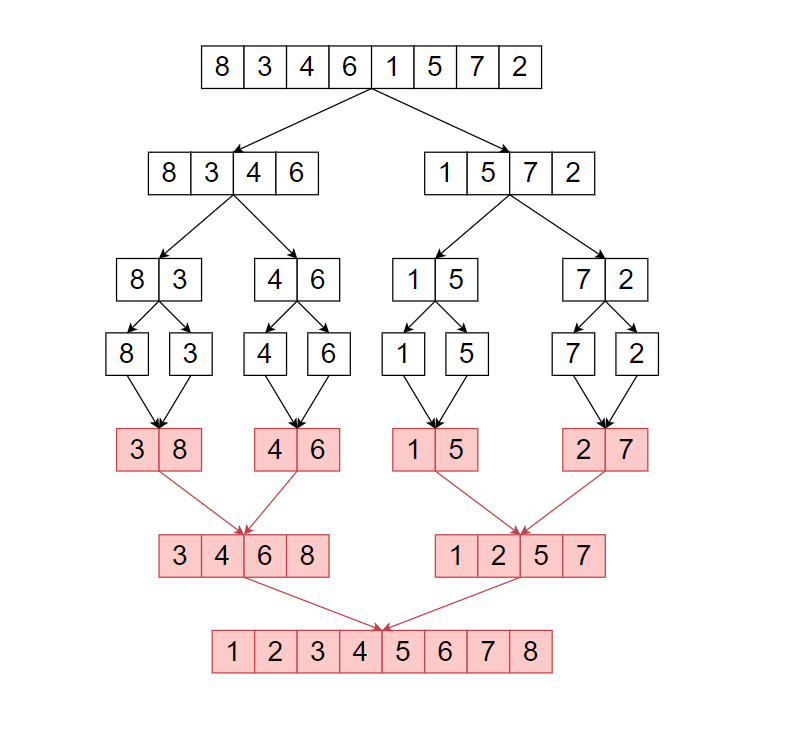
The above illustrates shows how merge sort works.
Note :
It is compulsory to use the ‘Merge Sort’ algorithm.
Problem approach
It works on the principle of Divide and Conquer. Merge sort repeatedly divides the array into several arrays until each array consists of a single element and merging those arrays in a manner that results into a sorted array.
Pseudocode :
MergeSort(A, p, r):
if p > r
return
q = (p+r)/2
mergeSort(A, p, q)
mergeSort(A, q+1, r)
merge(A, p, q, r)
Merge function : The task is to merge two subarrays A[p..q] and A[q+1..r] to create a sorted array A[p..r].
Steps :
Create copies of the subarrays L ← A[p..q] and M ← A[q+1..r].
Create three pointers i, j and k
i indicates current index of L, starting at 1
j indicates current index of M, starting at 1
k indicates the current index of A[p..q], starting at p.
Until we reach the end of either L or M, pick the larger among the elements from L and M and place them in the correct position at A[p..q]
When we run out of elements in either L or M, pick up the remaining elements and put in A[p..q]
Time complexity : O(nlogn)
2. Maximum Difference
Easy
15m average time
85% success
0/40
Asked in companies


You are given an array 'ARR' of the 'N' element. Your task is to find the maximum difference between any of the two elements from 'ARR'.
If the maximum difference is even print “EVEN” without quotes. If the maximum difference is odd print “ODD” without quotes.
For example:
Given 'ARR' = [1, 10, 5, 2, 8, 1 ] , answer is "ODD".
Here the maximum difference is between 10 and 1, 10 - 1 = 9
Problem approach
Recursively call the function and find the maximum number of the submatrix and update the answer for every element of the matrix.
Algorithm:-
- Run a for loop from 0 to N-1 (Let’s say the iterator be i).
- Run a nested for loop from 0 to N-1 (Let’s say the iterator be j).
- Recursively find the answer of submatrix with top-left corner (i+1, j+1).
- If i+1== N or j+1== N return -infinity.
- Update answer as maximum of answer and maximum value in the submatrix with top-left corner (i,j)- MAT[i][j].
- Recursively find the answer of submatrix with top-left corner (i+1, j+1).
- Run a nested for loop from 0 to N-1 (Let’s say the iterator be j).
- Print the answer found.
3. Technical Question
What is hashing and how can it be implemented?
Problem approach
Hashing is a technique of mapping keys, values into the hash table by using a hash function. It is done for faster access to elements.
Hashing is implemented in two steps:
An element is converted into an integer by using a hash function. This element is used as an index to store the original element, which falls into the hash table.
The element is stored in the hash table where it can be quickly retrieved using hashed key.
hash = hashfunc(key)
index = hash % array_size
04
Round
Easy
HR Round
Duration30 minutes
Interview date2 Dec 2016
Coding problem0
1. Questions related to to resume
2. Why do you want to join in PayPal?
3. Explain anything whatever you learned recently?


Here's your problem of the day 
Solving this problem will increase your chance to get selected in this company
Skill covered: Programming
How do you remove whitespace from the start of a string?
Choose another skill to practice
Similar interview experiences
Software Engineer
2 rounds | 3 problems
Interviewed by PayPal
 Selected
3218 views

0 comments

0 upvotes
Software Engineer
3 rounds | 6 problems
Interviewed by PayPal
Rejected
2470 views
0 comments
0 upvotes
Software Engineer
3 rounds | 5 problems
Interviewed by PayPal
 Selected
 3780 views
0 comments
0 upvotes
Software Engineer
3 rounds | 4 problems
Interviewed by PayPal
 Selected
 6480 views
0 comments
0 upvotes
Companies with similar interview experiences

Software Engineer
3 rounds | 7 problems
Interviewed by Optum
 Selected
 7976 views
1 comments
0 upvotes

Software Engineer
5 rounds | 5 problems
Interviewed by Microsoft
 Selected
 10148 views
1 comments
0 upvotes
Software Engineer
2 rounds | 4 problems
Interviewed by Amazon
Selected 4448 views
1 comments
0 upvotes