





PayPal interview experience Real time questions & tips from candidates to crack your interview

Software Developer
PayPal


2 rounds | 4 Coding
problems

 Selected
 Interview preparation journey

Preparation
Duration: 6 months
Topics: Data Structures, Algorithms, System Design, Aptitude, OOPS

Tip 1 : Must do Previously asked Interview as well as Online Test Questions.
Tip 2 : Go through all the previous interview experiences from Codestudio and Leetcode.
Tip 3 : Do at-least 2 good projects and you must know every bit of them.
Application process
Where: Campus
Eligibility: Above 7 CGPA
Tip 1 : Have at-least 2 good projects explained in short with all important points covered.
Tip 2 : Every skill must be mentioned.
Tip 3 : Focus on skills, projects and experiences more.

Interview rounds
01
Round
Easy
Face to Face
Duration60 minutes
Interview date12 Dec 2016
Coding problem2
I couldn't find an optimal approach to the first question, so she skipped that question and proceeded to next questions. Remaining questions I have answered satisfactorily.
1. Subset Sum Equal To K
Moderate
30m average time
65% success

0/80
Asked in companies



You are given an array/list ‘ARR’ of ‘N’ positive integers and an integer ‘K’. Your task is to check if there exists a subset in ‘ARR’ with a sum equal to ‘K’.
Note: Return true if there exists a subset with sum equal to ‘K’. Otherwise, return false.
For Example :
If ‘ARR’ is {1,2,3,4} and ‘K’ = 4, then there exists 2 subsets with sum = 4. These are {1,3} and {4}. Hence, return true.
Problem approach
The brute force approach is to use recursion. Generate all subsets and count the number of subsets with sum as 0. The time complexity of this approach would be exponential (2^n).
Dynamic programming can be used to optimize the above solution.
For every index i, we have two options, to include it in the sum or leave it. Suppose the sum of the elements we've chosen up to index 'i-1' is 'S'. From index ‘i’, we need to compute the number of subsets of the sub-array [i, N-1] whose sum equals -S.
dp[i][S] is defined as follows : the number of the subset of the subarray[i, N-1] with sum equal to '-S'.
Therefore, following recurrence relation can be used : dp[i][s] = dp[i+1][s+arr[i]] + dp[i+1][s]
2. BFS in Graph
Easy
10m average time
90% success
0/40
Asked in companies



Given an adjacency list representation of a directed graph with ‘n’ vertices and ‘m’ edges. Your task is to return a list consisting of Breadth-First Traversal (BFS) starting from vertex 0.
In this traversal, one can move from vertex 'u' to vertex 'v' only if there is an edge from 'u' to 'v'. The BFS traversal should include all nodes directly or indirectly connected to vertex 0.
Note:
The traversal should proceed from left to right according to the input adjacency list.
Example:
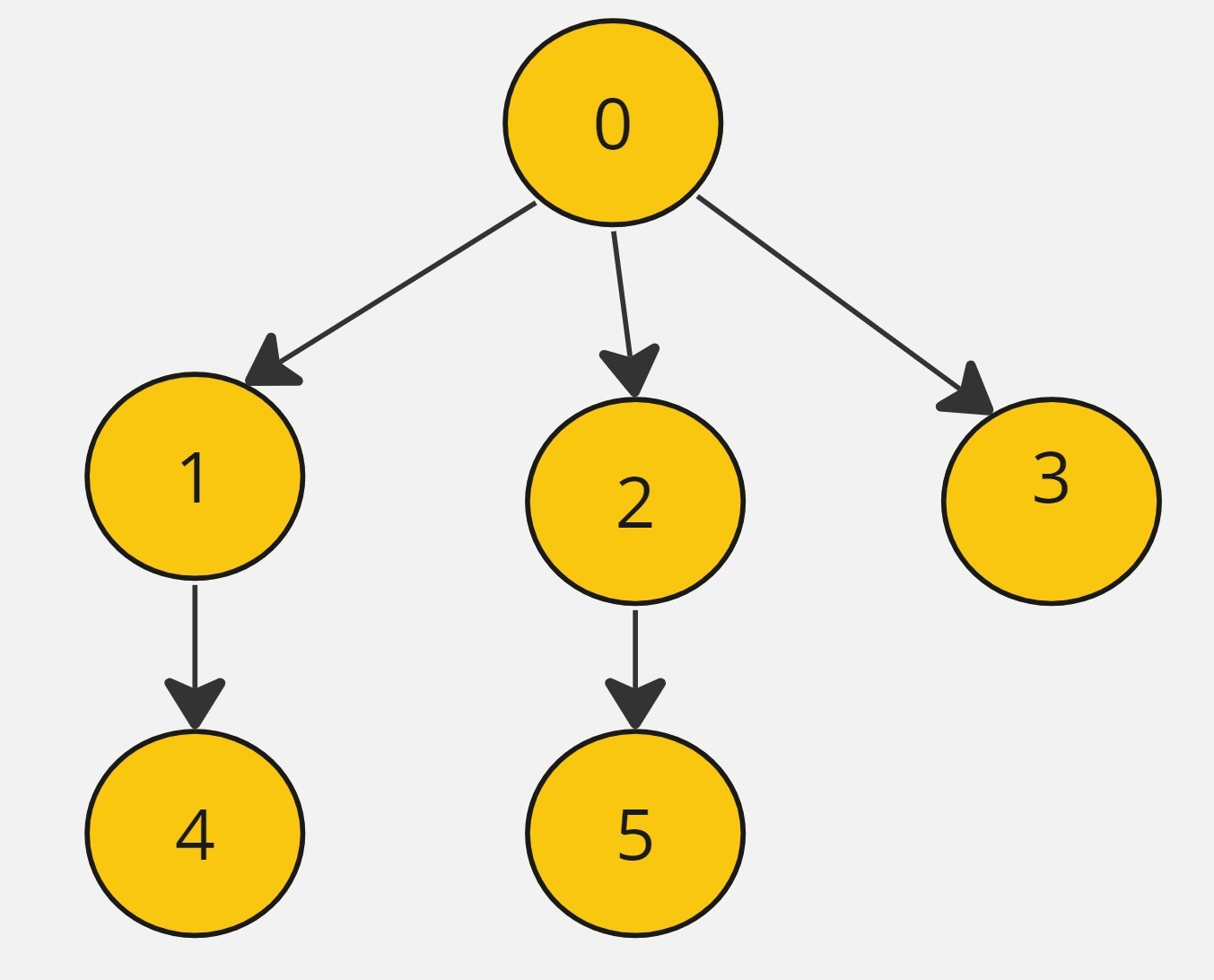
Adjacency list: { {1,2,3},{4}, {5}, {},{},{}}

The interpretation of this adjacency list is as follows:
Vertex 0 has directed edges towards vertices 1, 2, and 3.
Vertex 1 has a directed edge towards vertex 4.
Vertex 2 has a directed edge towards vertex 5.
Vertices 3, 4, and 5 have no outgoing edges.

We can also see this in the diagram below.

BFS traversal: 0 1 2 3 4 5
Problem approach
BFS is a traversing algorithm we start traversing from a selected node (starting node) and traverse the graph layer wise thus exploring the neighbor nodes (nodes which are directly connected to source node). And then move towards the next-level neighbor nodes.
Pseudocode :
BFS (G, s)
Q.push( s ) //Inserting s in queue Q until all its neighbor vertices are marked.
mark s as visited.
while ( Q is not empty)
//Removing that vertex from queue, whose neighbor will be visited now
u = Q.pop( )
//processing all the neighbors of u
for all neighbors v of u in Graph G
if v is not visited
Q.push( v ) //Stores v in Q to further visit its neighbor
mark w as visited.
02
Round
Easy
HR Round
Duration60 minutes
Interview date12 Dec 2016
Coding problem2
I told that my strength is problem solving and I can always find a way when there is a bottle-neck. Gave some examples of my experiences while doing my assignments.
1. Replace Spaces
Easy
15m average time
85% success
0/40
Asked in companies

You have been given a string 'STR' of words. You need to replace all the spaces between words with “@40”.
Problem approach
One approach could be to calculate the number of spaces in the given string. Calculate the new length of the string as original length + 2*(number of spaces). Create a new string of the length calculated. Traverse the original string and keep appending all characters except spaces in the new string. As soon as a space is encountered, append '%20' in the string. Return the new string created.
2. Basic HR Questions
1. Project Discussion
2. Strengths and weaknesses. Where do you see yourself in 5 years?
Problem approach
Tip 1 : The cross questioning can go intense some time, think before you speak.
Tip 2 : Be open minded and answer whatever you are thinking, in these rounds I feel it is important to have opinion.
Tip 3 : Context of questions can be switched, pay attention to the details. It is okay to ask questions in these round, like what are the projects currently the company is investing, which team you are mentoring. How all is the work environment etc.
Tip 4 : Since everybody in the interview panel is from tech background, here too you can expect some technical questions. No coding in most of the cases but some discussions over the design can surely happen.


Here's your problem of the day 
Solving this problem will increase your chance to get selected in this company
Skill covered: Programming
How do you remove whitespace from the start of a string?
Choose another skill to practice
Similar interview experiences
Software Engineer
4 rounds | 7 problems
Interviewed by PayPal
Selected 
1448 views

0 comments

0 upvotes
SDE - 1
2 rounds | 4 problems
Interviewed by PayPal
Rejected
1709 views
0 comments
0 upvotes
SDE - Intern
2 rounds | 4 problems
Interviewed by PayPal
 Selected
 5017 views
0 comments
0 upvotes
SDE - 2
2 rounds | 4 problems
Interviewed by PayPal
 Selected
 1002 views
0 comments
0 upvotes
Companies with similar interview experiences
Software Developer
5 rounds | 14 problems
Interviewed by Microsoft
 Selected
 4029 views
1 comments
0 upvotes

Software Developer
6 rounds | 12 problems
Interviewed by SAP Labs
Selected 2912 views
0 comments
0 upvotes
Software Developer
3 rounds | 3 problems
Interviewed by Amazon
 Selected
 1270 views
0 comments
0 upvotes