





Paytm (One97 Communications Limited) interview experience Real time questions & tips from candidates to crack your interview

SDE - 1
Paytm (One97 Communications Limited)


3 rounds | 10 Coding
problems

 Selected
 Interview preparation journey

Preparation
Duration: 1 Month
Topics: Data structures, Algorithms, System Design, OOP concepts, DBMS, OS

Tip 1 : Paytm focused on core CSE concepts. Make sure to revise DBMS, OS and Computer Networks
Tip 2 : Read basics of system design even for SDE-1 round. Though it's not a dedicated interview round but Hiring Manager generally asks questions around the same. So be prepared
Application process
Where: Referral
Eligibility: No criteria
Tip 1 : Mention only those skills on your resume in which you are confident as there will be questions around the same
Tip 2 : Keep your resume of Max 1 page and include only the information relevant to software developer role.
Interview rounds
01
Round
Easy
Online Coding Interview
Duration60 Minutes
Interview date4 Jun 2021
Coding problem6
There were mostly MCQ questions from OOP concepts, DBMS, OS and Computer Networks. One coding problem was also there
1. DBMS Questions
There were questions regarding SQL queries, ACID properties in DBMS and Normalisation forms specially 3NF and BCNF.
Problem approach
Tip 1 : Practice SQL queries thoroughly specially JOINS and read the theory of DBMS
2. OS Questions
Questions were around
1. memory management
2. paging
3. CPU scheduling (numerical questions) like First come First serve, Round Robin scheduling etc.
Problem approach
Tip 1 : Read Galvin book for Operating systems and try covering the entire range of topics.
Tip 2 : Deadlocks and semaphore is also an important topic which wasn't covered in this round but I got a question during the interview.
3. Networking Questions
Questions were around
1. TCP vs UDP
2. DNS system
3. SMTP SNMP protocol.
Problem approach
Tip 1 : Read book Computer Networks: A Top Down Approach by Kurose and Ross
4. OOPS Questions
Questions were around
1. Java memory management,
2. Garbage collection,
3. a few code snippets asking the output of a code,
4. polymorphism,
5. thread synchronisation - theory as well as 1 code snippet.
Problem approach
Tip 1 : Always revise OOP concepts for the online round. Generally they hold a good weightage.
Tip 2 : Understand the basic theory behind every concept.
5. Technical Questions
Questions were around
1. unordered map vs map,
2. asymptomatic complexities of a few code snippets,
3. DFS vs BFS in a graph,
4. order of complexity for different sorting techniques like bubble sort merge sort etc.
Problem approach
Tip 1 : Revise all the basic algorithms and their asymptomatic complexities. Try creating a tabular sheet and write all those. It will help in revising and comparing different complexities easily
6. Diameter Of Binary Tree
Easy
10m average time
90% success

0/40
Asked in companies


You are given a Binary Tree.
Return the length of the diameter of the tree.
Note :
The diameter of a binary tree is the length of the longest path between any two end nodes in a tree.

The number of edges between two nodes represents the length of the path between them.
Example :
Input: Consider the given binary tree:
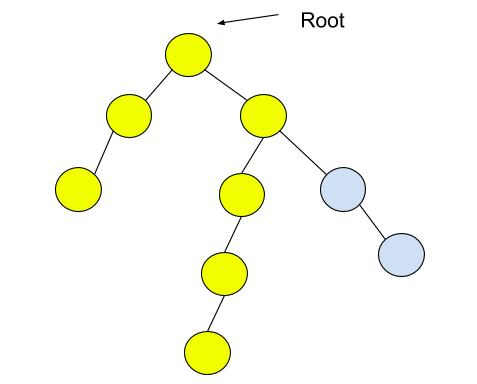
Output: 6

Explanation:
Nodes in the diameter are highlighted. The length of the diameter, i.e., the path length, is 6.
Problem approach
I explained my approach first. Since we ned to consider 2 end nodes, so those 2 end nodes could both lie in the left sub-tree, or the right sub-tree or 1 of them in either of the trees.
So the solution would be the maximum of the following:
1. the diameter of input tree's left subtree.
2. the diameter of input tree's right subtree.
3. the longest path between nodes that pass through the root of the input tree.
I used recursion to solve the problem.
02
Round
Easy
Video Call
Duration60 Minutes
Interview date4 Jun 2021
Coding problem2
This round focused on majorly problem solving, data structures and few theoretical questions related to OOP and basic CS fundamentals.
1. Minimum Cost Path
Moderate
25m average time
70% success
0/80
Asked in companies



You have been given a matrix of ‘N’ rows and ‘M’ columns filled up with integers. Find the minimum sum that can be obtained from a path which from cell (x,y) and ends at the top left corner (1,1).
From any cell in a row, we can move to the right, down or the down right diagonal cell. So from a particular cell (row, col), we can move to the following three cells:
Down: (row+1,col)
Right: (row, col+1)
Down right diagonal: (row+1, col+1)
Problem approach
I started thinking in the direction that there can be multiple ways to reach the last cell, so I need to find the minimum of all these possible ways.
Now the idea here is to think about the problem recursively and try to break it into smaller problems. This means that the problem can be broken down into smaller, simple sub-problems until we reach a base condition.
I used Dynamic Programming to solve this.
So Cost to reach cell (m, n) = cost[m][n] + min (cost to reach cell (m, n-1), cost to reach cell (m, n-1) )
2. Java Questions
Questions were around:
1. Explain abstraction and encapsulation with an example
2. What are design patterns? There was a small discussion around Builder Design Pattern
3. How hashmap internally works?
4. What are singleton classes? How can we make a class as singleton
Problem approach
Tip 1 : Revise basic JAVA concepts if you're applying for an SDE role.
Tip 2 : Even if the interview is for SDE-1 which is not design round specific, have a basic understanding of how systems are designed and what all terminologies are there e.g. load balancer, horizontal-vertical scaling etc.
03
Round
Easy
Video Call
Duration45 minutes
Interview date7 Jun 2021
Coding problem2
This was the hiring manager round. There were no technical coding based questions particularly. Only a few theoretical CS fundamentals and Java based questions and a few behavioural questions.
1. Basic HR Questions
1. Was there any instance when you had to incorporate last minute changes as per customer requirement. How did you handle it?
2. Why do you want to join Paytm?
3. Was there any situation when you had to take up some challenges outside of your domain?
4. Tell any one strength and one area of improvement
Problem approach
Tip 1 : Always be prepared to get such questions specially in HM round and answer them with honesty.
Tip 2 : Don't sound robotic, try explaining every point with real life examples maybe from your previous organisation or college projects/activities.
2. Java Questions
1. Difference between equals and == operator in Java
2. Why string in Java is immutable
3. What are checked and unchecked exceptions with example.
Problem approach
Tip 1 : Always revise Java basic fundamentals if applying for SDE backend/ full stack role


Here's your problem of the day 
Solving this problem will increase your chance to get selected in this company
Skill covered: Programming
To make an AI less repetitive in a long paragraph, you should increase:
Choose another skill to practice
Similar interview experiences
SDE - 1
2 rounds | 3 problems
Interviewed by Paytm (One97 Communications Limited)
Selected 
923 views

0 comments

0 upvotes
SDE - 1
2 rounds | 5 problems
Interviewed by Paytm (One97 Communications Limited)
Rejected
716 views
0 comments
0 upvotes
SDE - 1
3 rounds | 10 problems
Interviewed by Paytm (One97 Communications Limited)
Rejected
541 views
0 comments
0 upvotes
SDE - 1
3 rounds | 8 problems
Interviewed by Paytm (One97 Communications Limited)
Selected 521 views
0 comments
0 upvotes
Companies with similar interview experiences

SDE - 1
5 rounds | 12 problems
Interviewed by Amazon
 Selected
 114453 views
24 comments
0 upvotes

SDE - 1
4 rounds | 5 problems
Interviewed by Microsoft
Selected 57719 views
5 comments
0 upvotes
SDE - 1
3 rounds | 7 problems
Interviewed by Amazon
 Selected
 34914 views
7 comments
0 upvotes