





Paytm (One97 Communications Limited) interview experience Real time questions & tips from candidates to crack your interview

Backend Developer
Paytm (One97 Communications Limited)


1 rounds | 2 Coding
problems

Rejected
Interview preparation journey

Preparation
Duration: 5 months
Topics: Data Structures, Algorithms, System Design, Aptitude, OOPS

Tip 1 : Must do Previously asked Interview as well as Online Test Questions.
Tip 2 : Go through all the previous interview experiences from Codestudio and Leetcode.
Tip 3 : Do at-least 2 good projects and you must know every bit of them.
Application process
Where: Other
Eligibility: Above 7 CGPA
Tip 1 : Have at-least 2 good projects explained in short with all important points covered.
Tip 2 : Every skill must be mentioned.
Tip 3 : Focus on skills, projects and experiences more.
Interview rounds
01
Round
Easy
Video Call
Duration60 minutes
Interview date11 Jan 2021
Coding problem2
Technical Interview round with 2 DSA problems.
1. Detect cycle in undirected graph
Moderate

0/80
Asked in companies



You have been given an undirected graph with 'N' vertices and 'M' edges. The vertices are labelled from 1 to 'N'.
Your task is to find if the graph contains a cycle or not.
A path that starts from a given vertex and ends at the same vertex traversing the edges only once is called a cycle.
Example :
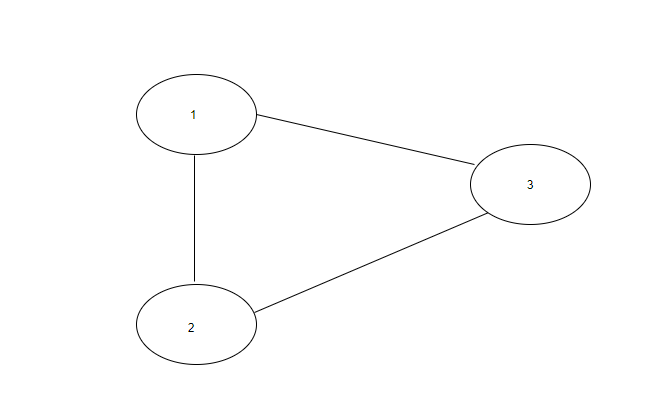
In the below graph, there exists a cycle between vertex 1, 2 and 3.
Note:
1. There are no parallel edges between two vertices.

2. There are no self-loops(an edge connecting the vertex to itself) in the graph.

3. The graph can be disconnected.
For Example :
Input: N = 3 , Edges =  [[1, 2], [2, 3], [1, 3]].
Output: Yes

Explanation : There are a total of 3 vertices in the graph. There is an edge between vertex 1 and 2, vertex 2 and 3 and vertex 1 and 3. So, there exists a cycle in the graph.
Problem approach
DFS can be used to detect cycle in an undirected graph. Do a DFS traversal of the given graph. For every visited vertex ‘v’, if there is an adjacent ‘u’ such that u is already visited and u is not parent of v, then there is a cycle in graph.
If we don’t find such an adjacent for any vertex, we say that there is no cycle.
Pseudocode :
DetectCycle(graph, v, visited[], parent)
{
	// mark the current node as visited
	visited[v] = true;
	// do for every edge (v, w)
	for (w: graph[v])
	{
		// if `w` is not visited yet
		if (!visited[w])
		{
			if (DetectCycle(graph, w, visited, v)) {
				return true;
			}
		}
		// if `w` is visited, and `w` is not a parent
		else if (w != parent)
		{
			// back-edge (cycle) found
			return true;
		}
	}
	// No back-edges were found in the graph
	return false;
}2. Zig-Zag Tree Traversal
Easy
10m average time
90% success
0/40
Asked in companies


You are given a ‘Binary Tree’.
Return the level-order traversal of the Binary Tree.
Example:
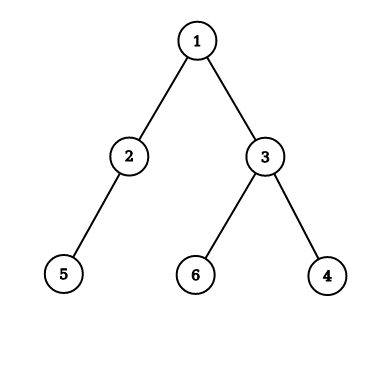
Input: Consider the following Binary Tree:
Output:
Following is the level-order traversal of the given Binary Tree: [1, 2, 3, 5, 6, 4]
Problem approach
This problem can be solved using two stacks.
Assume the two stacks are current: currentlevel and nextlevel. We would also need a variable to keep track of the current level order(whether it is left to right or right to left). We pop from the currentlevel stack and print the nodes value. Whenever the current level order is from left to right, push the nodes left child, then its right child to the stack nextlevel.
Since a stack is a LIFO(Last-In-First_out) structure, next time when nodes are popped off nextlevel, it will be in the reverse order. On the other hand, when the current level order is from right to left, we would push the nodes right child first, then its left child. Finally, do-not forget to swap those two stacks at the end of each level(i.e., when current level is empty)


Here's your problem of the day 
Solving this problem will increase your chance to get selected in this company
Skill covered: Programming
To make an AI less repetitive in a long paragraph, you should increase:
Choose another skill to practice
Similar interview experiences
Backend Developer
3 rounds | 5 problems
Interviewed by Paytm (One97 Communications Limited)
Rejected

0 views

0 comments

0 upvotes
Backend Developer
2 rounds | 3 problems
Interviewed by Paytm (One97 Communications Limited)
Rejected
563 views
0 comments
0 upvotes
Backend Developer
2 rounds | 3 problems
Interviewed by Paytm (One97 Communications Limited)
Rejected
646 views
0 comments
0 upvotes
SDE - 1
3 rounds | 8 problems
Interviewed by Paytm (One97 Communications Limited)
 Selected
 522 views
0 comments
0 upvotes