





Paytm (One97 Communications Limited) interview experience Real time questions & tips from candidates to crack your interview

SDE - 1
Paytm (One97 Communications Limited)


3 rounds | 7 Coding
problems

 Selected
 Interview preparation journey

Journey
I am a 2022 graduate of GGSIPU. In the initial years, my goal was to fill up my resume. So, in my second and third year, I worked with three startups, primarily as a full-stack developer. However, I hadn't put much effort into data structures and algorithms. I only knew basic STL in C++. Companies came and I wasn't even able to get through OAs. In the 7th semester, I started going through some DSA questions. By the end of the 7th semester, I had a decent package from Hitachi Vantara; since this was a service-based company, I kept looking for opportunities. 8th semester started, and I was confident with the DSA concepts, rigorously applying in Product based companies. In the mid of the 8th semester, in march 2022, I had my offer from Paytm.
Application story
Prepared the resume, Highlighted the appropriate skills required for the position. Shared the resume with several working employees of the company. One of them referred me for the role. Got a mail that I had been referred for the role, along with the next steps to be followed.
Why selected/rejected for the role?
I was selected. The interviewer was impressed with the work I had done in my internships and understanding of the frameworks I had used in those internships.
Preparation
Duration: 3 months
Topics: OOPS, DBMS, Data Structures, Algorithms, Networking

Tip 1 : Go through the basic data struuctures :- arrays, linkedlLst, String, Stack, Queue
Tip 2 : Go through the company specific questions before the interview.
Tip 3 : Have 2-3 projects or internships in your resume to talk about.
Application process
Where: Referral
Eligibility: 7 CGPA
Tip 1: Highlight the relevant key skills on your resume.
Tip 2: Be thorough with anything you write in your resume.
Interview rounds
01
Round
Medium
Online Coding Test
Duration45 minutes
Interview date5 Mar 2022
Coding problem3
The test was taken in the afternoon. It consisted of 3 questions, easy-medium level. Time given was 45 minutes.
1. Binary Tree Pruning
Moderate
20m average time
80% success

0/80
Asked in companies



You have been given a Binary Tree where the value of each node is either 0 or 1. Your task is to return the same Binary Tree but all of its subtrees that don't contain a 1 have been removed.
Note :
A subtree of a node X is X, plus every node that is a descendant of X.
For Example :
Look at the below example to see a Binary Tree pruning.
Input: [1, 1, 1, 0, 1, 0, 1, 0, 0, -1, -1, -1, -1, -1, -1, -1, -1, -1, -1]
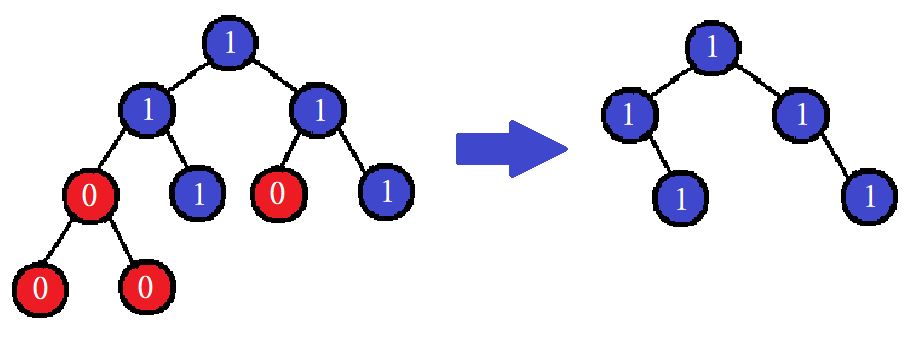
Output: [1, 1, 1, -1, 1, -1, 1, -1, -1, -1, -1]

For example, the input for the tree depicted in the below image would be :
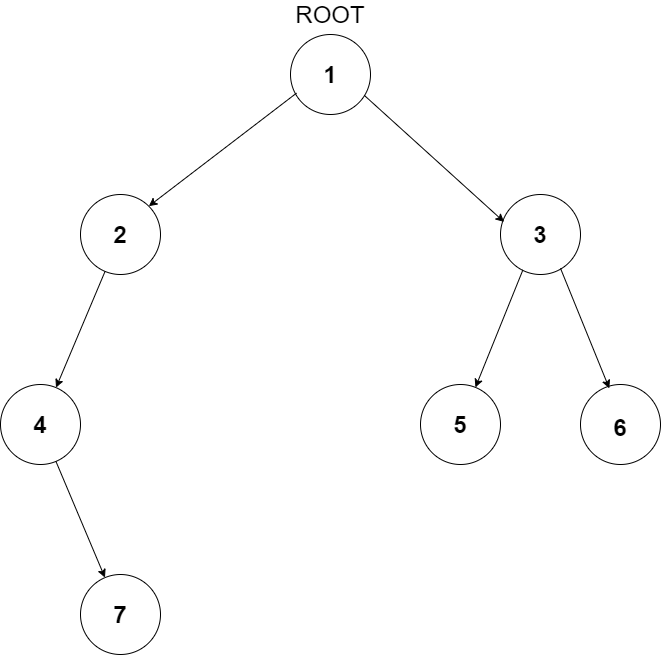
1
2 3
4 -1 5 6
-1 7 -1 -1 -1 -1
-1 -1
Explanation :
Level 1 :
The root node of the tree is 1

Level 2 :
Left child of 1 = 2
Right child of 1 = 3

Level 3 :
Left child of 2 = 4
Right child of 2 = null (-1)
Left child of 3 = 5
Right child of 3 = 6

Level 4 :
Left child of 4 = null (-1)
Right child of 4 = 7
Left child of 5 = null (-1)
Right child of 5 = null (-1)
Left child of 6 = null (-1)
Right child of 6 = null (-1)

Level 5 :
Left child of 7 = null (-1)
Right child of 7 = null (-1)

The first not-null node (of the previous level) is treated as the parent of the first two nodes of the current level. The second not-null node (of the previous level) is treated as the parent node for the next two nodes of the current level and so on.
The input ends when all nodes at the last level are null (-1).
Note :
The above format was just to provide clarity on how the input is formed for a given tree.

The sequence will be put together in a single line separated by a single space. Hence, for the above-depicted tree, the input will be given as:
1 2 3 4 -1 5 6 -1 7 -1 -1 -1 -1 -1 -1
2. Reverse List In K Groups
Hard
15m average time
85% success
0/120
Asked in companies



You are given a linked list of 'n' nodes and an integer 'k', where 'k' is less than or equal to 'n'.
Your task is to reverse the order of each group of 'k' consecutive nodes, if 'n' is not divisible by 'k', then the last group of nodes should remain unchanged.
For example, if the linked list is 1->2->3->4->5, and 'k' is 3, we have to reverse the first three elements, and leave the last two elements unchanged. Thus, the final linked list being 3->2->1->4->5.
Implement a function that performs this reversal, and returns the head of the modified linked list.
Example:
Input: 'list' = [1, 2, 3, 4], 'k' = 2

Output: 2 1 4 3

Explanation:
We have to reverse the given list 'k' at a time, which is 2 in this case. So we reverse the first 2 elements then the next 2 elements, giving us 2->1->4->3.
Note:
All the node values will be distinct.
3. Next Greater Element
Easy
10m average time
90% success
0/40
Asked in companies


You are given an array 'a' of size 'n'.
Print the Next Greater Element(NGE) for every element.
The Next Greater Element for an element 'x' is the first element on the right side of 'x' in the array, which is greater than 'x'.
If no greater elements exist to the right of 'x', consider the next greater element as -1.
For example:
Input: 'a' = [7, 12, 1, 20]

Output: NGE = [12, 20, 20, -1]

Explanation: For the given array,

- The next greater element for 7 is 12.

- The next greater element for 12 is 20.

- The next greater element for 1 is 20.

- There is no greater element for 20 on the right side. So we consider NGE as -1.
02
Round
Medium
Face to Face
Duration45 minutes
Interview date7 Mar 2022
Coding problem3
This round was involved questions on data structures, DBMS and some simple REACT based questions since I had mentioned a REACT internship on my resume.
1. Merge Sort
Easy
15m average time
85% success
0/40
Asked in companies



Given a sequence of numbers ‘ARR’. Your task is to return a sorted sequence of ‘ARR’ in non-descending order with help of the merge sort algorithm.
Example :
Merge Sort Algorithm -

Merge sort is a Divide and Conquer based Algorithm. It divides the input array into two-parts, until the size of the input array is not ‘1’. In the return part, it will merge two sorted arrays a return a whole merged sorted array.
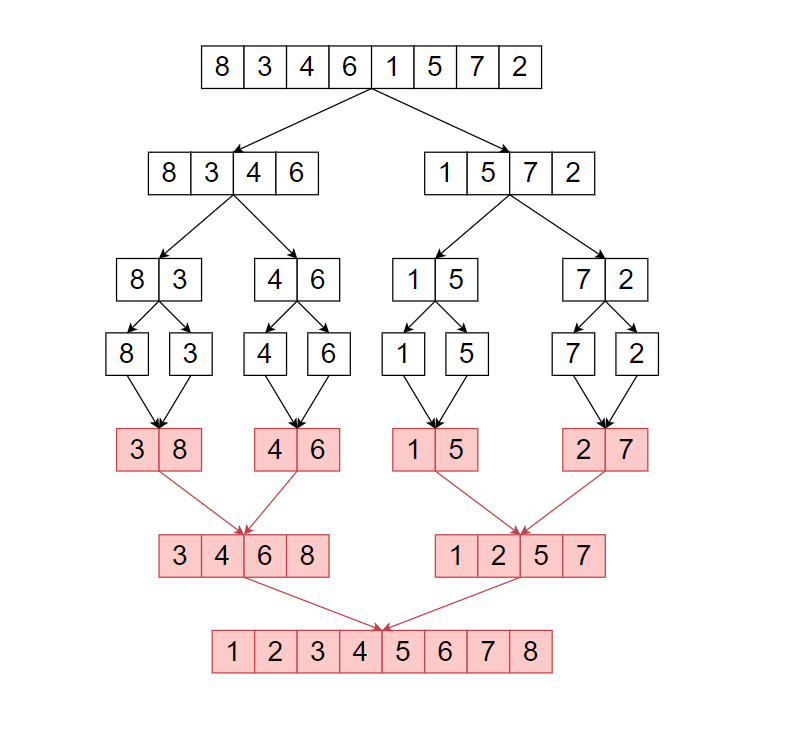
The above illustrates shows how merge sort works.
Note :
It is compulsory to use the ‘Merge Sort’ algorithm.
Problem approach
Discussed complexities, write the code for merge sort.
2. DBMS Question
Asked me to write a join query based on a problem statement. Do not remember it.
3. Detect And Remove Cycle
Easy
10m average time
90% success
0/40
Asked in companies


You have been given a Singly Linked List of integers, determine if it forms a cycle or not. If there is a cycle, remove the cycle and return the list.
A cycle occurs when a node's ‘next’ points back to a previous node in the list.
03
Round
Medium
Face to Face
Duration45 mins
Interview date7 Mar 2022
Coding problem1
I came in prepared for data structures. After a simple DSA question on tree traversal the interviewer threw me off guard with a system design problem instead.
1. Design Question
Design a parking lot.
Problem approach
Tip 1: Since I was a fresher, i didnt have much clue about this. I created classes that would be required to create specific features.
Tip 2: He asked me the kind of data structures I would need for specific situations for which I gave a solution involving dequeue.
Tip 3: This kind of interview is just to put you in a bit of pressure and see if you can come up with some rough solution to the problem at hand. He may not expect a complete and perfect solution from a frsher.


Here's your problem of the day 
Solving this problem will increase your chance to get selected in this company
Skill covered: Programming
To make an AI less repetitive in a long paragraph, you should increase:
Choose another skill to practice
Similar interview experiences
SDE - 1
2 rounds | 3 problems
Interviewed by Paytm (One97 Communications Limited)
Selected 
923 views

0 comments

0 upvotes
SDE - 1
2 rounds | 5 problems
Interviewed by Paytm (One97 Communications Limited)
Rejected
716 views
0 comments
0 upvotes
SDE - 1
3 rounds | 10 problems
Interviewed by Paytm (One97 Communications Limited)
Rejected
542 views
0 comments
0 upvotes
SDE - 1
3 rounds | 8 problems
Interviewed by Paytm (One97 Communications Limited)
Selected 522 views
0 comments
0 upvotes
Companies with similar interview experiences
SDE - 1
5 rounds | 12 problems
Interviewed by Amazon
 Selected
 114453 views
24 comments
0 upvotes
SDE - 1
4 rounds | 5 problems
Interviewed by Microsoft
Selected 57719 views
5 comments
0 upvotes
SDE - 1
3 rounds | 7 problems
Interviewed by Amazon
 Selected
 34914 views
7 comments
0 upvotes