





Paytm (One97 Communications Limited) interview experience Real time questions & tips from candidates to crack your interview

Software Engineer
Paytm (One97 Communications Limited)


4 rounds | 7 Coding
problems

 Selected
 Interview preparation journey

Journey
I started with DSA first. I was not consistent initially, but in my seventh semester, I started practising DSA on a regular basis. I maintained a streak of 10-15 questions daily. In my last semester, I learnt web development and did some projects as well that helped me enhance my resume. Finally, I was ready to apply in different companies for placements.
Application story
This company visited our campus for placement. It first did the shortlisting based on resume and CGPA. After that, an online assessment was conducted, and on that basis, 20 candidates were shortlisted for further rounds.
Why selected/rejected for the role?
I gave correct and optimized solutions for almost all the questions that were asked in the coding rounds. I also built the optimal solution starting from the brute force algorithm which also added to my points. Communication is key to selection.
Preparation
Duration: 4 months
Topics: Data Structures, Algorithms, C++ , System Design, DBMS, OOPs

Tip 1 : Always remember that question-solving is not everything in the interview, it's part of the interview. Communicating well with the interviewer is the most essential thing during the interview.
Tip 2 : Practice a lot of Data Structures and Algorithms based questions that I have practiced from Coding Ninjas and on other coding portals.
Application process
Where: Campus
Eligibility: 7.5 CGPA
Mention good projects and only those skills in which you are confident.
Interview rounds
01
Round
Hard
Online Coding Test
Duration180 minutes
Interview date11 Nov 2021
Coding problem1
This round was very important and tough too as only one coding question was there and we have to code within 3 hours.
1. Colorful Knapsack
Hard
45m average time

0/120
Asked in companies


You are given 'N' stones labeled from 1 to 'N'. The 'i-th' stone has the weight W[i]. There are 'M' colors labeled by integers from 1 to 'M'. The 'i-th' stone has the color C[i] which is an integer between 1 to 'M', both inclusive.
You have been required to fill a Knapsack with these stones. The Knapsack can hold a total weight of 'X'.
You are required to select exactly 'M' stones; one of each color. The sum of the weights of the stones must not exceed 'X'. Since you paid a premium for a Knapsack with capacity 'X', you are required to fill the Knapsack as much as possible.
Write a program to calculate the best way to fill the Knapsack - that is, the unused capacity should be minimized.
Problem approach
This was solved by me through dynamic programming. Let dp[i][j] denote the maximum possible weight you can fill in the bag with a total capacity of j using exactly one stone of each color from 1 to i. Now you can club all same-colored stones in a vector. Then this problem is same as the classical knapsack problem and I passed all test cases and was selected for the next round.
02
Round
Medium
Face to Face
Duration40 minutes
Interview date12 Nov 2020
Coding problem2
1. Longest Increasing Subsequence
Moderate
30m average time
65% success
0/80
Asked in companies



For a given array with N elements, you need to find the length of the longest subsequence from the array such that all the elements of the subsequence are sorted in strictly increasing order.
Strictly Increasing Sequence is when each term in the sequence is larger than the preceding term.
For example:
[1, 2, 3, 4] is a strictly increasing array, while [2, 1, 4, 3] is not.
Problem approach
Firstly I gave a recursion approach but then the interviewer asked me to optimize that so I gave him a standard DP approach for the longest increasing subsequences by storing the result and use them for future calculations of a bigger problem.
2. Top View Of Binary Tree
Moderate
25m average time
70% success
0/80
Asked in companies



You are given a Binary Tree of 'n' nodes.
The Top view of the binary tree is the set of nodes visible when we see the tree from the top.
Find the top view of the given binary tree, from left to right.
Example :
Input: Let the binary tree be:
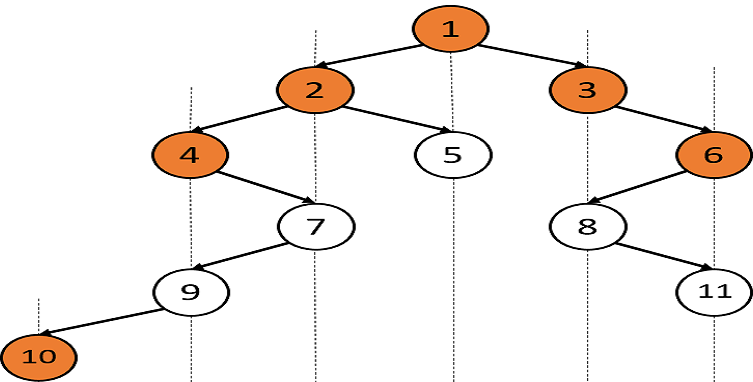
Output: [10, 4, 2, 1, 3, 6]

Explanation: Consider the vertical lines in the figure. The top view contains the topmost node from each vertical line.
Problem approach
I simply used level-order traversal and the concept of horizontal distance. Whenever we encountered the first node for a particular horizontal distance then we store that in the map and at last in the map we have a tree top view. The interviewer asked me to write its code and I wrote a clean and commented code for it and he was satisfied with that.
03
Round
Easy
Face to Face
Duration35 minutes
Interview date12 Nov 2020
Coding problem3
This was again simple coding round
1. Merge Point of Two Linked Lists
Moderate
0/80
Asked in companies


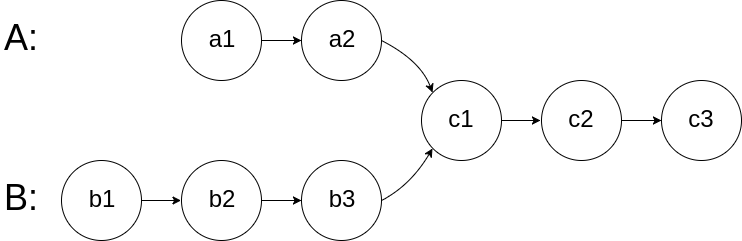
Given two singly linked lists, 'FIRST_HEAD' and 'SECOND_HEAD'. Your task is to find the 'MERGING POINT' i.e. the data of the node at which merging starts. If there is no merging, return -1.
For example:-
The given Linked Lists are merging at node c1.
In this case, c1 is 'MERGING POINT'.
Problem approach
At first, I gave the interviewer a complete brute force by considering each element of the first list and comparing it with each element of another list but that was inefficient. So I gave the interviewer the optimal approach by finding the difference of lengths of the linked list and then traversing bigger linked list to difference. Now start traversing both linked lists till we find the common element. This solution impressed the interviewer.
2. Project Question
Describe your major project.
Problem approach
I started by giving details of my projects and technology used in projects. Then he asked me the most challenging task in your project which I told him which was related to data passing from one page to another and its regular update.
3. DFS Traversal
Moderate
35m average time
65% success
0/80
Asked in companies


Given an undirected and disconnected graph G(V, E), containing 'V' vertices and 'E' edges, the information about edges is given using 'GRAPH' matrix, where i-th edge is between GRAPH[i][0] and GRAPH[i][1]. print its DFS traversal.
V is the number of vertices present in graph G and vertices are numbered from 0 to V-1.

E is the number of edges present in graph G.
Note :
The Graph may not be connected i.e there may exist multiple components in a graph.
Problem approach
I simply used the Depth-first search approach to solve this problem and wrote its neat code with good handwriting to the interviewer and he made me dry run it on few test cases and it was working fine.
04
Round
Easy
HR Round
Duration30 minutes
Interview date12 Nov 2020
Coding problem1
Checked my thinking and analytical skills
1. Basic HR Questions
1. Name different Android versions.
2. Tell me about your family backgrounds.
3. Ever handled pressure. If yes, Please elaborate
Problem approach
Tip 1 : Be confident while answering
Tip 2 : Keep proper eye contact
Tip 3 : Don't hesitate to ask anything from HR


Here's your problem of the day 
Solving this problem will increase your chance to get selected in this company
Skill covered: Programming
To make an AI less repetitive in a long paragraph, you should increase:
Choose another skill to practice
Similar interview experiences
Software Engineer
4 rounds | 9 problems
Interviewed by Paytm (One97 Communications Limited)
 Selected
1457 views

0 comments

0 upvotes
Software Engineer
4 rounds | 8 problems
Interviewed by Paytm (One97 Communications Limited)
 Selected
 550 views
1 comments
0 upvotes
Software Engineer
4 rounds | 8 problems
Interviewed by Paytm (One97 Communications Limited)
 Selected
 459 views
0 comments
0 upvotes
Software Engineer
3 rounds | 6 problems
Interviewed by Paytm (One97 Communications Limited)
Selected 504 views
1 comments
0 upvotes
Companies with similar interview experiences

Software Engineer
3 rounds | 5 problems
Interviewed by Mindtree
 Selected
 12178 views
7 comments
0 upvotes

Software Engineer
3 rounds | 7 problems
Interviewed by Optum
 Selected
 7857 views
1 comments
0 upvotes
Software Engineer
5 rounds | 5 problems
Interviewed by Microsoft
 Selected
 9947 views
1 comments
0 upvotes