





Paytm (One97 Communications Limited) interview experience Real time questions & tips from candidates to crack your interview

SDE - 1
Paytm (One97 Communications Limited)


3 rounds | 5 Coding
problems

Rejected
Interview preparation journey

Journey
When I joined college, I was unaware of this Data Structure and Algorithm, which made my journey to getting an internship way more complicated. From that point, I started doing questions on leetcode and code studio.
Application story
This company visited to my campus for the selection they first took a test then allow us to come for the interview.
Why selected/rejected for the role?
I was rejected because I have a good history of content preparation and i do not have a decent rank in leetcode and code forces. ,
Preparation
Duration: 4 Months
Topics: Data Structures, Pointers, OOPS, System Design, Algorithms, Dynamic Programming

Tip 1 : Practice from Leetcode, solve Leetcode medium level problems.
Tip 2 : Brush up computer fundamentals from subjects like OS, DBMS and CN.
Tip 3 : Have a good project or good internship experience and have in-depth knowledge regarding what you have done.
Application process
Where: Campus
Eligibility: Above 7 CGPA
Tip 1 : Have some projects on resume.
Tip 2 : Do not put false things on resume.
Interview rounds
01
Round
Easy
Video Call
Duration60 Minutes
Interview date19 Nov 2022
Coding problem2
1. Stack using queue
Moderate
25m average time
65% success

0/80
Asked in companies



Implement a Stack Data Structure specifically to store integer data using two Queues.
There should be two data members, both being Queues to store the data internally. You may use the inbuilt Queue.
Implement the following public functions :
1. Constructor:
It initializes the data members(queues) as required.

2. push(data) :
This function should take one argument of type integer. It pushes the element into the stack and returns nothing.

3. pop() :
It pops the element from the top of the stack and, in turn, returns the element being popped or deleted. In case the stack is empty, it returns -1.

4. top :
It returns the element being kept at the top of the stack. In case the stack is empty, it returns -1.

5. size() :
It returns the size of the stack at any given instance of time.

6. isEmpty() :
It returns a boolean value indicating whether the stack is empty or not.
Operations Performed on the Stack:
Query-1(Denoted by an integer 1): Pushes an integer data to the stack. (push function)

Query-2(Denoted by an integer 2): Pops the data kept at the top of the stack and returns it to the caller. (pop function)

Query-3(Denoted by an integer 3): Fetches and returns the data being kept at the top of the stack but doesn't remove it, unlike the pop function. (top function)

Query-4(Denoted by an integer 4): Returns the current size of the stack. (size function)

Query-5(Denoted by an integer 5): Returns a boolean value denoting whether the stack is empty or not. (isEmpty function)
Example
Operations:
1 5
1 10
2
3
4

Enqueue operation 1 5: We insert 5 at the back of the queue.
  Queue: [5]

Enqueue operation 1 10: We insert 10 at the back of the queue.
  Queue: [5, 10]

Dequeue operation 2: We remove the element from the front of the queue, which is 5, and print it.
  Output: 5
  Queue: [10]

Peek operation 3: We return the element present at the front of the queue, which is 10, without removing it.
  Output: 10
  Queue: [10]

IsEmpty operation 4: We check if the queue is empty.
  Output: False
  Queue: [10]
2. Fire in the cells.
Hard
15m average time
85% success
0/120
Asked in companies

You are given a matrix 'MAT' of size ‘N’ * ‘M’, where ‘N’ is the number of rows and ‘M’ is the number of columns. Value ‘0’ in a cell represents that the cell is set on fire initially, (at time t = ‘0’), and the cells which don’t have fire initially have value = ‘1’, and are called safe cells.
If a cell is on fire, then in one second the fire will expand to its adjacent cells (left, right, top, bottom) if they are not already on fire.
You are given the position of a person as integers ‘X’ and ‘Y’ denoting the cell (‘X’, ‘Y’). In one second the person can move from its current cell to any one of its adjacent cells, provided they are not on fire.
You have to determine if the person can move through the matrix to one of the escape cells without burning himself i.e. without going through the fire cells. If it’s possible, return time taken, else return -1.
Note:
1. Escape cells in this problem are all such cells that lie on the edge of the matrix but not on the corner. i.e all such cells which are in the first row, first column, last row, and last column excluding the four corner cells are considered as valid escape cells.

2. A cell once set on fire continues to remain on fire till the end.

3. Note that rows are indexed from 0 to ‘N’ - 1 and columns are indexed from 0 to ‘M’ - 1.

4. The escape cells may also be initially on fire or can catch fire from some neighboring cell.
02
Round
Easy
Video Call
Duration60 Minutes
Interview date19 Nov 2022
Coding problem2
1. N-th Term Of GP
Easy
15m average time
90% success
0/40
Asked in companies


You are given the first term (A), the common ratio (R) and an integer N. Your task is to find the Nth term of the GP series.
The general form of a GP(Geometric Progression) series is A, A(R), A(R^2), A*(R^3) and so on where A is the first term of GP series
Note :
As the answer can be large enough, return the answer modulo 10^9 + 7.
Problem approach
You are given the first term (A), the common ratio (R) and an integer N. Your task is to find the Nth term of the GP series.
The general form of a GP(Geometric Progression) series is A, A(R), A(R^2), A*(R^3) and so on where A is the first term of GP series
Note :
As the answer can be large enough, return the answer modulo 10^9 + 7.
2. Flatten Binary Tree to Linked List
Moderate
25m average time
70% success
0/80
Asked in companies



You are given a binary tree consisting of 'n' nodes.
Convert the given binary tree into a linked list where the linked list nodes follow the same order as the pre-order traversal of the given binary tree.
Use the right pointer of the binary tree as the “next” pointer for the linked list and set the left pointer to NULL.
Use these nodes only. Do not create extra nodes.
Example :
Input: Let the binary be as shown in the figure:
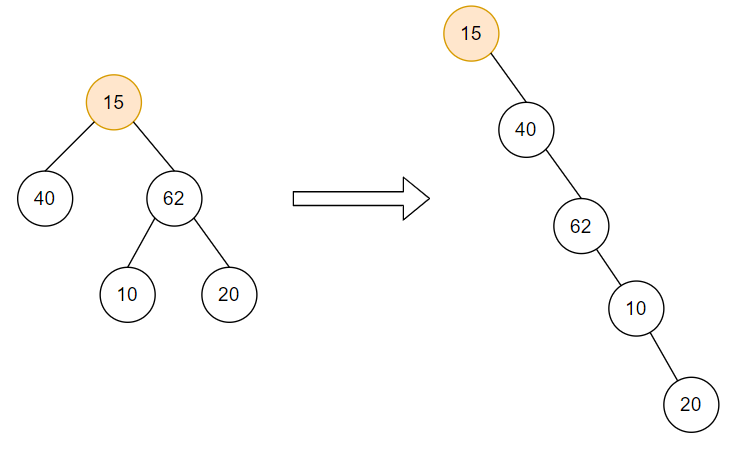
Output: Linked List: 15 -> 40 -> 62 -> 10 -> 20 -> NULL

Explanation: As shown in the figure, the right child of every node points to the next node, while the left node points to null.

Also, the nodes are in the same order as the pre-order traversal of the binary tree.
Problem approach
You are given a binary tree consisting of integer values. Your task is to convert the given binary tree into a linked list where the nodes of the linked list follow the same order as the pre-order traversal of the given binary tree.
03
Round
Easy
HR Round
Duration30 Minutes
Interview date19 Nov 2022
Coding problem1
1. Basic HR Questions
Tell me about yourself.
Why should I hire you?
What are your strengths and weaknesses?
Why do you want to work at our company?
What is the difference between confidence and over confidence?


Here's your problem of the day 
Solving this problem will increase your chance to get selected in this company
Skill covered: Programming
To make an AI less repetitive in a long paragraph, you should increase:
Choose another skill to practice
Similar interview experiences
SDE - 1
2 rounds | 3 problems
Interviewed by Paytm (One97 Communications Limited)
 Selected
923 views

0 comments

0 upvotes
SDE - 1
2 rounds | 5 problems
Interviewed by Paytm (One97 Communications Limited)
Rejected
716 views
0 comments
0 upvotes
SDE - 1
3 rounds | 10 problems
Interviewed by Paytm (One97 Communications Limited)
Rejected
541 views
0 comments
0 upvotes
SDE - 1
3 rounds | 8 problems
Interviewed by Paytm (One97 Communications Limited)
Selected 522 views
0 comments
0 upvotes
Companies with similar interview experiences
SDE - 1
5 rounds | 12 problems
Interviewed by Amazon
 Selected
 114453 views
24 comments
0 upvotes
SDE - 1
4 rounds | 5 problems
Interviewed by Microsoft
Selected 57719 views
5 comments
0 upvotes
SDE - 1
3 rounds | 7 problems
Interviewed by Amazon
 Selected
 34914 views
7 comments
0 upvotes