





Paytm (One97 Communications Limited) interview experience Real time questions & tips from candidates to crack your interview

Software Engineer
Paytm (One97 Communications Limited)


3 rounds | 8 Coding
problems

 Selected
 Interview preparation journey

Journey
I started with no programming knowledge and began learning the basics, including languages, data structures, and algorithms. I spent hours practicing and even enrolled in online courses. To prepare for job interviews, I studied software engineering concepts and worked on personal projects to build my portfolio. During an interview, I confidently answered technical questions, and a few days later, I was offered the job. It was an incredible feeling to know my hard work had paid off. My journey to becoming a software engineer shows that anyone can achieve their goals with dedication and persistence.
Application story
I applied for the software engineering position through my college placement program, where the company participated in the recruitment process. The placement cell of the company received and forwarded my resume to the relevant hiring managers. Following this, an online assessment round was conducted to evaluate my technical skills and knowledge.
Why selected/rejected for the role?
Based on my performance in the online assessment round and the strength of my resume, I was shortlisted for the interview process.
Preparation
Duration: 4 months
Topics: Data Structures, Android Development, Operating Systems, DBMS, Computer Networks

Tip 1 : Practice a sufficient number of questions on critical topics such as trees, linked lists, arrays, and strings of medium difficulty level or higher. This will aid in strengthening your understanding of these essential concepts and enhance your problem-solving abilities.
Tip 2 : Please prepare at least two projects in either Android or web development, demonstrating your comprehensive understanding of the necessary skills required to create challenging and innovative projects. Avoid copying projects from GitHub or creating projects that are too simplistic. Instead, select topics that showcase your expertise and creativity.
Tip 3 : Don't forget to brush up on your core subjects and study all fundamental concepts from subjects such as operating systems, computer networks, and database management systems.
Application process
Where: Campus
Eligibility: No criteria
Tip 1: Highlight your internship experience: As a fresher, your internship experience can be a valuable addition to your resume. Include details about the company, your role, and any projects or responsibilities you had during your internship. Focus on highlighting the skills you developed, such as problem-solving, communication, or technical skills, and any accomplishments or projects you completed. You can also mention any positive feedback or recognition you received from your supervisors or colleagues during your internship. This can help demonstrate your ability to apply your skills and knowledge in a professional setting and make you stand out to potential employers.
Tip 2: Highlight your relevant projects: Since you may not have much work experience as a fresher, it's essential to emphasize your academic and personal projects that showcase your skills and understanding of programming languages, tools, and technologies. Make sure to include project details such as objectives, tools used, outcomes, and any unique challenges you overcame during the project.
Interview rounds
01
Round
Medium
Face to Face
Duration60 minutes
Interview date4 Dec 2020
Coding problem3
1. Prefix Suffix Search
Easy
20m average time
80% success

0/40
Asked in companies

Ninja has to implement a new data structure, ‘PRE_SUF_SEARCH’. This data structure allows searching the word by prefix and suffix that is present in ‘PRE_SUF_SEARCH’.
Ninja has to implement two functions:
1) wordFilter(‘WORDS’): Add this ‘WORDS’ array/list into ‘PRE_SUF_SEARCH’.
2) find(‘PREFIX’, ‘SUFFIX’): Return the index of the word that is present in ‘PRE_SUF_SEARCH’ having prefix as ‘PREFIX’ and the suffix as ‘SUFFIX’.
Note:
1) If there is more than one valid index in ‘PRE_SUF_SEARCH’ for the word, then return the largest possible index.
2) If there is no such word present in the ‘PRE_SUF_SEARCH’, then return -1.
3) ‘WORDS’ array/list contains only lowercase English alphabets.
For example:
‘PRE_SUF_SEARCH’ = [“apple”, “mango”, “banana”].
Query_1: find(‘a’, ‘e’).

We have to find the index of the largest possible word that starts with ‘a’ and ends with ‘e’.

Here we have only one word ‘apple’ present in ‘PRE_SUF_SEARCH’ and satisfy this condition. So we return 0.
2. Copy List with Random Pointer
Easy
10m average time
90% success
0/40
Asked in companies


Given a linked list having two pointers in each node. The first one points to the next node of the list, however, the other pointer is random and can point to any node of the list or null. The task is to create a deep copy of the given linked list and return its head. We will validate whether the linked list is a copy of the original linked list or not.
A deep copy of a Linked List means we do not copy the references of the nodes of the original Linked List rather for each node in the original Linked List, a new node is created.
For example,
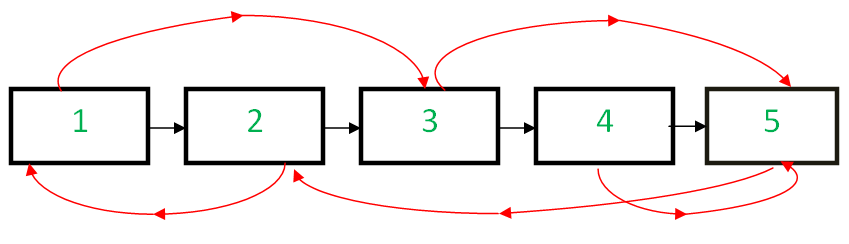
Random pointers are shown in red and next pointers in black.
3. Binary Tree Multiplication
Moderate
0/80
Asked in companies


Ninja has a binary tree. He wants to find the sum of multiplication of each node of the binary tree with its mirror node. Help Ninja to find the sum.
The mirror of a node is a node that is present at the mirror position in the opposite subtree at the root. The mirror of the root node is the node itself.
The answer can be very large, so print answer modulo 1000000007.
For Example :
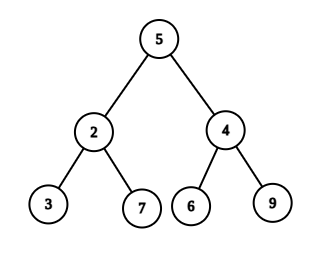
In this example, The mirror of 2 will be 4, the mirror of 3 will be 9 and the mirror of 7 will be 6 so the final answer is (5 * 5) + (2 * 4) + (3 * 9) + (7 * 6) = 102.
Note :
Every Node has a mirror node in the given tree.
02
Round
Medium
Face to Face
Duration60 minutes
Interview date4 Dec 2020
Coding problem2
1. LCA of Two Nodes In A BST
Moderate
15m average time
85% success
0/80
Asked in companies


You are given a binary search tree of integers with N nodes. You are also given references to two nodes 'P' and 'Q' from this BST.
Your task is to find the lowest common ancestor(LCA) of these two given nodes.
The lowest common ancestor for two nodes P and Q is defined as the lowest node that has both P and Q as descendants (where we allow a node to be a descendant of itself)
A binary search tree (BST) is a binary tree data structure which has the following properties.
• The left subtree of a node contains only nodes with data less than the node’s data.
• The right subtree of a node contains only nodes with data greater than the node’s data.
• Both the left and right subtrees must also be binary search trees.
For example:
'P' = 1, 'Q' = 3
tree = 2 1 4 -1 -1 3 -1 -1 -1,

The BST corresponding will be-
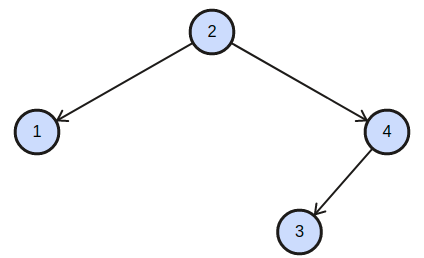
Here, we can clearly see that LCA of node 1 and node 3 is 2.
Problem approach
Firstly, I explained my recursion-based approach to the problem. Once the interviewer was satisfied with my understanding of the problem, he requested that I write the code for my proposed solution, taking into consideration any possible edge cases.
2. DBMS Question
What are ACID properties?
What is normalization?
What is 2NF, 3NF?
What are ER Diagrams?
03
Round
Medium
Face to Face
Duration60 minutes
Interview date4 Dec 2020
Coding problem3
1. OS Questions
Explain process and memory management?
What are paging and segmentation?
What is CPU scheduling?
Synchronization mechanisms such as semaphores (including types of semaphores).
2. Sort 0s, 1s, 2s
Easy
0/40
Asked in companies

You are given an array ‘arr’ consisting only of 0s , 1s, and 2s.
Sort the given array.
For Example:
For ‘arr’ = {1, 0, 0, 2, 1}.
‘Answer’ = {0, 0, 1, 1, 2}.
‘Answer’ should contain all 0s first, then all 1s and all 2s in the end.
3. Reverse Nodes in k-Group
Hard
56m average time
30% success
0/120
Asked in companies


You are given a Singly Linked List of integers and an integer array 'B' of size 'N'. Each element in the array 'B' represents a block size. Modify the linked list by reversing the nodes in each block whose sizes are given by the array 'B'.
Note:
1. If you encounter a situation when 'B[i]' is greater than the number of remaining nodes in the list, then simply reverse the remaining nodes as a block and ignore all the block sizes from 'B[i]'.

2. All block sizes are contiguous i.e. suppose that block 'B[i]' ends at a node cur, then the block 'B[i+1]' starts from the node just after the node cur.
Example
Linked list: 1->2->3->4->5
Array B: 3 3 5

Output: 3->2->1->5->4

We reverse the first block of size 3 and then move to block 2. Now, since the number of nodes remaining in the list (2) is less than the block size (3), we reverse the remaining nodes (4 and 5) as a block and ignore all the block sizes that follow.
Problem approach
I explained my recursive approach-based solution to a problem. The interviewer asked me to provide the code and explain the time and space complexity of the solution. After I completed this task, the interviewer asked for a more space-optimized solution. I presented the iterative solution and explained it to the interviewer. My explanation was sufficient, and the interviewer did not ask me to provide the code for the iterative solution.


Here's your problem of the day 
Solving this problem will increase your chance to get selected in this company
Skill covered: Programming
To make an AI less repetitive in a long paragraph, you should increase:
Choose another skill to practice
Similar interview experiences
Software Engineer
4 rounds | 9 problems
Interviewed by Paytm (One97 Communications Limited)
 Selected
1456 views

0 comments

0 upvotes
Software Engineer
4 rounds | 8 problems
Interviewed by Paytm (One97 Communications Limited)
Selected 550 views
1 comments
0 upvotes
Software Engineer
4 rounds | 8 problems
Interviewed by Paytm (One97 Communications Limited)
 Selected
 458 views
0 comments
0 upvotes
Software Engineer
3 rounds | 6 problems
Interviewed by Paytm (One97 Communications Limited)
Selected 503 views
1 comments
0 upvotes
Companies with similar interview experiences

Software Engineer
3 rounds | 5 problems
Interviewed by Mindtree
 Selected
 12178 views
7 comments
0 upvotes

Software Engineer
3 rounds | 7 problems
Interviewed by Optum
 Selected
 7857 views
1 comments
0 upvotes

Software Engineer
5 rounds | 5 problems
Interviewed by Microsoft
 Selected
 9947 views
1 comments
0 upvotes