





Phone Pe interview experience Real time questions & tips from candidates to crack your interview

SDE - 1
Phone Pe


2 rounds | 5 Coding
problems

Rejected
Interview preparation journey

Preparation
Duration: 5 months
Topics: Docker, OOPs, Postgres, DBMS, Networking

Tip 1 : Practice questions on online platforms
Tip 2 : Understand the best solutions in depth and algorithm used
Tip 3 : Ask clarifying questions to the interviewer and break the problem to smaller sub parts
Application process
Where: Naukri
Eligibility:
Tip 1 : Highlight your most impactful work on the resume
Tip 2 : Keep it easy to understand
Interview rounds
01
Round
Easy
Face to Face
Duration60 minutes
Interview date8 Apr 2022
Coding problem2
Given an array, check whether it is possible to get two numbers from the array with sum k.(the easy-this question is asked just for comforting purposes)
1. Number of Islands
Easy

0/40
Asked in companies



You have been given a non-empty grid consisting of only 0s and 1s. You have to find the number of islands in the given grid.
An island is a group of 1s (representing land) connected horizontally, vertically or diagonally. You can assume that all four edges of the grid are surrounded by 0s (representing water).
Problem approach
Solved it using BFs
2. Reverse A LL
Moderate
30m average time
65% success
0/80
Asked in companies



Ninjas is practicing problems on the linked list. He came across a problem in which he has given a linked list of ‘N’ nodes and two integers, ‘LOW’ and ‘HIGH’. He has to return the linked list ‘HEAD’ after reversing the nodes between ‘LOW’ and ‘HIGH’, including the nodes at positions ‘LOW’ and ‘HIGH’.
Problem approach
Using two pointers and swaping nodes
02
Round
Easy
Face to Face
Duration60 minutes
Interview date11 Apr 2022
Coding problem3
This round is also based on DSA. 3 questions were asked.
1. Snake and Ladder
Moderate
30m average time
60% success
0/80
Asked in companies

You have been given a Snake and Ladder Board with 'N' rows and 'N' columns with the numbers written from 1 to (N*N) starting from the bottom left of the board, and alternating direction each row.
For example
For a (6 x 6) board, the numbers are written as follows:
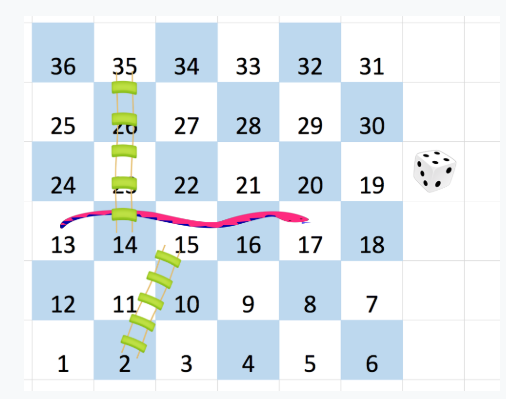
You start from square 1 of the board (which is always in the last row and first column). On each square say 'X', you can throw a dice which can have six outcomes and you have total control over the outcome of dice throw and you want to find out the minimum number of throws required to reach the last cell.
Some of the squares contain Snakes and Ladders, and these are possibilities of a throw at square 'X':
You choose a destination square 'S' with number 'X+1', 'X+2', 'X+3', 'X+4', 'X+5', or 'X+6', provided this number is <= N*N.
If 'S' has a snake or ladder, you move to the destination of that snake or ladder.  Otherwise, you move to S.
A board square on row 'i' and column 'j' has a "Snake or Ladder" if board[i][j] != -1. The destination of that snake or ladder is board[i][j].
Note :
You can only take a snake or ladder at most once per move: if the destination to a snake or ladder is the start of another snake or ladder, you do not continue moving - you have to ignore the snake or ladder present on that square.

For example, if the board is:
-1 1 -1
-1 -1 9
-1 4 -1
Let's say on the first move your destination square is 2  [at row 2, column 1], then you finish your first move at 4 [at row 1, column 2] because you do not continue moving to 9 [at row 0, column 0] by taking the ladder from 4.

A square can also have a Snake or Ladder which will end at the same cell.
For example, if the board is:
-1 3 -1
-1 5 -1
-1 -1 9
Here we can see Snake/Ladder on square 5 [at row 1, column 1] will end on the same square 5.
Problem approach
I solved it using graphs
2. Minimum Number of Deletions and Insertions
Moderate
0/80
Asked in companies

You are given 2 non-empty strings 's1' and 's2' consisting of lowercase English alphabets only.
In one operation you can do either of the following on 's1':
(1) Remove a character from any position in 's1'.
(2) Add a character to any position in 's1'.
Find the minimum number of operations required to convert string 's1' into 's2'.
Example:
Input: 's1' = "abcd", 's2' = "anc"

Output: 3

Explanation:
Here, 's1' = "abcd", 's2' = "anc".
In one operation remove 's1[3]', after this operation 's1' becomes "abc".
In the second operation remove 's1[1]', after this operation 's1' becomes "ac".
In the third operation add 'n' in 's1[1]', after this operation 's1' becomes "anc".

Hence, the minimum operations required will be 3. It can be shown that there's no way to convert s1 into s2 in less than 3 moves.
Problem approach
A simple approach is to consider all subsequences of str1 and for each subsequence calculate minimum deletions and insertions so as to transform it into str
3. Program to validate IP address
Easy
15m average time
85% success
0/40
Asked in companies


You are given the text ‘IPAddress’. Your task is to check if the given text ‘IPAddress’ is a valid ‘IPv4’ or not.
Conditions for a valid ‘IPv4’ are:
1. Text form of ‘IPAddress’ must be ‘a.b.c.d’
2. The values of a,b,c and d can vary from ‘0’ to ‘255’ and both ‘0’ and ‘255’ are inclusive.
Problem approach
We will check all the cases where IP address may be invalid
1. First we will split the given input using split() function then check if it has a length of 4 or not .If length is not equal to 4 then we will directly return 0.
2. In second step we will check if any split element contains any leading zero or not .if it is then we will return zero.
3. If any of the split does not contain any number then it is not a valid IP address .so we will return 0
4. Then we will check if all the splits are in the range of 0-255 or not .If not we will return 0.
5. Finally if none of the above condition is true we can finally say that it is a valid IP address and we will return True.


Here's your problem of the day 
Solving this problem will increase your chance to get selected in this company
Skill covered: Programming
How do you create a function in JavaScript?
Choose another skill to practice
Start a Discussion
Similar interview experiences
SDE - 1
4 rounds | 6 problems
Interviewed by Phone Pe
 Selected
2019 views

0 comments

0 upvotes
SDE - 1
5 rounds | 6 problems
Interviewed by Phone Pe
 Selected
 1791 views
0 comments
0 upvotes
SDE - 1
4 rounds | 7 problems
Interviewed by Phone Pe
 Selected
 1775 views
0 comments
0 upvotes
SDE - 1
4 rounds | 6 problems
Interviewed by Phone Pe
 Selected
 1305 views
0 comments
0 upvotes
Companies with similar interview experiences
SDE - 1
5 rounds | 12 problems
Interviewed by Amazon
 Selected
 106026 views
24 comments
0 upvotes
SDE - 1
4 rounds | 5 problems
Interviewed by Microsoft
Selected 50694 views
5 comments
0 upvotes
SDE - 1
3 rounds | 7 problems
Interviewed by Amazon
 Selected
 31561 views
6 comments
0 upvotes