





PolicyBazaar.com interview experience Real time questions & tips from candidates to crack your interview
SDE - 1
PolicyBazaar.com


3 rounds | 7 Coding
problems

 Selected
 Interview preparation journey

Preparation
Duration: 6 months
Topics: Data Structures, Algorithms, System Design, Aptitude, OOPS

Tip 1 : Learn DS, SQL for the interview as it will be ask and be confident about what you are saying
Tip 2 : Go through all the previous interview experiences from Codestudio and Leetcode.
Tip 3 : Do at-least 2 good projects and you must know every bit of them.
Application process
Where: Other
Eligibility: Above 7 CGPA
Tip 1 : Have at-least 2 good projects explained in short with all important points covered.
Tip 2 : Every skill must be mentioned.
Tip 3 : Focus on skills, projects and experiences more.

Interview rounds
01
Round
Easy
Video Call
Duration60 minutes
Interview date15 Jul 2021
Coding problem3
Easy level DSA questions were asked to implement.
1. BFS in Graph
Easy
10m average time
90% success

0/40
Asked in companies



Given an adjacency list representation of a directed graph with ‘n’ vertices and ‘m’ edges. Your task is to return a list consisting of Breadth-First Traversal (BFS) starting from vertex 0.
In this traversal, one can move from vertex 'u' to vertex 'v' only if there is an edge from 'u' to 'v'. The BFS traversal should include all nodes directly or indirectly connected to vertex 0.
Note:
The traversal should proceed from left to right according to the input adjacency list.
Example:
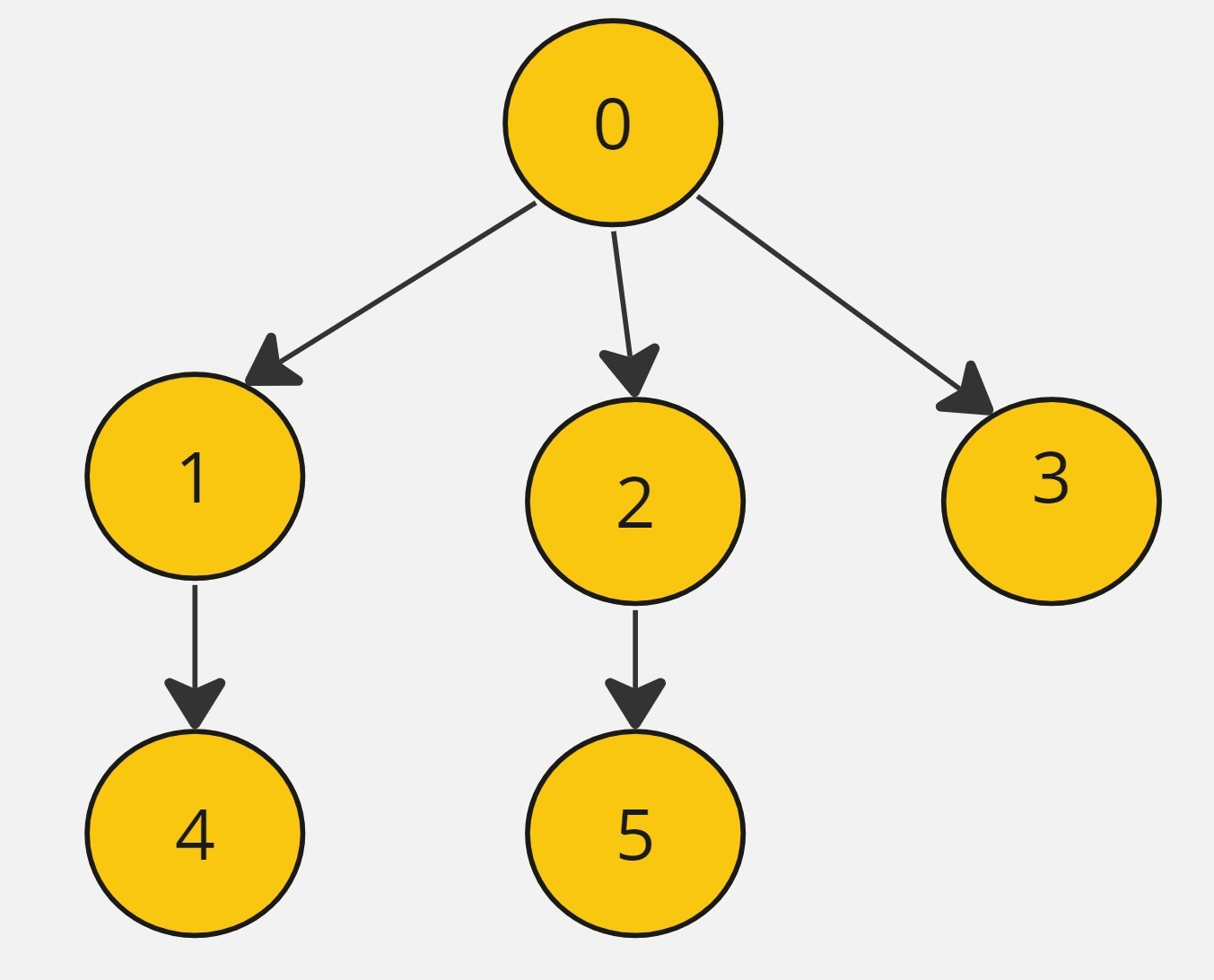
Adjacency list: { {1,2,3},{4}, {5}, {},{},{}}

The interpretation of this adjacency list is as follows:
Vertex 0 has directed edges towards vertices 1, 2, and 3.
Vertex 1 has a directed edge towards vertex 4.
Vertex 2 has a directed edge towards vertex 5.
Vertices 3, 4, and 5 have no outgoing edges.

We can also see this in the diagram below.

BFS traversal: 0 1 2 3 4 5
Problem approach
BFS is a traversing algorithm we start traversing from a selected node (starting node) and traverse the graph layer wise thus exploring the neighbor nodes (nodes which are directly connected to source node). And then move towards the next-level neighbor nodes.
Pseudocode :
BFS (G, s)
Q.push( s ) //Inserting s in queue Q until all its neighbor vertices are marked.
mark s as visited.
while ( Q is not empty)
//Removing that vertex from queue, whose neighbor will be visited now
u = Q.pop( )
//processing all the neighbors of u
for all neighbors v of u in Graph G
if v is not visited
Q.push( v ) //Stores v in Q to further visit its neighbor
mark w as visited.
2. DFS Traversal
Moderate
35m average time
65% success
0/80
Asked in companies



Given an undirected and disconnected graph G(V, E), containing 'V' vertices and 'E' edges, the information about edges is given using 'GRAPH' matrix, where i-th edge is between GRAPH[i][0] and GRAPH[i][1]. print its DFS traversal.
V is the number of vertices present in graph G and vertices are numbered from 0 to V-1.

E is the number of edges present in graph G.
Note :
The Graph may not be connected i.e there may exist multiple components in a graph.
Problem approach
The DFS algorithm is a recursive algorithm based on the idea of backtracking. It starts with the initial node of the graph G, and then goes to deeper and deeper until we find the goal node or the node which has no children.
Pseudocode :
DFS(G, s):
mark s as visited
for all neighbors v of s in Graph G:
if v is not visited:
DFS-recursive(G, v)
3. Nth Fibonacci Number
Easy
0/40
Asked in companies



The n-th term of Fibonacci series F(n), where F(n) is a function, is calculated using the following formula -
    F(n) = F(n - 1) + F(n - 2),
    Where, F(1) = 1, F(2) = 1
Provided 'n' you have to find out the n-th Fibonacci Number. Handle edges cases like when 'n' = 1 or 'n' = 2 by using conditionals like if else and return what's expected.
"Indexing is start from 1"
Example :
Input: 6

Output: 8

Explanation: The number is ‘6’ so we have to find the “6th” Fibonacci number.
So by using the given formula of the Fibonacci series, we get the series:
[ 1, 1, 2, 3, 5, 8, 13, 21]
So the “6th” element is “8” hence we get the output.
Problem approach
The recursive approach involves direct implementation of mathematical recurrence formula.
F(n) = F(n-1)+F(n-2)
Pseudocode :
fibonacci(n):
if(n<=1)
return n;
return fibonacci(n-1) + fibonacci(n-2)
This is an exponential approach.
It can be optimized using dynamic programming. Maintain an array that stores all the calculated fibonacci numbers so far and return the nth fibonacci number at last. This approach will take O(n) time complexity and O(n) auxiliary space.
02
Round
Easy
Video Call
Duration60 minutes
Interview date16 Jul 2021
Coding problem3
DSA questions based on trees were asked to implement.
1. Left View Of a Binary Tree
Easy
10m average time
90% success
0/40
Asked in companies



You have been given a binary tree of integers. You are supposed to find the left view of the binary tree. The left view of a binary tree is the set of all nodes that are visible when the binary tree is viewed from the left side.
Example:
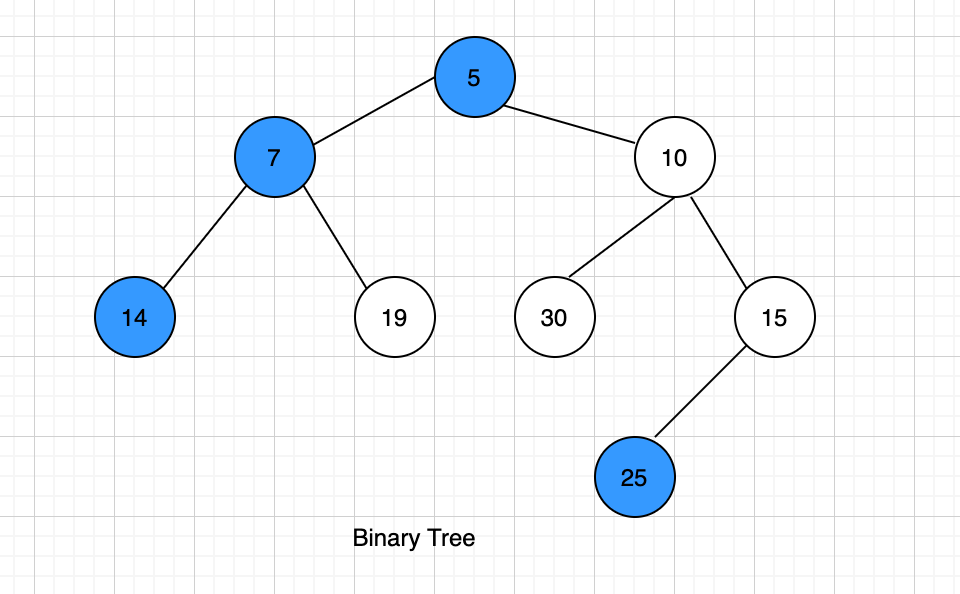
The left view of the above binary tree is {5, 7, 14, 25}.
Problem approach
A level order traversal based solution can be presented here. For each level, we need to print the first node i.e. the leftmost node of that level.
Steps :
1. Make a queue of node type and push the root node in the queue.
2. While the queue is not empty, do :
2.1 Determine the current size of the queue.
2.2 Run a for loop to traverse all nodes of the current level and do :
2.2.1 Remove the topmost node from the queue.
2.2.2 If i==0 (first node of that level) , print it.
2.2.3 Push the left and right child of the node if they exist.
Time Complexity : O(n), where n is number of nodes in binary tree
2. Right View
Moderate
35m average time
65% success
0/80
Asked in companies



You have been given a Binary Tree of integers.
Your task is to print the Right view of it.
The right view of a Binary Tree is a set of nodes visible when the tree is viewed from the Right side and the nodes are printed from top to bottom order.
Problem approach
BFS can be used to solve this question.
Steps :
1. Traverse the whole tree in level order fashion using BFS along with storing the last processed node (curr).
2. Keep a tag at the end of each level to know that a particular level has ended.
3. Whenever a level ends store the last processed node value to the resultant list.
Time Complexity : O(n) [ Since, each node is traversed exactly once ]
Space Complexity : O(w) [ 'w' is the maximum width of the tree ]
3. Height of the Binary Tree
Moderate
10m average time
90% success
0/80
Asked in companies

You have been given the Inorder Traversal and Level Order Traversal of a Binary Tree of integers. Your task is to calculate the height of the Binary tree without constructing it.
The height of the binary tree is the number of edges in the longest path from the root node to any leaf node in the tree. In case the tree has only one node, the height is taken to be 0.
Problem approach
This problem can be solved using recursion. Recursively calculate height of left and right subtrees for each node node and assign height to the node as max of the heights of two children plus 1
Algorithm :
height()
1. If tree is empty , return -1
2. Else
(a) Get the height of left subtree recursively i.e. call height( tree->left-subtree)
(a) Get the height of right subtree recursively i.e. call height( tree->right-subtree)
(c) Get the max of height of left and right subtrees and add 1 to it for the current node.
max_depth = max(height of left subtree, height of right subtree) + 1
(d) Return max_depth
03
Round
Easy
HR Round
Duration30 minutes
Interview date19 Jul 2021
Coding problem1
Typical HR round where the interviewer asked questions to know more about me.
1. Basic HR Questions
1. Why Policy Bazaar?
2. What are your strengths and weaknesses?
3. How you keep yourself information-aware?
Problem approach
Tip 1 : The cross questioning can go intense some time, think before you speak.
Tip 2 : Be open minded and answer whatever you are thinking, in these rounds I feel it is important to have opinion.
Tip 3 : Context of questions can be switched, pay attention to the details. It is okay to ask questions in these round, like what are the projects currently the company is investing, which team you are mentoring. How all is the work environment etc.


Here's your problem of the day 
Solving this problem will increase your chance to get selected in this company
Skill covered: Programming
How do you remove whitespace from the start of a string?
Choose another skill to practice
Similar interview experiences
SDE - 1
2 rounds | 4 problems
Interviewed by PolicyBazaar.com
Rejected

1245 views

0 comments

0 upvotes
SDE - 1
2 rounds | 4 problems
Interviewed by PolicyBazaar.com
Rejected
882 views
0 comments
0 upvotes
SDE - 1
2 rounds | 4 problems
Interviewed by PolicyBazaar.com
Rejected
911 views
0 comments
0 upvotes
SDE - 1
2 rounds | 5 problems
Interviewed by PolicyBazaar.com
Rejected
870 views
0 comments
0 upvotes
Companies with similar interview experiences
SDE - 1
5 rounds | 12 problems
Interviewed by Amazon
 Selected
 115097 views
24 comments
0 upvotes

SDE - 1
4 rounds | 5 problems
Interviewed by Microsoft
Selected 58237 views
5 comments
0 upvotes
SDE - 1
3 rounds | 7 problems
Interviewed by Amazon
 Selected
 35147 views
7 comments
0 upvotes