





PolicyBazaar.com interview experience Real time questions & tips from candidates to crack your interview
SDE - 1
PolicyBazaar.com


3 rounds | 6 Coding
problems

Rejected
Interview preparation journey

Journey
My journey started at my college when I first learned to code. From there onwards, I have done a lot of practice from leetcode to code studio. I have maintained a streak of doing at least 50 questions a week to maintain my accuracy.
Application story
This company visited my campus for the placement. They first took the Online assessment and then allowed the selected candidates to face the interview.
Why selected/rejected for the role?
I was rejected because I have some design projects in my resume, and some of them are well known in the open source community.
Preparation
Duration: 4 months
Topics: Data Structures, Algorithms, OOPS, Dynamic Programming, DBMS

Tip 1 : Practice popular questions from Arrays, Binary Trees, LinkedLists from CodeStudio's Interview Problems
Tip 2 : Make sure you are aware of calculating the time and space complexity for every problem you're coding.
Tip 3 : Prepare through Mock Interviews to practice explaining your approach while solving in an actual interview.
Application process
Where: Campus
Eligibility: Above 7 CGPA
Tip 1 : Describe best of your projects in minimum words. Don't forget to add buzz words like REST APIs/ DB Indexing/ Benchmarking etc if you worked on backend.
Tip 2 : Don't add school achievements like Olympiads or Class Topper in your resume.
Tip 3 : If you've some work experience, put it in a way ,you're marketing yourself. Add terms like 'Created/Owned the Project through entire SDLC'
Tip 4 : Make sure you mention how your work experience actually impacted the company. Or how your self project can be actually useful to end user.

Interview rounds
01
Round
Hard
Video Call
Duration60 minutes
Interview date21 Sep 2022
Coding problem2
1. Merge Point of Two Linked Lists
Moderate

0/80
Asked in companies



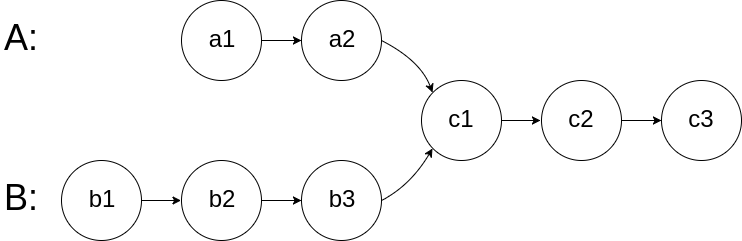
Given two singly linked lists, 'FIRST_HEAD' and 'SECOND_HEAD'. Your task is to find the 'MERGING POINT' i.e. the data of the node at which merging starts. If there is no merging, return -1.
For example:-
The given Linked Lists are merging at node c1.
In this case, c1 is 'MERGING POINT'.
Problem approach
Given two singly linked lists, 'FIRST_HEAD' and 'SECOND_HEAD'. Your task is to find the 'MERGING POINT' i.e. the data of the node at which merging starts. If there is no merging, return -1.
2. Maximum Coins
Hard
16m average time
78% success
0/120
Asked in companies



You are given a two-dimensional matrix of integers of dimensions N*M, where each cell represents the number of coins in that cell. Alice and Bob have to collect the maximum number of coins. The followings are the conditions to collect coins:
Alice starts from top left corner, i.e., (0, 0) and should reach left bottom corner, i.e., (N-1, 0). Bob starts from top right corner, i.e., (0, M-1) and should reach bottom right corner, i.e., (N-1, M-1).
From a point (i, j), Alice and Bob can move to (i+1, j+1) or (i+1, j-1) or (i+1, j)
They have to collect all the coins that are present at a cell. If Alice has already collected coins of a cell, then Bob gets no coins if goes through that cell again.
For example :
If the matrix is
0 2 4 1
4 8 3 7
2 3 6 2
9 7 8 3
1 5 9 4

Then answer is 47. As, Alice will collect coins 0+8+3+9+1 = 21 coins. Bob will collect coins 1+7+6+8+4 = 26 coins. Total coins is 21+26 = 47 coins.
Problem approach
You are given a two-dimensional matrix of integers of dimensions N*M, where each cell represents the number of coins in that cell. Alice and Bob have to collect the maximum number of coins.
02
Round
Hard
Video Call
Duration60 minutes
Interview date21 Sep 2022
Coding problem2
1. Word Break
Moderate
15m average time
85% success
0/80
Asked in companies



You are given a list of “N” strings A. Your task is to check whether you can form a given target string using a combination of one or more strings of A.
Note :
You can use any string of A multiple times.
Examples :
A =[“coding”, ”ninjas”, “is”, “awesome”]  target = “codingninjas”
Ans = true as we use “coding” and “ninjas” to form “codingninjas”
Problem approach
You are given a list of “N” strings A. Your task is to check whether you can form a given target string using a combination of one or more strings of A.
2. System Design Question
Design something similar to red bus which can handle bookings and can onboard vendors and customers to their platform
03
Round
Easy
Video Call
Duration60 minutes
Interview date21 Sep 2022
Coding problem2
1. K Most Frequent Elements
Moderate
10m average time
85% success
0/80
Asked in companies



You are given an Integer array ‘ARR’ and an Integer ‘K’.
Your task is to find the ‘K’ most frequent elements in ‘ARR’. Return the elements in any order.
For Example:
You are given ‘ARR’ = {1, 2, 2, 3, 3} and ‘K’ = 2.

The answer will {2, 3} as 2 and 3 are the elements occurring most times.
2. Distance Of Nearest Cell Having 1 In A Binary Matrix
Moderate
35m average time
65% success
0/80
Asked in companies


You have been given a binary matrix 'MAT' containing only 0’s and 1’s of size N x M. You need to find the distance of the nearest cell having 1 in the matrix for each cell.
The distance is calculated as |i1 – i2| + |j1 – j2|, where i1, j1 are the coordinates of the current cell and i2, j2 are the coordinates of the nearest cell having value 1.
Note :
You can only move in four directions which are : Up, Down, Left and Right.
For example :
If N = 3, M = 4

and mat[ ][ ] = { 0, 0, 0, 1,
                  0, 0, 1, 1,
                  0, 1, 1, 0 }

then the output matrix will be

3  2  1  0
2  1  0  0
1  0  0  1
Problem approach
You have been given a binary matrix 'MAT' containing only 0’s and 1’s of size N x M. You need to find the distance of the nearest cell having 1 in the matrix for each cell.


Here's your problem of the day 
Solving this problem will increase your chance to get selected in this company
Skill covered: Programming
What is the best case time complexity of Bubble Sort?
Choose another skill to practice
Similar interview experiences
SDE - 1
2 rounds | 4 problems
Interviewed by PolicyBazaar.com
Rejected

1273 views

0 comments

0 upvotes
SDE - 1
2 rounds | 4 problems
Interviewed by PolicyBazaar.com
Rejected
914 views
0 comments
0 upvotes
SDE - 1
2 rounds | 4 problems
Interviewed by PolicyBazaar.com
Rejected
934 views
0 comments
0 upvotes
SDE - 1
2 rounds | 5 problems
Interviewed by PolicyBazaar.com
Rejected
896 views
0 comments
0 upvotes
Companies with similar interview experiences
SDE - 1
5 rounds | 12 problems
Interviewed by Amazon

 Selected
 115614 views
24 comments
0 upvotes
SDE - 1
4 rounds | 5 problems
Interviewed by Microsoft
Selected 58630 views
5 comments
0 upvotes
SDE - 1
3 rounds | 7 problems
Interviewed by Amazon
 Selected
 35337 views
7 comments
0 upvotes