





Posist Technologies interview experience Real time questions & tips from candidates to crack your interview
SDE - Intern
Posist Technologies


2 rounds | 4 Coding
problems

Rejected
Interview preparation journey

Journey
I was setting foot on the path of my B. Tech in Computer Science was an exhilarating commencement. They introduced me to the joy of coding the initial year while I delved into the intricacies of data structures and algorithms during my sophomore year. Year three allowed for specialization, exploring diverse facets of computer science, and internships provided practical insights into real-world applications. Culminating in the final year's capstone project, my graduation was not just the attainment of a degree but a profound personal achievement. Armed with a repertoire of experiences, enduring friendships, and an unwavering passion for the dynamic field of technology, I am poised to embrace the challenges that lie ahead in my professional journey.
Application story
I submitted my application via a referral I received from a senior colleague on LinkedIn, leveraging the professional network to enhance my job application process
Why selected/rejected for the role?
I was rejected because I was unable to provide optimized solutions for the questions being asked during the interview.
Preparation
Duration: 5 months
Topics: Data Structures, Pointers, OOPS, System Design, Algorithms, Dynamic Programming

Tip 1: Establish a Consistent Coding Routine, Allocate Dedicated Time Daily
Tip 2: Work on Real-world Projects to Apply Theoretical Knowledge
Tip 3: Actively Engage in Coding Communities, Attend Hackathons, and Collaborate with Peers
Application process
Where: Linkedin
Eligibility: Above 6 CGPA
Tip 1: Quantify Achievements - Include specific numbers or percentages to highlight the impact of your contributions, making your accomplishments more tangible and impressive.
Tip 2: Tailor for the Job - Customize your resume for each application by emphasizing skills and experiences relevant to the specific job description, showcasing your suitability for the position.

Interview rounds
01
Round
Medium
Video Call
Duration60 minutes
Interview date12 Sep 2022
Coding problem2
Timing: The round occurred during standard working hours, eliminating the need for late-night participation.
Environment: The setting was professional and conducive to focused discussions, ensuring a distraction-free atmosphere.
Significant Activity: The primary emphasis was on the interview itself, with no noteworthy extraneous activities during the round.
1. Median in a stream
Hard
50m average time
50% success

0/120
Asked in companies



Given that integers are read from a data stream. Your task is to find the median of the elements read so far.
Median is the middle value in an ordered integer list. If the size of the list is even there is no middle value. So the median is the floor of the average of the two middle values.
For example :
[2,3,4] - median is 3.
[2,3] - median is floor((2+3)/2) = 2.
Problem approach
Given that integers are read from a data stream. Your task is to find the median of the elements read so far.
Median is the middle value in an ordered integer list. If the size of the list is even there is no middle value. So the median is the floor of the average of the two middle values.
2. Dice Throws
Hard
35m average time
65% success
0/120
Asked in companies


You are given D dice, each having F faces numbered 1 to F, both inclusive. The task is to find the possible number of ways to roll the dice together such that the sum of face-up numbers equal the given target S.
Note :
As the answer can be large, return your answer modulo 10^9 + 7.
Follow Up :
Can you solve this using not more than O(S) extra space?
Problem approach
You are given D dice, each having F faces numbered 1 to F, both inclusive. The task is to find the possible number of ways to roll the dice together such that the sum of face-up numbers equal the given target S.
02
Round
Medium
Video Call
Duration1 hour
Interview date15 Sep 2022
Coding problem2
1. Check Identical Trees
Moderate
20m average time
85% success
0/80
Asked in companies

You are given two binary trees with 'n' and 'm' nodes respectively.
You need to return true if the two trees are identical. Otherwise, return false.
Example:
For the trees given below:-
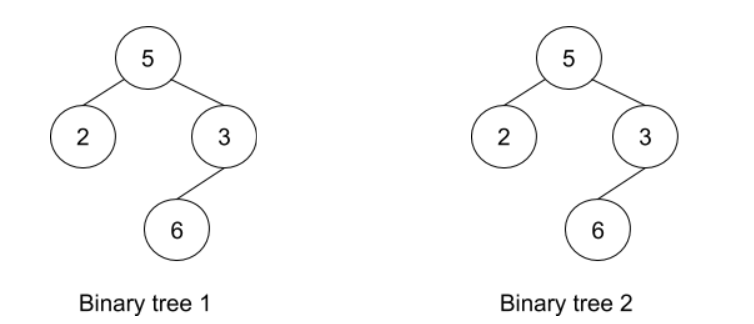
The given trees are identical as:-
1. The number of nodes in both trees is the same.
2. The number of edges in both trees is the same.
3. The data for root for both the trees is the same i.e 5.
4. The data of root -> left (root’s left child) for both the trees is the same i.e 2.
5. The data of root -> right (root’s right child) for both the trees is the same i.e 3.
6. The data of root -> right -> left ( left child of root’s right child) for both the trees is the same i.e 6.
7. Nodes with data 2 and 6 are the leaf nodes for both the binary trees.
Problem approach
You need to return true if the two trees are identical. Otherwise, return false.
2. Distinct Subsequences
Moderate
10m average time
80% success
0/80
Asked in companies



You have been given string 'S' of length 'N' that may contain duplicate alphabets. Your task is to return the count of distinct subsequences of it.
For example:
For the given string “deed” :
The possible subsequences are {“”}, {“d”}, {“e”}, {“de”}, {“e”}, {“de”}, {“ee”}, {“dee”}, {“d”}, {“dd”}, {“ed”}, {“ded”}, {“ed”}, {“ded”}, {“eed”} and {“deed”}.

As, {“d”}, {“e”}, {“de”}, {“ed”} and {“ded”} are repeated.

The distinct subsequences are {“”}, {“d”}, {“e”}, {“de”}, {“ee”}, {“dee”}, {“dd”}, {“ed”}, {“ded”}, {“eed”} and {“deed”}

Thus, the output will be 11.
Note:
As the answer can be large, return your answer modulo 10^9 + 7.
Problem approach
You have been given string 'S' of length 'N' that may contain duplicate alphabets. Your task is to return the count of distinct subsequences of it.


Here's your problem of the day 
Solving this problem will increase your chance to get selected in this company
Skill covered: Programming
How do you remove whitespace from the start of a string?
Choose another skill to practice
Similar interview experiences

SDE - 1
3 rounds | 7 problems
Interviewed by OYO
 Selected
6182 views

0 comments

0 upvotes

SDE - Intern
2 rounds | 3 problems
Interviewed by Amazon
Rejected
1565 views
0 comments
0 upvotes
SDE - 1
2 rounds | 5 problems
Interviewed by Meesho
Rejected
7245 views
0 comments
0 upvotes

SDE - 1
3 rounds | 9 problems
Interviewed by Salesforce
 Selected
 4552 views
0 comments
0 upvotes
Companies with similar interview experiences
SDE - Intern
3 rounds | 6 problems
Interviewed by Amazon

Rejected
16212 views
4 comments
0 upvotes
SDE - Intern
4 rounds | 7 problems
Interviewed by Microsoft
 Selected
 16223 views
1 comments
0 upvotes
SDE - Intern
2 rounds | 4 problems
Interviewed by Amazon
Selected 10541 views
2 comments
0 upvotes