





Protium interview experience Real time questions & tips from candidates to crack your interview
Software Engineer
Protium


2 rounds | 3 Coding
problems

 Selected
 Interview preparation journey

Preparation
Duration: 5 months
Topics: DSA, SQL, Operating Systems, Python, C++

Tip 1 : Strong DSA is required with good problem solving skills
Tip 2 : Should be thorough with the resume
Application process
Where: Campus
Eligibility: Above 7 cgpa
Tip 1 : Should be thorough with what is mentioned in the resume
Tip 2 : Show atleast 2 projects and 2 work experiences

Interview rounds
01
Round
Medium
Online Coding Test
Duration60 minutes
Interview date15 Jun 2021
Coding problem1
1. Sum of Digits
Easy
15m average time
85% success

0/40
Asked in companies



Ninja is given an integer ‘N’. One day Ninja decides to do the sum of all digits and replace the ‘N’ with the sum of digits until it becomes less than 10. Ninja wants to find what will be the value of ‘N’ after applying this operation.
Help Ninja in finding out this value.
Problem approach
Just get the length and then modulo the integer and put it in the set and then add the set.
02
Round
Medium
Video Call
Duration60 minutes
Interview date16 Jun 2021
Coding problem2
1. Binary Tree Pruning
Moderate
20m average time
80% success
0/80
Asked in companies


You have been given a Binary Tree where the value of each node is either 0 or 1. Your task is to return the same Binary Tree but all of its subtrees that don't contain a 1 have been removed.
Note :
A subtree of a node X is X, plus every node that is a descendant of X.
For Example :
Look at the below example to see a Binary Tree pruning.
Input: [1, 1, 1, 0, 1, 0, 1, 0, 0, -1, -1, -1, -1, -1, -1, -1, -1, -1, -1]
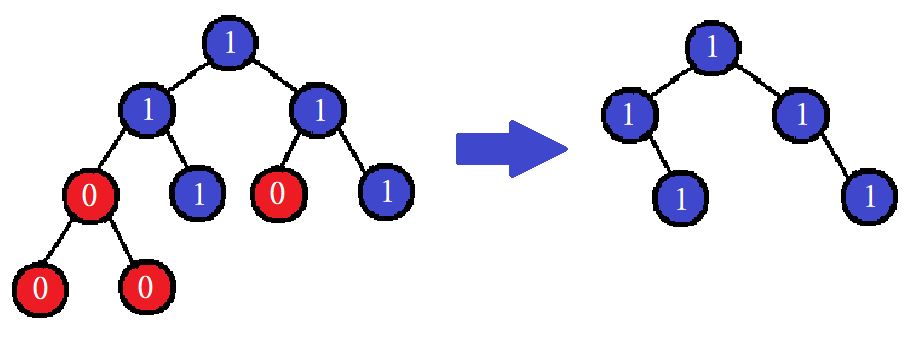
Output: [1, 1, 1, -1, 1, -1, 1, -1, -1, -1, -1]

For example, the input for the tree depicted in the below image would be :
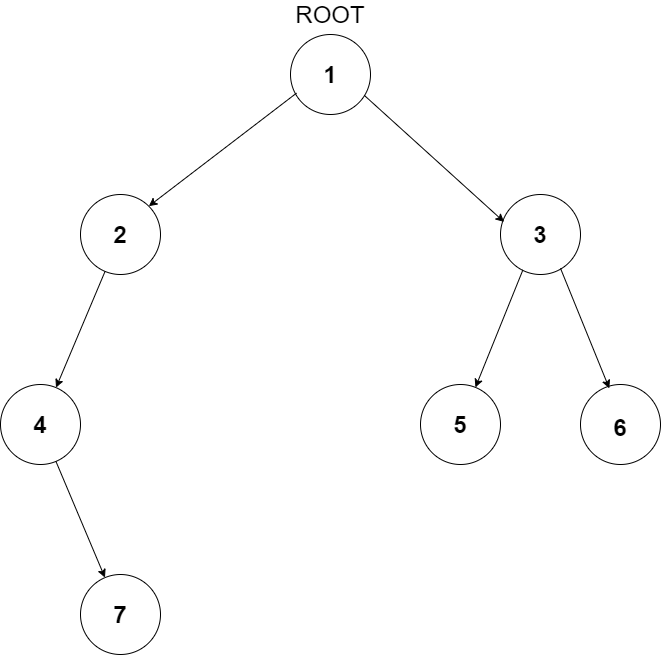
1
2 3
4 -1 5 6
-1 7 -1 -1 -1 -1
-1 -1
Explanation :
Level 1 :
The root node of the tree is 1

Level 2 :
Left child of 1 = 2
Right child of 1 = 3

Level 3 :
Left child of 2 = 4
Right child of 2 = null (-1)
Left child of 3 = 5
Right child of 3 = 6

Level 4 :
Left child of 4 = null (-1)
Right child of 4 = 7
Left child of 5 = null (-1)
Right child of 5 = null (-1)
Left child of 6 = null (-1)
Right child of 6 = null (-1)

Level 5 :
Left child of 7 = null (-1)
Right child of 7 = null (-1)

The first not-null node (of the previous level) is treated as the parent of the first two nodes of the current level. The second not-null node (of the previous level) is treated as the parent node for the next two nodes of the current level and so on.
The input ends when all nodes at the last level are null (-1).
Note :
The above format was just to provide clarity on how the input is formed for a given tree.

The sequence will be put together in a single line separated by a single space. Hence, for the above-depicted tree, the input will be given as:
1 2 3 4 -1 5 6 -1 7 -1 -1 -1 -1 -1 -1
2. Cycle Detection in a Singly Linked List
Moderate
15m average time
80% success
0/80
Asked in companies



You are given a Singly Linked List of integers. Return true if it has a cycle, else return false.
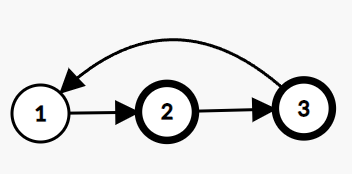
A cycle occurs when a node's next points back to a previous node in the list.
Example:
In the given linked list, there is a cycle, hence we return true.


Here's your problem of the day 
Solving this problem will increase your chance to get selected in this company
Skill covered: Programming
How do you remove whitespace from the start of a string?
Choose another skill to practice
Similar interview experiences
Software Engineer
3 rounds | 5 problems
Interviewed by Protium
Selected 
1363 views

0 comments

0 upvotes
Frontend Engineer
3 rounds | 9 problems
Interviewed by Protium
Selected 1044 views
0 comments
0 upvotes

SDE - 1
4 rounds | 8 problems
Interviewed by Amazon
Selected 11211 views
0 comments
0 upvotes
SDE - Intern
1 rounds | 3 problems
Interviewed by Amazon
Selected 4456 views
0 comments
0 upvotes
Companies with similar interview experiences

Software Engineer
3 rounds | 7 problems
Interviewed by Optum
 Selected
 8607 views
1 comments
0 upvotes

Software Engineer
5 rounds | 5 problems
Interviewed by Microsoft
 Selected
 11120 views
1 comments
0 upvotes
Software Engineer
2 rounds | 4 problems
Interviewed by Amazon
Selected 5208 views
1 comments
0 upvotes