





Quadrical AI interview experience Real time questions & tips from candidates to crack your interview
SDE - Intern
Quadrical AI


3 rounds | 6 Coding
problems

 Selected
 Interview preparation journey

Journey
I started my coding journey on YouTube, where I first learned the data structure and Algorithm. Then, I started my preparation of Data Structure and Algorithms on CodeStudio.
Application story
I applied through a referral from a senior. Then, they sent a confirmation email for further rounds. I needed to upload my resume to the Google form shared by HR.
Why selected/rejected for the role?
I was selected because I could give precise and optimized solutions to the questions. I could also dry-run the code. The interviewer was impressed by my approach.
Preparation
Duration: 4 months
Topics: Data Structures, Pointers, OOPS, Algorithms, Dynamic Programming, System Design, LinkedList and Graphs

Tip 1: Practice at least 250 questions on coding platforms.
Tip 2: Complete at least 2 projects.
Application process
Where: Campus
Eligibility: 6.5 CGPA
Tip 1: Have some projects on your resume.
Tip 2: Do not include false information on your resume.
Tip 3: Only list the skills that you are confident in.

Interview rounds
01
Round
Medium
Online Coding Test
Duration60 minutes
Interview date2 Jan 2023
Coding problem2
1. Check If Linked List Is Palindrome
Easy
15m average time
85% success

0/40
Asked in companies



You are given a Singly Linked List of integers. You have to return true if the linked list is palindrome, else return false.
A Linked List is a palindrome if it reads the same from left to right and from right to left.
Example:
The lists (1 -> 2 -> 1), (3 -> 4 -> 4-> 3), and (1) are palindromes, while the lists (1 -> 2 -> 3) and (3 -> 4) are not.
Problem approach
Use the two-pointer technique to solve this problem.
2. Distinct Subsequences
Moderate
10m average time
80% success
0/80
Asked in companies



You have been given string 'S' of length 'N' that may contain duplicate alphabets. Your task is to return the count of distinct subsequences of it.
For example:
For the given string “deed” :
The possible subsequences are {“”}, {“d”}, {“e”}, {“de”}, {“e”}, {“de”}, {“ee”}, {“dee”}, {“d”}, {“dd”}, {“ed”}, {“ded”}, {“ed”}, {“ded”}, {“eed”} and {“deed”}.

As, {“d”}, {“e”}, {“de”}, {“ed”} and {“ded”} are repeated.

The distinct subsequences are {“”}, {“d”}, {“e”}, {“de”}, {“ee”}, {“dee”}, {“dd”}, {“ed”}, {“ded”}, {“eed”} and {“deed”}

Thus, the output will be 11.
Note:
As the answer can be large, return your answer modulo 10^9 + 7.
Problem approach
First, create a queue of pairs and push only those elements in the queue which is rotten, after that run a while loop until the queue is empty and pop elements and push nearby elements that are not rotten and make them rotten.
02
Round
Medium
Video Call
Duration45 minutes
Interview date4 Jan 2023
Coding problem2
1. Reverse Linked List
Moderate
15m average time
85% success
0/80
Asked in companies



Given a singly linked list of integers. Your task is to return the head of the reversed linked list.
For example:
The given linked list is 1 -> 2 -> 3 -> 4-> NULL. Then the reverse linked list is 4 -> 3 -> 2 -> 1 -> NULL and the head of the reversed linked list will be 4.
Follow Up :
Can you solve this problem in O(N) time and O(1) space complexity?
Problem approach
Initialize three pointers prev as NULL, curr as head, and next as NULL.
Iterate through the linked list. In a loop, do the following:
Before changing the next of curr, store the next node
next = curr -> next
Now update the next pointer of curr to the prev
curr -> next = prev
Update prev as curr and curr as next
prev = curr
curr = next
2. Is SubSequence
Easy
10m average time
90% success
0/40
Asked in companies



You have been given two strings ‘STR1’ and ‘STR2’.
Your task is to find if ‘STR1’ is a subsequence of ‘STR2’.
A subsequence of a string is a new string that can be derived from the original string by deleting some characters (can be none) without changing the relative ordering of other characters.
Example:
‘ACE’ is a subsequence of ‘ABCDE’ because ‘ACE’ can be formed by deleting ‘B’ and ‘D’ without changing the relative order of characters. ‘ADB’ is not a subsequence of ‘ABCDE’ because we can get ‘ABD’ from ‘ABCDE’ but not ‘ADB’ and in ‘ADB’ relative order of ‘B’ and ‘D’ are different from original strings.
Note:
1.Strings ‘STR1’ and ‘STR2’ consists only of English uppercases.

2.Length of string ‘STR2’ will always be greater than or equal to the length of string ‘STR1’.
Example:
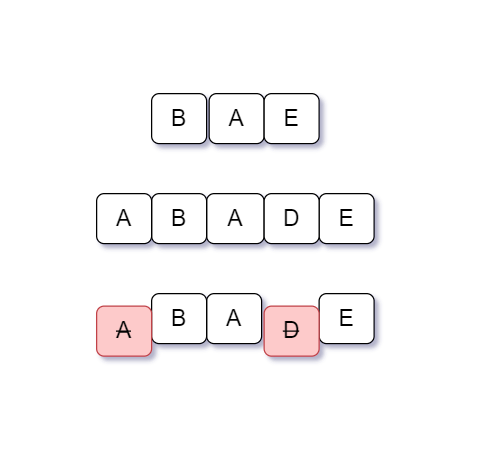
For example, the given ‘STR1’ is ‘BAE’ and ‘STR2’ is ‘ABADE’.
String ‘STR1’ is a subsequence of string ‘STR2’ because ‘BAE’ can be formed by deleting ‘A’ and ‘D’ from ‘ABADE’ and the relative ordering of the characters of the string ‘ABADE’ persists.
Problem approach
Run from the end of both strings and each time if s[i]==t[j] then i-- and j-- and if s[i]!=t[j] then j--. If in the end, i comes to be -1 it means the whole string is found in sequence in t
03
Round
Easy
Online Coding Interview
Duration60 minutes
Interview date10 Jan 2023
Coding problem2
1. Tiling Problem
Hard
45m average time
0/120
Asked in companies


You have been given a board where there are '2' rows and 'N' columns. You have an infinite supply of 2x1 tiles, and you can place a tile in the following ways:
1. Horizontally as 1x2 tile
2. Vertically as 2x1 tile
Count the number of ways to tile the given board using the available tiles.
Note :
The number of ways might be large so output your answer modulo 10^9 + 7.
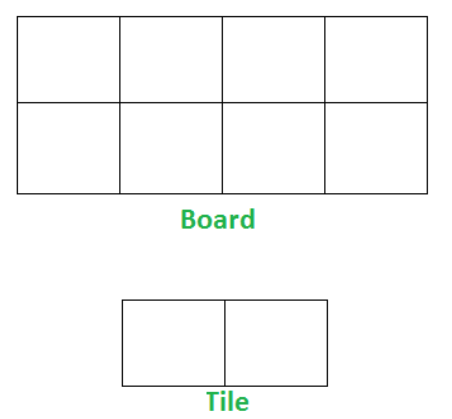
Here an example of tile and board for 'N' = 4 :
2. Puzzle
There are 3 jars, namely, A, B, C. All of them are mislabeled. Following are the labels of each of the jars:A: CandiesB: SweetsC: Candies and Sweets (mixed in a random proportion)You can put your hand in a jar and pick only one eatable at a time. Tell the minimum number of eatable(s) that has/have to be picked to label the jars correctly. (Learn)


Here's your problem of the day 
Solving this problem will increase your chance to get selected in this company
Skill covered: Programming
How do you remove whitespace from the start of a string?
Choose another skill to practice
Similar interview experiences

SDE - 1
3 rounds | 7 problems
Interviewed by OYO
 Selected
6182 views

0 comments

0 upvotes
SDE - Intern
2 rounds | 3 problems
Interviewed by Amazon
Rejected
1566 views
0 comments
0 upvotes
SDE - 1
2 rounds | 5 problems
Interviewed by Meesho
Rejected
7245 views
0 comments
0 upvotes
SDE - 1
3 rounds | 9 problems
Interviewed by Salesforce
 Selected
 4552 views
0 comments
0 upvotes
Companies with similar interview experiences
SDE - Intern
3 rounds | 6 problems
Interviewed by Amazon

Rejected
16212 views
4 comments
0 upvotes

SDE - Intern
4 rounds | 7 problems
Interviewed by Microsoft
 Selected
 16223 views
1 comments
0 upvotes
SDE - Intern
2 rounds | 4 problems
Interviewed by Amazon
Selected 10541 views
2 comments
0 upvotes