





Qualcomm interview experience Real time questions & tips from candidates to crack your interview

SDE - 1
Qualcomm


2 rounds | 5 Coding
problems

Rejected
Interview preparation journey

Journey
I have followed the Striver's Coding Sheet which consists of 180 coding questions. I had started preparing just 2 months before the placements. I revised the striver's sheet at least 5 times before the placements.
Application story
I applied through on-campus placements. The online assessment exam consisted of aptitude questions, which were easy but time-consuming. This was followed by basic C input-output questions and other CS fundamentals.
Why selected/rejected for the role?
My name was neither on the selected list nor on the rejected list. Some were saying that the company might reconsider me when it visits for the second time. Nevertheless, I suppose I could have prepared for C language a bit more. Since I was proficient in Java, it was a bit tough to write code from scratch in C.
Preparation
Duration: 2.5 Months
Topics: Data Structures and Algorithms, Operating Systems, DBMS, C language, Computer Networks.

Tip 1: Start as early as possible.
Tip 2: Along with DSA, CS fundamentals are also equally important.
Tip 3: Must know 2-3 approaches to solve a problem along with the most optimal one.
Application process
Where: Campus
Eligibility: 7 CGPA
Tip 1: Do not include false information on your resume.
Tip 2: Thoroughly prepare for questions and answers about the projects you have implemented.

Interview rounds
01
Round
Medium
Video Call
Duration45 Minutes
Interview date17 Jul 2022
Coding problem3
The round was conducted via video call. The interviewer was polite. The interview took place in the morning, around 10.
1. Stack Implementation Using Array
Easy
20m average time
70% success

0/40
Asked in companies


Stack is a data structure that follows the LIFO (Last in First out) principle. Design and implement a stack to implement the following functions:
1. Push(num): Push the given number in the stack if the stack is not full.

2. Pop: Remove and print the top element from the stack if present, else print -1.

3. Top: Print the top element of the stack if present, else print -1.

4. isEmpty: Print 1 if the stack is empty, else print 0.

5. isFull: Print 1 if the stack is full, else print 0.
You have been given ‘m’ operations which you need to perform in the stack. Your task is to implement all the functions of the stack.
Example:
We perform the following operations on an empty stack which has capacity 2:

When operation 1 1 is performed, we insert 1 in the stack.

When operation 1 2  is performed, we insert 2 in the stack.

When operation 2 is performed, we remove the top element from the stack and print 2.

When operation 3 is performed, we print the top element of the stack, i.e., 3.

When operation 4 is performed, we print 0 because the stack is not empty.

When operation 5 is performed, we print 0 because the stack is size 1, which is not equal to its capacity.
2. Reverse Level Order Traversal
Moderate
30m average time
52% success
0/80
Asked in companies



You have been given a Binary Tree of integers. You are supposed to return the reverse of the level order traversal.
For example:
For the given binary tree
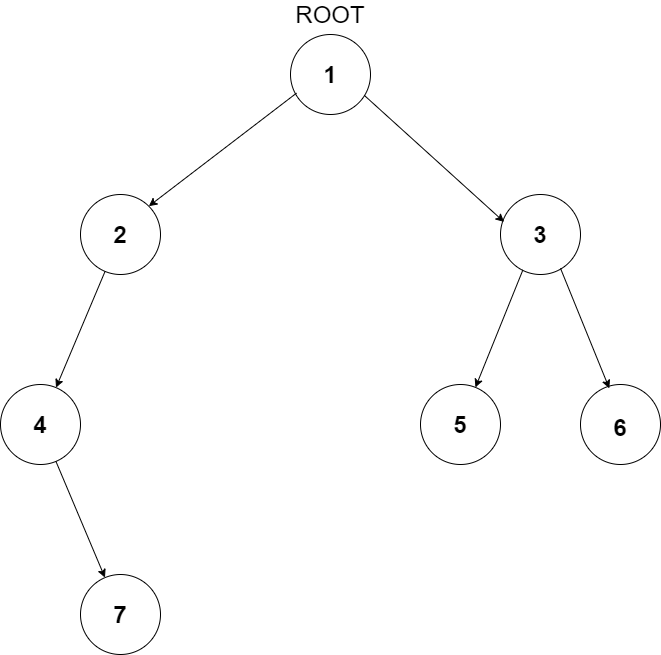
The reverse level order traversal will be {7,6,5,4,3,2,1}.
3. Middle Of Linked List
Easy
20m average time
80% success
0/40
Asked in companies

Given a singly linked list of 'N' nodes. The objective is to determine the middle node of a singly linked list. However, if the list has an even number of nodes, we return the second middle node.
Note:
1. If the list is empty, the function immediately returns None because there is no middle node to find.
2. If the list has only one node, then the only node in the list is trivially the middle node, and the function returns that node.
02
Round
Hard
Video Call
Duration45 minutes
Interview date17 Jul 2022
Coding problem2
1. LRU Cache Implementation
Moderate
25m average time
65% success
0/80
Asked in companies



Design and implement a data structure for Least Recently Used (LRU) cache to support the following operations:
1. get(key) - Return the value of the key if the key exists in the cache, otherwise return -1.

2. put(key, value), Insert the value in the cache if the key is not already present or update the value of the given key if the key is already present. When the cache reaches its capacity, it should invalidate the least recently used item before inserting the new item.
You will be given ‘Q’ queries. Each query will belong to one of these two types:
Type 0: for get(key) operation.
Type 1: for put(key, value) operation.
Note :
1. The cache is initialized with a capacity (the maximum number of unique keys it can hold at a time).

2. Access to an item or key is defined as a get or a put operation on the key. The least recently used key is the one with the oldest access time.
2. Maximum of all Subarrays of size K
Easy
15m average time
85% success
0/40
Asked in companies

You are given an array “A” of N integers. Your task is to find the maximum element in all K sized contiguous subarrays from left to right.
For Example:
If A = [3, 2, 3], and K = 2.
Then max of [3, 2] = 3 and max of [2, 3] = 3
So, the answer will be [3, 3]

If A = [3, 2, 3, 5, 1, 7] and K = 3.
Then max of [3, 2, 3] = 3
Then max of [2, 3, 5] = 5
Then max of [3, 5, 1] = 5
Then max of [5, 1, 7] = 7
So  the answer will be [3, 5, 5, 7]
Follow Up :
Can you solve the problem in O(N) time complexity and O(K) space complexity?


Here's your problem of the day 
Solving this problem will increase your chance to get selected in this company
Skill covered: Programming
How do you remove whitespace from the start of a string?
Choose another skill to practice
Similar interview experiences
SDE - 1
2 rounds | 3 problems
Interviewed by Qualcomm
Rejected

2804 views

0 comments

0 upvotes
SDE - 1
4 rounds | 3 problems
Interviewed by Qualcomm

 Selected
 1871 views
0 comments
0 upvotes
SDE - 1
3 rounds | 8 problems
Interviewed by Qualcomm

Rejected
2544 views
0 comments
0 upvotes
SDE - 1
2 rounds | 3 problems
Interviewed by Qualcomm
 Selected
 1872 views
0 comments
0 upvotes
Companies with similar interview experiences
SDE - 1
5 rounds | 12 problems
Interviewed by Amazon
 Selected
 117552 views
24 comments
0 upvotes
SDE - 1
4 rounds | 5 problems
Interviewed by Microsoft
Selected 60143 views
5 comments
0 upvotes
SDE - 1
3 rounds | 7 problems
Interviewed by Amazon
 Selected
 36138 views
7 comments
0 upvotes