





Quikr interview experience Real time questions & tips from candidates to crack your interview

SDE - 1
Quikr


3 rounds | 6 Coding
problems

Rejected
Interview preparation journey

Journey
I started my journey from a government school where I was first introduce with the computer when I was at my 11 th standard now I am a software developer.
Application story
This company visited our campus to hire their only I applied for the same it has many round starting with online assessment.
Why selected/rejected for the role?
I was not able to provide all the answers upto the points and hence i am not able to get through the interview .
Preparation
Duration: 4 months
Topics: Data Structures, Pointers, OOPS, System Design, Algorithms, Dynamic Programming

Tip 1 : Mention some good projects on resume
Tip 2 : Be confident
Tip 3 : Good with computer science basics and ds and algo
Application process
Where: Campus
Eligibility: Above 6 CGPA
Tip 1 : Good Projects
Tip 2 : Having some achievements is plus point

Interview rounds
01
Round
Hard
Video Call
Duration60 minutes
Interview date21 Jan 2022
Coding problem2
1. Word Break
Moderate
15m average time
85% success

0/80
Asked in companies



You are given a list of “N” strings A. Your task is to check whether you can form a given target string using a combination of one or more strings of A.
Note :
You can use any string of A multiple times.
Examples :
A =[“coding”, ”ninjas”, “is”, “awesome”]  target = “codingninjas”
Ans = true as we use “coding” and “ninjas” to form “codingninjas”
Problem approach
You are given a list of “N” strings A. Your task is to check whether you can form a given target string using a combination of one or more strings of A.
2. Maximum Level Sum
Moderate
20m average time
80% success
0/80
Asked in companies


You are given a tree consisting of ‘N’ nodes. Your task is to find the level of the tree with the maximum sum.
The level of a node of the tree is the distance of the node from the root node + 1.
For example:
You are given the tree:
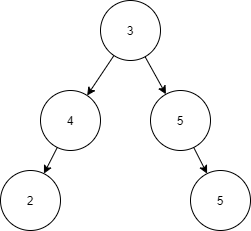
The Sum of all the levels are = [3, 9, 7], Here the level whose sum is maximum is level 2. Hence the answer is 2.
Example:
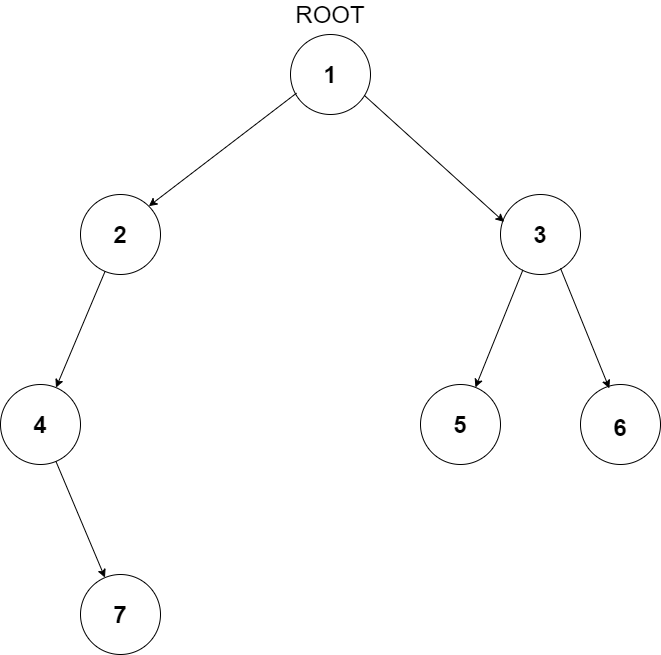
Elements are in the level order form. The input consists of values of nodes separated by a single space in a single line. In case a node is null, we take -1 in its place.

For example, the input for the tree depicted in the below image would be :
1
2 3
4 -1 5 6
-1 7 -1 -1 -1 -1
-1 -1

Explanation :
Level 1 :
The root node of the tree is 1

Level 2 :
Left child of 1 = 2
Right child of 1 = 3

Level 3 :
Left child of 2 = 4
Right child of 2 = null (-1)
Left child of 3 = 5
Right child of 3 = 6

Level 4 :
Left child of 4 = null (-1)
Right child of 4 = 7
Left child of 5 = null (-1)
Right child of 5 = null (-1)
Left child of 6 = null (-1)
Right child of 6 = null (-1)

Level 5 :
Left child of 7 = null (-1)
Right child of 7 = null (-1)

The first not-null node (of the previous level) is treated as the parent of the first two nodes of the current level.

The second not-null node (of the previous level) is treated as the parent node for the next two nodes of the current level and so on.

The input ends when all nodes at the last level are null (-1).
Note :
The above format was just to provide clarity on how the input is formed for a given tree.

The sequence will be put together in a single line separated by a single space. Hence, for the above-depicted tree, the input will be given as:

1 2 3 4 -1 5 6 -1 7 -1 -1 -1 -1 -1 -1
Problem approach
You have been given a binary tree of integers. Your task is to calculate the sum of all the leaf nodes which are present at the deepest level of this binary tree. If there are no such nodes, print 0.
02
Round
Easy
Video Call
Duration60 minutes
Interview date21 Jan 2022
Coding problem2
1. Add Two Numbers As Linked Lists
Moderate
20m average time
80% success
0/80
Asked in companies



You are given two non-negative numbers 'num1' and 'num2' represented in the form of linked lists.
The digits in the linked lists are stored in reverse order, i.e. starting from least significant digit (LSD) to the most significant digit (MSD), and each of their nodes contains a single digit.
Calculate the sum of the two numbers and return the head of the sum list.
Example :
Input:
'num1' : 1 -> 2 -> 3 -> NULL
'num2' : 4 -> 5 -> 6 -> NULL

Output: 5 -> 7 -> 9 -> NULL

Explanation: 'num1' represents the number 321 and 'num2' represents 654. Their sum is 975.
Problem approach
You are given two linked lists representing two non-negative numbers. The digits in the linked list are stored in reverse order, i.e. starting from least significant digit (LSD) to the most significant digit (MSD), and each of their nodes contains a single digit. Your task is to find the sum list and return the head of the sum list where the sum list is a linked list representation of the addition of two numbers.
2. Reverse A Doubly Linked List
Easy
15m average time
85% success
0/40
Asked in companies



You are given a doubly-linked list of size 'N', consisting of positive integers. Now your task is to reverse it and return the head of the modified list.
Note:
A doubly linked list is a kind of linked list that is bidirectional, meaning it can be traversed in both forward and backward directions.
Example:
Input:
4
4 3 2 1

This means you have been given doubly linked list of size 4 = 4 <-> 3 <-> 2 <-> 1.

Output:
1 2 3 4

This means after reversing the doubly linked list it becomes 1 <-> 2 <-> 3 <-> 4.
Problem approach
You are given a doubly-linked list of size 'N', consisting of positive integers. Now your task is to reverse it and return the head to the modified list.
03
Round
Easy
Video Call
Duration60 minutes
Interview date21 Jan 2022
Coding problem2
1. Roots of the tree having minimum height
Moderate
25m average time
75% success
0/80
Asked in companies


You are given an undirected Tree having 'N' nodes. The nodes are numbered from 1 to 'N'. Your task is to find the sorted list of all such nodes, such that rooting the tree on that node gives the minimum height possible of the given tree.
A tree is a connected acyclic graph. The height of a rooted tree is the maximum value of the distance between the root and all nodes of the tree.
Problem approach
You are given an undirected Tree having 'N' nodes. The nodes are numbered from 1 to 'N'. Your task is to find the sorted list of all such nodes, such that rooting the tree on that node gives the minimum height possible of the given tree.
2. First Missing Positive
Moderate
18m average time
84% success
0/80
Asked in companies


You are given an array 'ARR' of integers of length N. Your task is to find the first missing positive integer in linear time and constant space. In other words, find the lowest positive integer that does not exist in the array. The array can have negative numbers as well.
For example, the input [3, 4, -1, 1] should give output 2 because it is the smallest positive number that is missing in the input array.
Problem approach
You are given an array 'ARR' of integers of length N. Your task is to find the first missing positive integer in linear time and constant space. In other words, find the lowest positive integer that does not exist in the array. The array can have negative numbers as well.


Here's your problem of the day 
Solving this problem will increase your chance to get selected in this company
Skill covered: Programming
How do you remove whitespace from the start of a string?
Choose another skill to practice
Similar interview experiences
SDE - 1
2 rounds | 3 problems
Interviewed by Quikr
 Selected
0 views

0 comments

0 upvotes
SDE - 1
2 rounds | 4 problems
Interviewed by Quikr
Selected 871 views
0 comments
0 upvotes
SDE - 1
2 rounds | 4 problems
Interviewed by Quikr
Rejected
909 views
0 comments
0 upvotes
SDE - 1
3 rounds | 6 problems
Interviewed by Quikr
Selected 888 views
0 comments
0 upvotes
Companies with similar interview experiences
SDE - 1
5 rounds | 12 problems
Interviewed by Amazon
 Selected
 117552 views
24 comments
0 upvotes
SDE - 1
4 rounds | 5 problems
Interviewed by Microsoft
Selected 60143 views
5 comments
0 upvotes
SDE - 1
3 rounds | 7 problems
Interviewed by Amazon
 Selected
 36138 views
7 comments
0 upvotes