





Rakuten India interview experience Real time questions & tips from candidates to crack your interview

SDE - 1
Rakuten India


3 rounds | 7 Coding
problems

 Selected
 Interview preparation journey

Journey
From the 1st semester onward, I started doing competitive coding and building logical ability. Then, from the 3rd semester, I started using online platforms to prepare for the internship season. I finished that preparation in just 4 months and kept revising it until I could solve questions just by looking at their names. After the internship season, I started learning about web development and also solving online coding questions. I created good e-commerce websites and solved around 600 questions on online coding platforms. When my placement season came, I got placed in just the 2nd week.
Application story
This company visited our campus, which is why every student is eligible to take the online assessment (coding round) test. After this round, all those who qualify will be eligible for interviews.
Why selected/rejected for the role?
I was selected because I have developed skills in DSA, problem-solving, web development, and logical building ability. I also prepared for the HR round, and since I was already familiar with the questions from my extracurricular activities, I was able to answer them correctly.
Preparation
Duration: 6 Months
Topics: DSA, Dynamic Programming, Tree, Graph, Arrays, Hash Table, OOPS, DBMS, OS, Computer Network

Tip 1: Don't learn the question; learn the concept.
Tip 2: First solve the question by yourself, then look for others' solutions.
Tip 3: The quality of the question matters more than quantity (try to do the most liked and most asked questions).
Tip 4: Have at least one good project, and make sure you know all the technologies used in that project.
Application process
Where: Campus
Eligibility: above 7 CGPA
Tip 1: The resume should not be longer than one page.
Tip 2: You must be aware of everything that is written in the resume.
Tip 3: Highlight your job-related achievements and experience.

Interview rounds
01
Round
Easy
Online Coding Test
Duration60 minutes
Interview date11 Oct 2022
Coding problem2
First, the interviewer asked me to introduce myself. Then he started asking questions related to my project, which we discussed for around 15 minutes. After that, he asked about DSA and posed 2 DSA questions.
1. Merge overlapping intervals
Easy
10m average time
90% success

0/40
Asked in companies



Given 'N' number of intervals, where each interval contains two integers denoting the boundaries of the interval. The task is to merge all the overlapping intervals and return the list of merged intervals sorted in ascending order.
Two intervals will be considered to be overlapping if the starting integer of one interval is less than or equal to the finishing integer of another interval, and greater than or equal to the starting integer of that interval.
Example:
for the given 5 intervals - [1,4], [3,5], [6,8], [10,12], [8,9].
Since intervals [1,4] and [3,5] overlap with each other, we will merge them into a single interval as [1,5].

Similarly [6,8] and [8,9] overlaps, we merge them into [6,9].

Interval [10,12] does not overlap with any interval.

Final List after merging overlapping intervals: [1,5], [6,9], [10,12]
Problem approach
We just need to push the new interval vector to the intervals vector. Then we can sort the intervals vector. Now proceed the same as in the merge intervals problem.
2. LCA Of Binary Tree
Moderate
10m average time
90% success
0/80
Asked in companies



You have been given a Binary Tree of distinct integers and two nodes ‘X’ and ‘Y’. You are supposed to return the LCA (Lowest Common Ancestor) of ‘X’ and ‘Y’.
The LCA of ‘X’ and ‘Y’ in the binary tree is the shared ancestor of ‘X’ and ‘Y’ that is located farthest from the root.
Note :
You may assume that given ‘X’ and ‘Y’ definitely exist in the given binary tree.
For example :
For the given binary tree
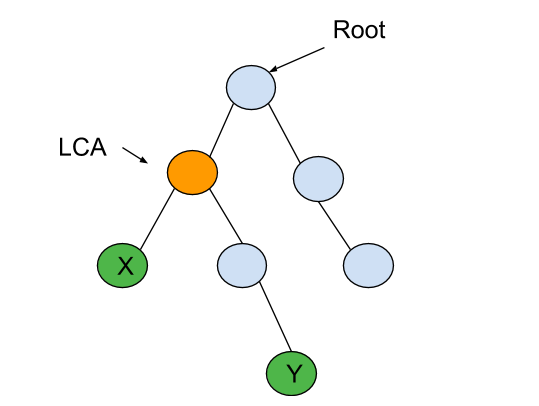
LCA of ‘X’ and ‘Y’ is highlighted in yellow colour.
Problem approach
A node is the LCA if we find p and q in the left and right subtrees of that node. One has to be from the left subtree and one from the right.
If we land on p or q before finding a node that fits the first criteria above, then the node we landed on (p or q) is the LCA.
If we search the left and right subtrees of a node and don't find p or q in a subtree (it returns NULL), that means we can ignore the subtree where we didn't find p or q.
02
Round
Easy
Online Coding Test
Duration60 minutes
Interview date12 Oct 2022
Coding problem2
The interview first asked me to introduce myself, followed by a few questions related to the project. Then he jumped onto the DSA part, where he asked me two DSA questions one by one, and I was capable of solving all of them as I had done those questions on online coding platforms.
1. Min Jumps
Easy
15m average time
85% success
0/40
Asked in companies



You live in a Ninja town which is in the form of a N * M grid. In this town, people travel from one place to another by jumping over the buildings which are present in each cell of the grid. It is Christmas eve, and Santa wants to give gifts and chocolates to the kids who live in the building which is present at the cell (N - 1, M - 1). Initially, Santa is present on cell (0, 0). Since Santa is in a hurry, help him find a path from starting point to the endpoint with the least amount of time.
The Santa may go only from one building to any of its adjacent buildings which is present either to the right or to the bottom or bottom right cell i.e. if the current position is (x, y), he may go to (x + 1, y + 1) or (x + 1, y) or (x, y + 1) given that the new coordinates are in the grid. The time taken to reach from one building to another is equal to the absolute difference between the heights of buildings.
Note:
1. The heights of the buildings are positive.
2. Santa starts from the cell (0, 0) and he has to reach the building (N - 1, M - 1).
3. Santa cannot leave the grid at any point of time.
Problem approach
Initialize a variable reach to 0, which represents the farthest index that can be reached so far.
Loop through the array nums and for each index i, do the following:
a. If i is greater than reach or reach is greater than or equal to nums.length - 1, break the loop as it means reaching the last index is not possible.
b. Update the value of reach as the maximum of reach and i + nums[i].
Return reach >= nums.length - 1, which means whether the last index can be reached or not.
2. Reach the destination
Easy
15m average time
85% success
0/40
Asked in companies


Given a source point (sx, sy) and a destination point (dx, dy), the task is to check if it is possible to reach the destination point using the following valid moves:
(a, b) -> (a + b, b)
(a, b) -> (a, a + b)
Your task is to find if it is possible to reach the destination point using only the desired moves or not.
For example:
For the coordinates, source point = (1, 1) and destination point = (3, 5)
The output will be true as the destination point can be reached using the following sequence of moves:
(1, 1) -> (1, 2) -> (3, 2) -> (3, 5)
03
Round
Easy
HR Round
Duration25 minutes
Interview date13 Oct 2022
Coding problem3
Firstly, he asked me to introduce myself. Then he started asking about my hobbies, background, curricular activities, and also focused on my situation-based skills.
1. Basic HR Question
Tell me about yourself.
Problem approach
Tip 1: Do not ask the interviewer what he wants to know about you. You may be asking genuinely, but that just sounds rude.
Tip 2: Do not speak what is already there in the resume. The interviewer wants to know what they have not seen on the resume. And do not speak about anything personal.
Tip 3: Introduce yourself by including certain adjectives like problem-solving, innovative, tech-savvy, creative, quick learner, etc., that best describe you in your professional life to boost your chances.
2. Basic HR Question
If your teammate takes all the credit for your work, and only you and the manager know this, what will you do in that situation?
Problem approach
Tip 1: Let them know that you sometimes don't mind these situations.
Tip 2: Also, talk to your manager about the matter.
3. Basic HR Question
Was there any point in your career where you made a mistake?
Problem approach
Tip 1: Talk about a mistake you made which you were able to rectify and which didn’t cause any critical damage to your organization.
Tip 2: Talk about what you learned while working on fixing the mistake.
Tip 3: Avoid any mistake that represents a flaw in your personality.


Here's your problem of the day 
Solving this problem will increase your chance to get selected in this company
Skill covered: Programming
How do you remove whitespace from the start of a string?
Choose another skill to practice
Similar interview experiences
SDE - 1
3 rounds | 3 problems
Interviewed by Rakuten India
 Selected
1954 views

0 comments

0 upvotes
SDE - 1
3 rounds | 4 problems
Interviewed by Rakuten India
Selected 1508 views
0 comments
0 upvotes
SDE - 1
3 rounds | 5 problems
Interviewed by Rakuten India
Selected 1177 views
0 comments
0 upvotes
SDE - 1
3 rounds | 6 problems
Interviewed by Rakuten India
Rejected
1223 views
0 comments
0 upvotes
Companies with similar interview experiences

SDE - 1
2 rounds | 3 problems
Interviewed by BNY Mellon
 Selected
 6786 views
3 comments
0 upvotes
SDE - 1
3 rounds | 6 problems
Interviewed by BNY Mellon
 Selected
 0 views
0 comments
0 upvotes

SDE - 1
3 rounds | 5 problems
Interviewed by CIS - Cyber Infrastructure
Selected 2419 views
0 comments
0 upvotes