





Reliance Jio interview experience Real time questions & tips from candidates to crack your interview

SDE - 1
Reliance Jio


4 rounds | 6 Coding
problems

 Selected
 Interview preparation journey

Preparation
Duration: 6 months
Topics: DSA, OOPS, MERN STACK, DBMS, Technologies used in Projects

Tip 1 : Practice DSA daily with at least 1-2 questions, and participate in a contest
Tip 2 : Make 2-3 good projects which you could tell in great detail
Application process
Where: Campus
Eligibility: 7 CGPA
Tip 1 : Resume should be one page at most
Tip 2 : Try to avoid adding things that are insignificant (like preschool achievements, no of DSA questions you solved)
Tip 3 : Don't add projects or experiences you have no idea off

Interview rounds
01
Round
Medium
Online Coding Test
Duration50 minutes
Interview date3 Sep 2020
Coding problem2
1. Number of Islands
Easy

0/40
Asked in companies



You have been given a non-empty grid consisting of only 0s and 1s. You have to find the number of islands in the given grid.
An island is a group of 1s (representing land) connected horizontally, vertically or diagonally. You can assume that all four edges of the grid are surrounded by 0s (representing water).
Problem approach
Using Graph
2. Minimum Steps
Easy
0/40
Asked in companies


You are given an integer ‘N,’ and your task is to find the minimum steps to reach from 1 to 'N'. There are also ‘M’ mines on which you can not move.
In each step, you can move in the following way:
1 - You move either 1 or 2 steps forward.

2 - Whenever you are at a prime number, you can make a special move, where you can move to the sum of digits in (Count the number of primes before the current prime + Difference between the next prime and current number) until it becomes a single-digit number.

3- If you make a special move, you can’t make another special move for the next ‘L’ moves.
For Example:
You are given ‘N’ = 10, L = 2, and mines = [6], Here you can make the following moves for minimum path 1 -> 3 -> 5 (special move) -> 9 -> 10. Hence the answer is 4.
02
Round
Medium
Video Call
Duration60 minutes
Interview date10 Sep 2020
Coding problem1
Coding problem + all technology listed in my resume
1. Group Anagrams Together
Moderate
0/80
Asked in companies



You have been given an array/list of strings 'STR_LIST'. You are supposed to return the strings as groups of anagrams such that strings belonging to a particular group are anagrams of one another.
Note :
An Anagram is a word or phrase formed by rearranging the letters of a different word or phrase. We can generalize this in string processing by saying that an anagram of a string is another string with the same quantity of each character in it, in any order.
Example:
{ “abc”, “ged”, “dge”, “bac” }
In the above example the array should be divided into 2 groups. The first group consists of { “abc”, “bac” } and the second group consists of { “ged”, “dge” }.
03
Round
Medium
Face to Face
Duration60 minutes
Interview date10 Sep 2020
Coding problem2
In-depth questions on my projects and 2 coding questions on binary tree
1. Bottom View Of Binary Tree
Moderate
10m average time
90% success
0/80
Asked in companies

You are given a 'Binary Tree'.
Return the bottom view of the binary tree.
Note :
1. A node will be in the bottom-view if it is the bottom-most node at its horizontal distance from the root.

2. The horizontal distance of the root from itself is 0. The horizontal distance of the right child of the root node is 1 and the horizontal distance of the left child of the root node is -1.

3. The horizontal distance of node 'n' from root = horizontal distance of its parent from root + 1, if node 'n' is the right child of its parent.

4. The horizontal distance of node 'n' from root = horizontal distance of its parent from the root - 1, if node 'n' is the left child of its parent.

5. If more than one node is at the same horizontal distance and is the bottom-most node for that horizontal distance, including the one which is more towards the right.
Example:
Input: Consider the given Binary Tree:
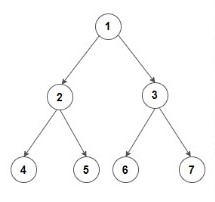
Output: 4 2 6 3 7

Explanation:
Below is the bottom view of the binary tree.

1 is the root node, so its horizontal distance = 0.
Since 2 lies to the left of 0, its horizontal distance = 0-1= -1
3 lies to the right of 0, its horizontal distance = 0+1 = 1
Similarly, horizontal distance of 4 = Horizontal distance of 2 - 1= -1-1=-2
Horizontal distance of 5 = Horizontal distance of 2 + 1=  -1+1 = 0
Horizontal distance of 6 = 1-1 =0
Horizontal distance of 7 = 1+1 = 2

The bottom-most node at a horizontal distance of -2 is 4.
The bottom-most node at a horizontal distance of -1 is 2.
The bottom-most node at a horizontal distance of 0 is 5 and 6. However, 6 is more towards the right, so 6 is included.
The bottom-most node at a horizontal distance of 1 is 3.
The bottom-most node at a horizontal distance of 2 is 7.

Hence, the bottom view would be 4 2 6 3 7
2. Symmetric Tree
Moderate
25m average time
70% success
0/80
Asked in companies



You have been given a Binary Tree having 'n' nodes.
A Symmetric tree is a binary tree whose mirror image is the same as the original tree.
Find out whether the given tree is symmetric or not.
Example :
Input: Let the binary tree be:
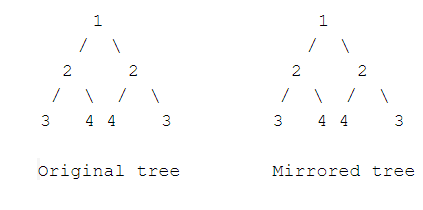
Output: YES

Explanation: As we can see in the image, the original tree is the same as the mirrored tree.
04
Round
Easy
HR Round
Duration30 minutes
Interview date10 Sep 2020
Coding problem1
Normal HR questions
1. Basic HR Questions
What is your biggest challenge in life?
How would I cope under pressure?
Why should we hire you?


Here's your problem of the day 
Solving this problem will increase your chance to get selected in this company
Skill covered: Programming
How do you remove whitespace from the start of a string?
Choose another skill to practice
Similar interview experiences
Data Analyst Intern
2 rounds | 4 problems
Interviewed by Reliance Jio
Selected 
0 views

0 comments

0 upvotes
SDE - 1
3 rounds | 7 problems
Interviewed by OYO
Selected 6182 views
0 comments
0 upvotes
Data Engineering Intern
3 rounds | 5 problems
Interviewed by Reliance Jio
Selected 940 views
0 comments
0 upvotes
SDE - 1
3 rounds | 9 problems
Interviewed by Salesforce
 Selected
 4552 views
0 comments
0 upvotes
Companies with similar interview experiences
SDE - 1
5 rounds | 12 problems
Interviewed by Amazon
 Selected
 117552 views
24 comments
0 upvotes
SDE - 1
4 rounds | 5 problems
Interviewed by Microsoft
Selected 60143 views
5 comments
0 upvotes
SDE - 1
3 rounds | 7 problems
Interviewed by Amazon
 Selected
 36138 views
7 comments
0 upvotes