





Samsung R&D Institute interview experience Real time questions & tips from candidates to crack your interview

SDE - 1
Samsung R&D Institute


3 rounds | 6 Coding
problems

 Selected
 Interview preparation journey

Preparation
Duration: 6 Months
Topics: Arrays, Hashmaps, LinkedLists, Stacks, Queues, Trees, Recursion, DP, OOPS, DBMS, CN.

Tip 1 : Practice at least 350 DSA Standard questions
Tip 2 : Build strong base of OOPS which will be very helpful for future perspective as well.
Tip 3 : Try to self explain every problem you solve so as to maintain clear and confident conversation with the interviewer at the time of interview.
Application process
Where: Campus
Eligibility: Above 7 CGPA
Tip 1 : Have at least 2 projects on resume
Tip 2 : Mention all your coding platform based achievements (even number of questions solved in DSA) in resume.

Interview rounds
01
Round
Medium
Online Coding Test
Duration80 minutes
Interview date22 Dec 2021
Coding problem3
The coding round was help near about 2 PM (approx).
The environment was good and easy to understand.
1. Next Permutation
Moderate
15m average time
85% success

0/80
Asked in companies



You have been given a permutation of ‘N’ integers. A sequence of ‘N’ integers is called a permutation if it contains all integers from 1 to ‘N’ exactly once. Your task is to rearrange the numbers and generate the lexicographically next greater permutation.
To determine which of the two permutations is lexicographically smaller, we compare their first elements of both permutations. If they are equal — compare the second, and so on. If we have two permutations X and Y, then X is lexicographically smaller if X[i] < Y[i], where ‘i’ is the first index in which the permutations X and Y differ.
For example, [2, 1, 3, 4] is lexicographically smaller than [2, 1, 4, 3].
2. Identical Trees
Moderate
20m average time
85% success
0/80
Asked in companies



You are given two binary trees with 'n' and 'm' nodes respectively.
You need to return true if the two trees are identical. Otherwise, return false.
Example:
For the trees given below:-
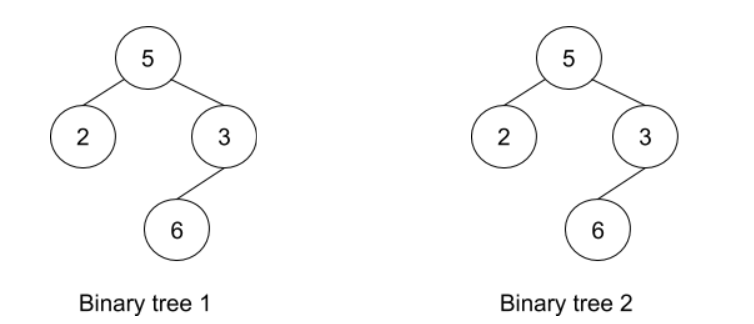
The given trees are identical as:-
1. The number of nodes in both trees is the same.
2. The number of edges in both trees is the same.
3. The data for root for both the trees is the same i.e 5.
4. The data of root -> left (root’s left child) for both the trees is the same i.e 2.
5. The data of root -> right (root’s right child) for both the trees is the same i.e 3.
6. The data of root -> right -> left ( left child of root’s right child) for both the trees is the same i.e 6.
7. Nodes with data 2 and 6 are the leaf nodes for both the binary trees.
3. Find Non - Repeating Numbers
Easy
15m average time
85% success
0/40
Asked in companies


You are given an array of integers ‘A’ having ‘N’ number of elements. It is given that all the numbers in the array occur twice except the two numbers that appear only one time. You need to find those two non-repeating numbers.
For Example:
If the given array is [ 4, 7, 3, 2, 7, 2 ], you have to find ‘4’ and ‘3’ as 4 and 3 occur one time, and the rest of the elements ( 7 and 2 ) are occurring twice.
02
Round
Medium
Video Call
Duration60 minutes
Interview date4 Jan 2022
Coding problem3
First of all the interviewer for very friendly and helpful.
Firstly he asked me to introduce myself (which I obviously did). Then he stated that he will first ask me OOPS related questions and then he will move to DSA part.
We discussed OOPs near about 10-15 minutes in which topics were four pillars of OOPs, etc, and I was pretty confident in all of my answers and the interviewer was also quite contended by my responses.
Then he went on asking fundamental DBMS related questions, and finally asked 1 quiz related to coin swap
And by this the round ended and I got a pretty good response from the interviewer and he was very helpful at some places too wherever i got stuck.
Eventually I cleared this round.
1. Next Greater Element
Easy
10m average time
90% success
0/40
Asked in companies



You are given an array 'a' of size 'n'.
Print the Next Greater Element(NGE) for every element.
The Next Greater Element for an element 'x' is the first element on the right side of 'x' in the array, which is greater than 'x'.
If no greater elements exist to the right of 'x', consider the next greater element as -1.
For example:
Input: 'a' = [7, 12, 1, 20]

Output: NGE = [12, 20, 20, -1]

Explanation: For the given array,

- The next greater element for 7 is 12.

- The next greater element for 12 is 20.

- The next greater element for 1 is 20.

- There is no greater element for 20 on the right side. So we consider NGE as -1.
2. Rat In A Maze
Easy
15m average time
85% success
0/40
Asked in companies


You are given a starting position for a rat which is stuck in a maze at an initial point (0, 0) (the maze can be thought of as a 2-dimensional plane). The maze would be given in the form of a square matrix of order 'N' * 'N' where the cells with value 0 represent the maze’s blocked locations while value 1 is the open/available path that the rat can take to reach its destination. The rat's destination is at ('N' - 1, 'N' - 1). Your task is to find all the possible paths that the rat can take to reach from source to destination in the maze. The possible directions that it can take to move in the maze are 'U'(up) i.e. (x, y - 1) , 'D'(down) i.e. (x, y + 1) , 'L' (left) i.e. (x - 1, y), 'R' (right) i.e. (x + 1, y).
Note:
Here, sorted paths mean that the expected output should be in alphabetical order.
For Example:
Given a square matrix of size 4*4 (i.e. here 'N' = 4):
1 0 0 0
1 1 0 0
1 1 0 0
0 1 1 1
Expected Output:
DDRDRR DRDDRR
i.e. Path-1: DDRDRR and Path-2: DRDDRR

The rat can reach the destination at (3, 3) from (0, 0) by two paths, i.e. DRDDRR and DDRDRR when printed in sorted order, we get DDRDRR DRDDRR.
3. Delete Node In A Linked List
Easy
15m average time
80% success
0/40
Asked in companies


You are given a Singly Linked List of integers and a reference to the node to be deleted. Every node of the Linked List has a unique value written on it. Your task is to delete that node from the linked list.
A singly linked list is a linear data structure in which we can traverse only in one direction i.e. from Head to Tail. It consists of several nodes where each node contains some data and a reference to the next node.
Note:
• The reference to the head of the linked list is not given.
• The node to be deleted is not a tail node.
• The value of each node in the Linked List is unique.
• It is guaranteed that the node to be deleted is present in the linked list.
A sample Linked List-

03
Round
Easy
HR Round
Duration10 minutes
Interview date5 Jan 2022
Coding problem0
This was a HR formality round in which HR took my intro and asked if I am comfortable to relocate to Noida which i asserted and then he asked if I have proper WIFI connection and whether I have proper specification equipped laptop or not.
And after all these queries he congratulated me on passing all the rounds successfully and that I have received full time offer from Samsung R&D Institute Noida.


Here's your problem of the day 
Solving this problem will increase your chance to get selected in this company
Skill covered: Programming
How do you remove whitespace from the start of a string?
Choose another skill to practice
Similar interview experiences
SDE - 1
3 rounds | 3 problems
Interviewed by Samsung R&D Institute
 Selected
0 views

0 comments

0 upvotes
SDE - 1
3 rounds | 6 problems
Interviewed by Samsung R&D Institute
Selected 1417 views
0 comments
0 upvotes
SDE - 1
2 rounds | 3 problems
Interviewed by Samsung R&D Institute
Rejected
1300 views
0 comments
0 upvotes
SDE - 1
3 rounds | 6 problems
Interviewed by Samsung R&D Institute
 Selected
 1149 views
0 comments
0 upvotes
Companies with similar interview experiences
SDE - 1
5 rounds | 12 problems
Interviewed by Amazon
 Selected
 115097 views
24 comments
0 upvotes
SDE - 1
4 rounds | 5 problems
Interviewed by Microsoft
Selected 58238 views
5 comments
0 upvotes
SDE - 1
3 rounds | 7 problems
Interviewed by Amazon
 Selected
 35147 views
7 comments
0 upvotes