





Samsung R&D Institute interview experience Real time questions & tips from candidates to crack your interview

SDE - Intern
Samsung R&D Institute


2 rounds | 5 Coding
problems
 Selected
 Interview preparation journey

Preparation
Duration: 5 months
Topics: Tree, Hashing, Sorting Algorithms Pointers, OOPS, Graphs, Linked List, Two Pointers, Operating System, Binary Search

Tip 1 : Revise and Practice Data Structures and Algorithms throughly.
Tip 2 : Revise CS Fundamentals and OOPS and mentioned language in resume.
Tip 3 : Prepare how to explain your projects and cross question asked related to your project.
Application process
Where: Campus
Eligibility: Students of branch CSE , ECE , EE, EIE and having CGPA above 7.5 were eligible.
Tip 1 : Mention atleast two projects in the resume and your coding profiles links.
Tip 2 : Mention only those things which you have read about, don't fake out it will fireback.

Interview rounds
01
Round
Medium
Online Coding Interview
Duration70 minutes
Interview date9 Nov 2021
Coding problem3
The round was having 3 medium coding questions and you have include libraries by yourself for using STL/Collections.
Web Cam and microphone was mandatory without which the test will not load and the timing of test was around 7PM.
Try to write the most optimised solution because the cocubes platform dosen't show the no of test cases passed.And also if any violation is observed the test will logout immediately. Lastly try to do as fast as you can for getting shortlisted because the questions are of medium level so everyone will able to solve , after solving all problems submit the test immediately without waiting for test to end also auto submit feature is not there in cocubes so atleast submit your test.
1. Convert a binary tree to its sum tree
Easy
15m average time
85% success

0/40
Asked in companies



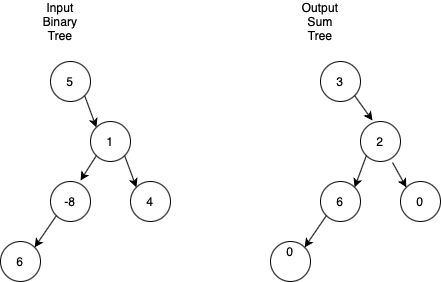
Given a binary tree of integers, you are supposed to modify the given binary tree to a sum tree where each node value is replaced by the sum of the values of both left and right subtrees in the given tree. The value of leaf nodes is changed to zero.
Example:
Below is the example showing the input tree and its sum tree.
Problem approach
Do a traversal of the given tree. In the traversal, store the old value of the current node, recursively call for left and right subtrees and change the value of current node as sum of the values returned by the recursive calls. Finally return the sum of new value and value (which is sum of values in the subtree rooted with this node).
2. Remove BST keys outside the given range
Easy
15m average time
85% success
0/40
Asked in companies


Given a Binary Search Tree (BST) and a range [min, max], remove all keys which are outside the given range. The modified tree should also be BST.
Problem approach
There are two possible cases for every node.
1.Node’s key is outside the given range. This case has two sub-cases.
a)Node’s key is smaller than the min value.
b)Node’s key is greater than the max value.
2.Node’s key is in range.
We don’t need to do anything for case 2. In case 1, we need to remove the node and change the root of the subtree rooted with this node.
The idea is to fix the tree in a Post-order fashion. When we visit a node, we make sure that its left and right sub-trees are already fixed. In case 1.a), we simply remove the root and return the right sub-tree as a new root. In case 1.b), we remove the root and return the left sub-tree as a new root
3. Zigzag Binary Tree Traversal
Easy
10m average time
90% success
0/40
Asked in companies


You are given a ‘Binary Tree’.
Return the level-order traversal of the Binary Tree.
Example:
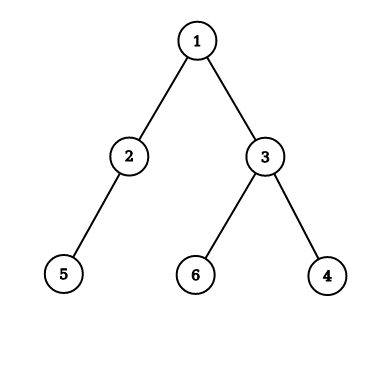
Input: Consider the following Binary Tree:
Output:
Following is the level-order traversal of the given Binary Tree: [1, 2, 3, 5, 6, 4]
Problem approach
We can use a queue just like we used in Level Order Traversal. But in this case, we can also maintain a flag variable which keeps track of alternate level to reverse the order of the corresponding level traversal.flag==true implies we have to insert from left to right and flag==false means we have to insert element from right to left our answer vector.
02
Round
Medium
Video Call
Duration60 minutes
Interview date11 Nov 2021
Coding problem2
This round was mainly focused on the Algorithm and Technical skills. The interview was scheduled on Google Meet. The interviewer initially asked me to introduce myself for 5 minutes or so and then started asking me questions from my resume.
First he asked me to explain any one of my project then he asked lot of cross questions related to my projects and my project was a full stack e-commerce clone.
After this he asked lot of question related to OOPS.
Then he asked me to implement any sorting algorithm I implemented quick sort.
Then he asked question related to pointers and some language specific questions mentioned in the resume, ( I had mentioned C and C++)
Then he asked lot of questions of operating system.
He also asked me theoretical part of hashing (Collision, collison handling,linear probing,open chain addressing etc)
I was able to answer lot of questions asked by him and the interviewer seemed happy with me. The interviewer was quiet polite and humble.
In the end he asked me that If I had any questions for him. I asked about the team he was working with and the which team I would be working with If I get selected.
1. OS Questions
What is difference between process and threads.
What is semaphore and mutex.
What is thrashing.
What is a deadlock?
What is virtual memory?
2. Quick Sort
Moderate
10m average time
90% success
0/80
Asked in companies

You are given an array of integers. You need to sort the array in ascending order using quick sort.
Quick sort is a divide and conquer algorithm in which we choose a pivot point and partition the array into two parts i.e, left and right. The left part contains the numbers smaller than the pivot element and the right part contains the numbers larger than the pivot element. Then we recursively sort the left and right parts of the array.
Example:
Let the array = [ 4, 2, 1, 5, 3 ]
Let pivot to be the rightmost number.
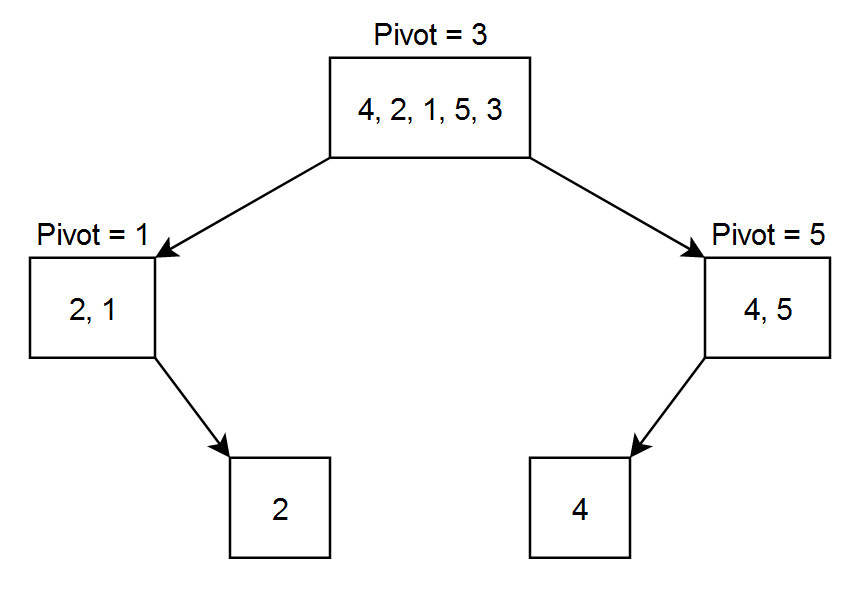
After the 1st level partitioning the array will be { 2, 1, 3, 4, 5 } as 3 was the pivot. After 2nd level partitioning the array will be { 1, 2, 3, 4, 5 } as 1 was the pivot for the left part and 5 was the pivot for the right part. Now our array is sorted and there is no need to divide it again.
Problem approach
It is a straight forward sorting algorithm.


Here's your problem of the day 
Solving this problem will increase your chance to get selected in this company
Skill covered: Programming
How do you remove whitespace from the start of a string?
Choose another skill to practice
Similar interview experiences
SDE - Intern
2 rounds | 5 problems
Interviewed by Samsung R&D Institute
 Selected
0 views

0 comments

0 upvotes
SDE - Intern
2 rounds | 3 problems
Interviewed by Samsung R&D Institute
 Selected
 1092 views
0 comments
0 upvotes
Software Engineer
3 rounds | 7 problems
Interviewed by Samsung R&D Institute

Rejected
1033 views
0 comments
0 upvotes
SDE - Intern
2 rounds | 4 problems
Interviewed by Samsung R&D Institute
 Selected
 455 views
0 comments
0 upvotes
Companies with similar interview experiences
SDE - Intern
3 rounds | 6 problems
Interviewed by Amazon

Rejected
15605 views
4 comments
0 upvotes
SDE - Intern
4 rounds | 7 problems
Interviewed by Microsoft
 Selected
 15499 views
1 comments
0 upvotes
SDE - Intern
2 rounds | 4 problems
Interviewed by Amazon
Selected 10216 views
2 comments
0 upvotes