





Samsung interview experience Real time questions & tips from candidates to crack your interview

SDE - 1
Samsung


4 rounds | 6 Coding
problems

 Selected
 Interview preparation journey

Journey
Honestly speaking, I was not familiar with coding until my fourth semester. I had completed my 12th with PCM as my subjects, but computer science was not one of them. So, during my early days in college, I was a little afraid of coding and DSA. After my second year, a few of my classmates were doing competitive programming. They introduced me to this field and hackathons. Then I started learning DSA and CP through various Youtube videos and books. After my third year, I started solving problems on Codechef and Leetcode. At the end of my seventh semester, I cracked an internship (Off-Campus) at JPMC as an analyst for three months. Unfortunately, I couldn't get a PPO. So, I started preparing for interviews. Then I landed a full-time role as SDE-1 in a fintech firm (On-Campus). Unfortunately, due to market downturns in mid-2022, they postponed my joining. Then, I applied through a referral in Samsung and got a job as an SDE-1 in August 2022.
Application story
I applied through referral. I got the referral through Linkedin. The application process was quite simple. There was a google form shared with me. I filled all my details and resume and submitted that. Then after a week I got the link foe online assessment on CoCubes. I got the result of online assessment after two days. Then I had another online assessment. It had hard level questions. I got the the result five days later. Then I had one round of technical interview followed by one HR interview. I got the result two days later and I was selected. After five days I got my offer letter.
Why selected/rejected for the role?
I was good at problem solving.
Special Tips :
) You should have a good understanding of DSA and your chosen language. Every round is an elimination round.
) Samsung has a unique way of holding tests. You need to log in to a virtual desktop to appear for the round. And a separate phone for the proctor to monitor you. Make sure you set this up a day before the test.
) Keep calm and try to make things clear.
Preparation
Duration: 3 months
Topics: Data Structures ( linked-list, deque, tree, graph and heap), Dynamic Programming, Algorithms Complexity Analysis, OOPS and DBMS.

Tip 1 : Learn basic data structures like list, deque, tree and algorithms like sorting, Binary search, Recursion and others basics very deeply because you will find their implementations in every questions. You can solve 90 percent of the interview question using these basic DSA concepts only (may be in brute- force way).
Tip 2 : Don't jump on doing competitive programming directly. First learn the basics of DSA then solve easy questions first then start doing CP.
Tip 3 : Practice as many questions as you can (minimum 200 questions). Solve at least four questions on each concept then you will never forget them.
Tip 4 : I f you are good in CP then doing some easy projects will also get you cracking good companies but if you are not much into problem solving and CP then do at least two very good, impactful projects. Try to do projects which have some unique problem statements.
Application process
Where: Referral
Eligibility: Off Campus placement doesn't have any specific criteria. It just that a good GPA will help you stand better in the crowd.
Tip 1: Mention your experiences at the top followed by your projects then your education.
Tip 2: One page resume is the best.

Interview rounds
01
Round
Medium
Online Coding Test
Duration60 minutes
Interview date10 Jul 2022
Coding problem2
Two Leetcode medium-level questions.
- Topics were Binary trees, BFS/DFS.
- Solved both of them.
1. LCA Of Binary Tree
Moderate
10m average time
90% success

0/80
Asked in companies



You have been given a Binary Tree of distinct integers and two nodes ‘X’ and ‘Y’. You are supposed to return the LCA (Lowest Common Ancestor) of ‘X’ and ‘Y’.
The LCA of ‘X’ and ‘Y’ in the binary tree is the shared ancestor of ‘X’ and ‘Y’ that is located farthest from the root.
Note :
You may assume that given ‘X’ and ‘Y’ definitely exist in the given binary tree.
For example :
For the given binary tree
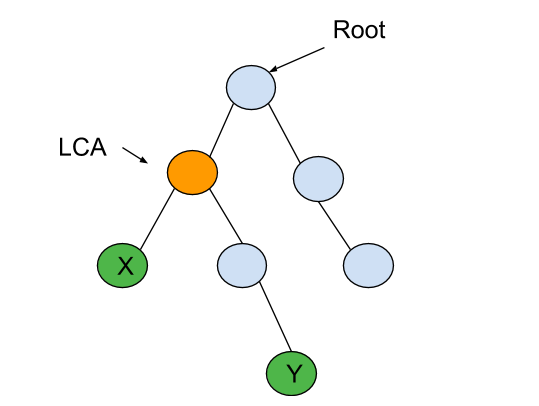
LCA of ‘X’ and ‘Y’ is highlighted in yellow colour.
Problem approach
Use LCA to find distance between two nodes.
2. Cycle Detection in a Singly Linked List
Moderate
15m average time
80% success
0/80
Asked in companies



You are given a Singly Linked List of integers. Return true if it has a cycle, else return false.
A cycle occurs when a node's next points back to a previous node in the list.
Example:
In the given linked list, there is a cycle, hence we return true.
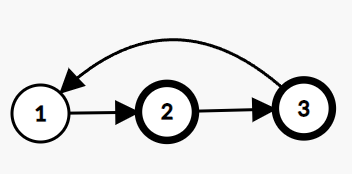
02
Round
Hard
Online Coding Test
Duration3 hrs
Interview date13 Jul 2022
Coding problem1
- 1 Leetcode hard-level question
- The question was based on graphs and algorithms.
- The constraint about this round was I needed to pass all the 50 TCs to clear it and I was able to solve it.
1. Cycle Detection In Undirected Graph
Moderate
0/80
Asked in companies


You have been given an undirected graph with 'N' vertices and 'M' edges. The vertices are labelled from 1 to 'N'.
Your task is to find if the graph contains a cycle or not.
A path that starts from a given vertex and ends at the same vertex traversing the edges only once is called a cycle.
Example :
In the below graph, there exists a cycle between vertex 1, 2 and 3.
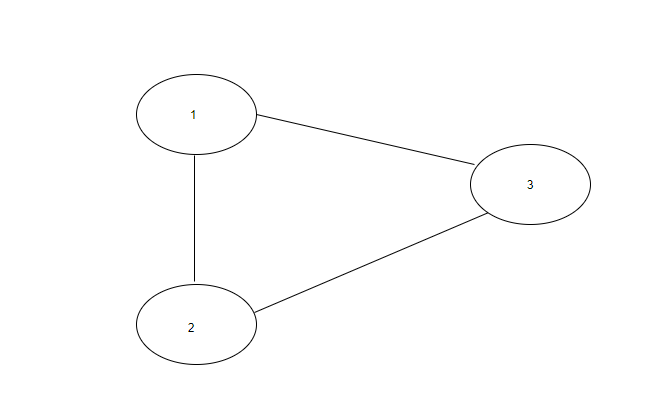
Note:
1. There are no parallel edges between two vertices.

2. There are no self-loops(an edge connecting the vertex to itself) in the graph.

3. The graph can be disconnected.
For Example :
Input: N = 3 , Edges =  [[1, 2], [2, 3], [1, 3]].
Output: Yes

Explanation : There are a total of 3 vertices in the graph. There is an edge between vertex 1 and 2, vertex 2 and 3 and vertex 1 and 3. So, there exists a cycle in the graph.
03
Round
Medium
Face to Face
Duration60 minutes
Interview date17 Jul 2022
Coding problem2
- Brief Introduction of myself.
- OOPS concepts with a real-life example.
- Asked me to implement Trie (Insert & Search functions)
- A brief discussion on all Graph Path Finding Algos.
1. Trie Implementation
Moderate
25m average time
65% success
0/80
Asked in companies


Implement a Trie Data Structure which supports the following three operations:
Operation 1 - insert(word) - To insert a string WORD in the Trie.

Operation 2-  search(word) - To check if a string WORD is present in Trie or not.

Operation 3-  startsWith(word) - To check if there is a string that has the prefix WORD.
Trie is a data structure that is like a tree data structure in its organisation. It consists of nodes that store letters or alphabets of words, which can be added, retrieved, and deleted from the trie in a very efficient way.
In other words, Trie is an information retrieval data structure, which can beat naive data structures like Hashmap, Tree, etc in the time complexities of its operations.
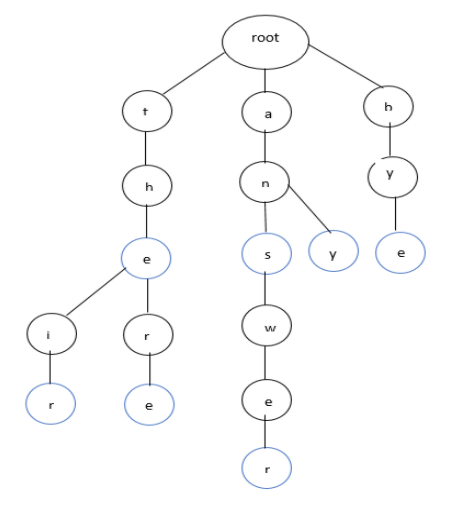
The above figure is the representation of a Trie. New words that are added are inserted as the children of the root node.

Alphabets are added in the top to bottom fashion in parent to children hierarchy. Alphabets that are highlighted with blue circles are the end nodes that mark the ending of a word in the Trie.
For Example:-
Type = ["insert", "search"], Query = ["coding", "coding].
We return ["null", "true"] as coding is present in the trie after 1st operation.
2. JAVA Questions
Moderate
25m average time
65% success
0/80
Asked in companies
Interface vs abstract class, heap memory vs stack memory, collections, Exception Handling etc.
Difference between Merge Sort vs Quick Sort.
04
Round
Easy
HR Round
Duration30 min
Interview date24 Jul 2022
Coding problem1
1. basic HR Questions
- Brief Introduction of myself, my current location, my education details
- Information about my current Organisation
- Why do I want to join Samsung?
- My strengths & weaknesses


Here's your problem of the day 
Solving this problem will increase your chance to get selected in this company
Skill covered: Programming
How do you remove whitespace from the start of a string?
Choose another skill to practice
Similar interview experiences
SDE - 1
3 rounds | 4 problems
Interviewed by Samsung
Selected 
1221 views

0 comments

0 upvotes
SDE - 1
3 rounds | 6 problems
Interviewed by Samsung
Rejected
2229 views
0 comments
0 upvotes
SDE - 1
3 rounds | 6 problems
Interviewed by Samsung
 Selected
 1427 views
0 comments
0 upvotes
SDE - 1
3 rounds | 5 problems
Interviewed by Samsung
Rejected
418 views
0 comments
0 upvotes
Companies with similar interview experiences
SDE - 1
5 rounds | 12 problems
Interviewed by Amazon
 Selected
 115096 views
24 comments
0 upvotes
SDE - 1
4 rounds | 5 problems
Interviewed by Microsoft
Selected 58237 views
5 comments
0 upvotes
SDE - 1
3 rounds | 7 problems
Interviewed by Amazon
 Selected
 35146 views
7 comments
0 upvotes