





Samsung interview experience Real time questions & tips from candidates to crack your interview

SDE - Intern
Samsung


3 rounds | 5 Coding
problems

 Selected
 Interview preparation journey

Preparation
Duration: 6 months
Topics: Data Structures, JAVA, OOPS, System Design, Algorithms, Dynamic Programming

Tip 1 - Practice Atleast 250 Questions from coding ninjas
Tip 2 - Do atleast 2 good projects
Application process
Where: Campus
Eligibility: Above 7 CGPA
Tip 1 : Have some projects on resume.
Tip 2 : Do not put false things on resume and be confident.

Interview rounds
01
Round
Easy
Online Coding Interview
Duration70 minutes
Interview date1 Dec 2018
Coding problem2
The round was of 70 min duration and consist of 3 coding problems on the Cocubes Platform. There were many sets of problems and most of the people get different problems.
1. Missing number in Arithmetic progression
Easy
15m average time
85% success

0/40
Asked in companies


You are given a sorted array of ‘N’ distinct integers that are in the Arithmetic Progression sequence except for one element which is missing from the sequence. You have to find that missing number from the given sequence.
Note:
1. A sequence [arr0, arr1,…, arr(n-1)] is called an Arithmetic progression if for each 'i' ( 0 ≤ i < n - 1) the value arr[i+1] − arr[i] is the same.
2. There is exactly one missing number in the given sequence.
3. All the numbers present in the sequence are distinct.
4. It is the guarantee that the first and last elements of the sequence are not missing elements.
Follow Up
The overall run time complexity should be O(log(N)).
Problem approach
The idea is to go to the middle element. Check if the difference between middle and next to middle is equal to diff or not, if not then the missing element lies between mid and mid+1. If the middle element is equal to n/2th term in Arithmetic Series (Let n be the number of elements in input array), then missing element lies in right half. Else element lies in left half.
2. Top View Of Binary Tree
Moderate
25m average time
70% success
0/80
Asked in companies



You are given a Binary Tree of 'n' nodes.
The Top view of the binary tree is the set of nodes visible when we see the tree from the top.
Find the top view of the given binary tree, from left to right.
Example :
Input: Let the binary tree be:
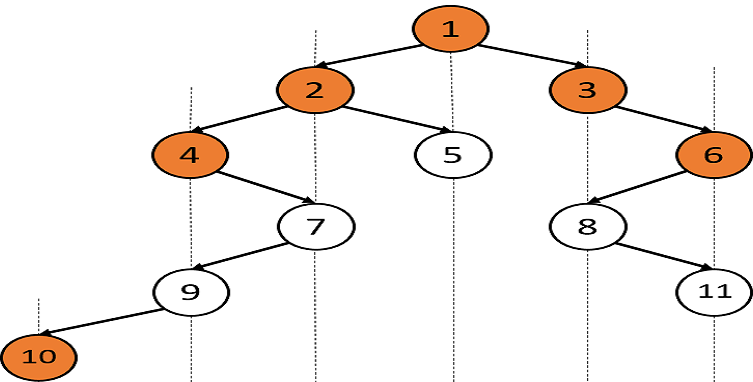
Output: [10, 4, 2, 1, 3, 6]

Explanation: Consider the vertical lines in the figure. The top view contains the topmost node from each vertical line.
Problem approach
The idea is to do something similar to vertical Order Traversal.
02
Round
Easy
Video Call
Duration60 minutes
Interview date3 Dec 2018
Coding problem2
This round was held on skype, the interviewer was of a very friendly nature, he started with introducing himself and without my introduction. He asked me about my strong point, I mentioned Competitive Programming and DSA.
Detecting cycle in a directed graph
Detecting cycle in an undirected graph
Opps:
Inheritance
Polymorphism
Virtual Function
OS:
Deadlock
Paging
Segmentation
Semaphore
1. Detect Cycle in a Directed Graph
Moderate
25m average time
65% success
0/80
Asked in companies


Given a directed graph, check whether the graph contains a cycle or not. Your function should return true if the given graph contains at least one cycle, else return false.
Problem approach
Depth First Traversal can be used to detect a cycle in a Graph
2. Cycle Detection In Undirected Graph
Moderate
0/80
Asked in companies
You have been given an undirected graph with 'N' vertices and 'M' edges. The vertices are labelled from 1 to 'N'.
Your task is to find if the graph contains a cycle or not.
A path that starts from a given vertex and ends at the same vertex traversing the edges only once is called a cycle.
Example :
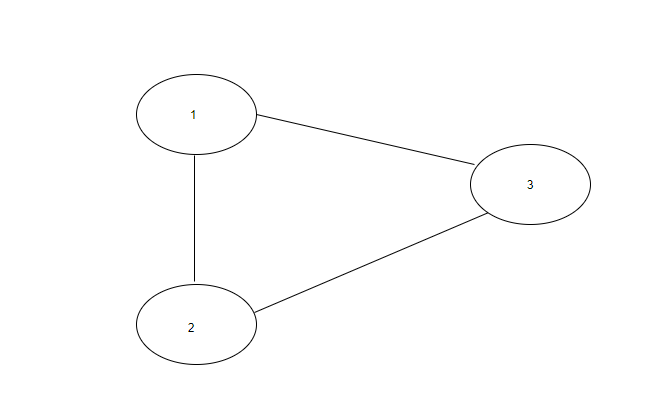
In the below graph, there exists a cycle between vertex 1, 2 and 3.
Note:
1. There are no parallel edges between two vertices.

2. There are no self-loops(an edge connecting the vertex to itself) in the graph.

3. The graph can be disconnected.
For Example :
Input: N = 3 , Edges =  [[1, 2], [2, 3], [1, 3]].
Output: Yes

Explanation : There are a total of 3 vertices in the graph. There is an edge between vertex 1 and 2, vertex 2 and 3 and vertex 1 and 3. So, there exists a cycle in the graph.
Problem approach
To detect if there is any cycle in the undirected graph or not, we will use the DFS traversal for the given graph. For every visited vertex v, when we have found any adjacent vertex u, such that u is already visited, and u is not the parent of vertex v. Then one cycle is detected.
03
Round
Medium
Video Call
Duration60 minutes
Interview date5 Dec 2018
Coding problem1
This round was also held on skype. The interview was very friendly, starting with his introduction, and asked from where I am, he moved to the first problem :
Minimum cost to reach bottom-right corner starting from top-left of a matrix, where every cell represents a cost to cover that one
Given a string, it consists of only two types of characters 1 and 2 . Make a new string by replacing every 1 by 11 and two consecutive two to only single
1. Minimum Cost Path
Moderate
25m average time
70% success
0/80
Asked in companies



You have been given a matrix of ‘N’ rows and ‘M’ columns filled up with integers. Find the minimum sum that can be obtained from a path which from cell (x,y) and ends at the top left corner (1,1).
From any cell in a row, we can move to the right, down or the down right diagonal cell. So from a particular cell (row, col), we can move to the following three cells:
Down: (row+1,col)
Right: (row, col+1)
Down right diagonal: (row+1, col+1)
Problem approach
The idea is to use recursion.


Here's your problem of the day 
Solving this problem will increase your chance to get selected in this company
Skill covered: Programming
How do you remove whitespace from the start of a string?
Choose another skill to practice
Similar interview experiences
SDE - Intern
3 rounds | 4 problems
Interviewed by Samsung
 Selected
1351 views

0 comments

0 upvotes
SDE - Intern
2 rounds | 4 problems
Interviewed by Samsung
Selected 918 views
0 comments
0 upvotes
SDE - Intern
2 rounds | 8 problems
Interviewed by Samsung
Selected 1056 views
0 comments
0 upvotes
SDE - Intern
3 rounds | 5 problems
Interviewed by Samsung
 Selected
 1616 views
1 comments
0 upvotes
Companies with similar interview experiences
SDE - Intern
3 rounds | 6 problems
Interviewed by Amazon

Rejected
15605 views
4 comments
0 upvotes
SDE - Intern
4 rounds | 7 problems
Interviewed by Microsoft
 Selected
 15499 views
1 comments
0 upvotes
SDE - Intern
2 rounds | 4 problems
Interviewed by Amazon
Selected 10216 views
2 comments
0 upvotes