





Samsung interview experience Real time questions & tips from candidates to crack your interview

SDE - 1
Samsung


4 rounds | 9 Coding
problems

 Selected
 Interview preparation journey

Preparation
Duration: 4 Months
Topics: Data Structures, Algorithms, System Design, Aptitude, OOPS

Tip 1 : Must do Previously asked Interview as well as Online Test Questions.
Tip 2 : Go through all the previous interview experiences from Codestudio.
Tip 3 : Do at-least 2 good projects and you must know every bit of them.
Application process
Where: Campus
Eligibility: Above 7 CGPA
Tip 1 : Have at-least 2 good projects explained in short with all important points covered.
Tip 2 : Every skill must be mentioned.
Tip 3 : Focus on skills, projects and experiences more.

Interview rounds
01
Round
Medium
Online Coding Test
Duration120 Minutes
Interview date15 Jul 2021
Coding problem3
This was an online coding round where we had 3 questions to solve under 120 minutes. The questions were of medium to hard difficulty level.
1. Triplets with Given Sum
Moderate
15m average time
85% success

0/80
Asked in companies



You are given an array/list ARR consisting of N integers. Your task is to find all the distinct triplets present in the array which adds up to a given number K.
An array is said to have a triplet {ARR[i], ARR[j], ARR[k]} with sum = 'K' if there exists three indices i, j and k such that i!=j, j!=k and i!=j and ARR[i] + ARR[j] + ARR[k] = 'K'.
Note:
1. You can return the list of values in any order. For example, if a valid triplet is {1, 2, -3}, then {2, -3, 1}, {-3, 2, 1} etc is also valid triplet. Also, the ordering of different triplets can be random i.e if there are more than one valid triplets, you can return them in any order.
2. The elements in the array need not be distinct.
3. If no such triplet is present in the array, then return an empty list, and the output printed for such a test case will be "-1".
Problem approach
Approach :
1) Sort the array in ascending order.
2) Now since we want triplets such that x + y + z = ‘K’, we have x+ y = ‘K’ - z and now we can fix z as arr[i]. So we want to find the sum of two numbers x and y as ‘K’ - arr[i] in the array.
3) We will use two pointers, one will start from i+1, and the other will start from the end of the array.
4) Let the two pointers be ‘FRONT’ and ‘BACK’, where ‘FRONT’ = i + 1 and ‘BACK’ = n - 1. Let ‘SUM’ = x + y, where x = ‘ARR[FRONT]’ and y = ‘ARR[BACK]’. We have to find the triplets such that ‘TARGET’ = ‘SUM’.
5) While ‘FRONT’ < ‘BACK’, there will be 3 cases:
5.1) if ('SUM' < ‘TARGET’), we will have to increase the sum and hence increment front pointer.
5.2) Else if ('SUM' > ‘TARGET’), we will have to decrease the sum and hence decrease the ‘BACK’
pointer.
5.3) Else print the triplet and since we want distinct triplets, do the following.
a) Increment the front pointer until ‘ARR[FRONT]’ = x and ‘FRONT’ < ‘BACK’.
b) Decrement the back pointer until ‘ARR[BACK]’ = y and ‘FRONT’ < ‘BACK’.
6) While ‘ARR[i]’ = ‘ARR[i+1]’, keep on incrementing i, this will automatically ensure that we are only finding distinct triplets.
TC : O(N^2) , where N=size of the array
SC : O(1)
2. Minimum operation needed to convert to the given string
Moderate
26m average time
0/80
Asked in companies


You are given two strings 'str1' and 'str2'. Find the minimum operations required to convert str1 into str2.
An Operation is defined as:
A character from an index of a string(str1) is put at the end of it, is defined as a single operation.
Note :
You cannot perform any operation on the string, str2.
Problem approach
Approach : I solved this problem using 2-pointer technique.
1) Initialize the first pointer to the start of str1 and the second pointer to the start of the str2.
2) Now increase the first pointer till the character pointed by the first pointer in str1 matches the character at the second pointer in str2. And the number of character which did not match should be placed at the end of str1. Therefore increase our answer by how many times we needed to increase the first pointer.
3) Now character pointed by both the pointer is the same so simply increase both pointers as they are same. And perform this while both the pointer do not exhaust the str1 and str2 respectively.
4) One thing to note is that all the characters which did not match would be placed at the end optimally so that the cost will be equal to the unmatched characters with the prefix of str2.
TC : O(N+M), where N is the size of the first string and M is the size of the second string.
SC : O(1)
3. Power of Two
Easy
15m average time
85% success
0/40
Asked in companies


You have been given an integer 'N'.
Your task is to return true if it is a power of two. Otherwise, return false.
An integer 'N' is a power of two, if it can be expressed as 2 ^ 'K' where 'K' is an integer.
For example:
'N' = 4,
4 can be represented as 2^2. So, 4 is the power of two, and hence true is our answer.
Problem approach
Approach : If a number N is power of 2 then bitwise & of N and N-1 will be zero. We can say N is a power of 2 or not based on the value of N&(N-1). The expression N&(N-1) will not work when N is 0.
So,handle that case separately.
TC : O(1)
SC : O(1)
02
Round
Medium
Video Call
Duration60 Minutes
Interview date15 Jul 2021
Coding problem3
1. Merge K Sorted Arrays
Moderate
15m average time
85% success
0/80
Asked in companies



You have been given ‘K’ different arrays/lists, which are sorted individually (in ascending order). You need to merge all the given arrays/list such that the output array/list should be sorted in ascending order.
Problem approach
Approach 1 (Brute Force) :
Create an output array and and one by one copy all arrays to it. Finally, sort the output array using. This approach takes O(N Logn N) time where N is count of all elements.
Approach 2 (Using Min-Heap) :
1. Create an output array.
2. Create a min heap of size k and insert 1st element in all the arrays into the heap
3. Repeat following steps while priority queue is not empty.
3.1) Remove minimum element from heap (minimum is always at root) and store it in output array.
3.2) Insert next element from the array from which the element is extracted. If the array doesn’t have
any more elements, then do nothing.
TC : O(N*log(K))
SC : O(N)
2. Spiral Order Traversal of a Binary Tree
Easy
20m average time
75% success
0/40
Asked in companies


You have been given a binary tree of 'N' nodes. Print the Spiral Order traversal of this binary tree.
For example
For the given binary tree [1, 2, 3, -1, -1, 4, 5, -1, -1, -1, -1]
    1
   / \
  2   3
     / \
    4   5

Output: 1 3 2 4 5
Problem approach
Approach 1 (Using Level Order Traversal) :
Steps :
1) Initialize an array ‘spiral’ to store the result.
2) Initialize a variable ‘direction’ to keep track of traversing direction with 1(denoting left to right)
3) Find the height of the given tree and store it in a variable ‘height’.
4) Run a loop - level : 1 to height, to traverse through every level.
4.1) Find level order traversal in the current direction.and store in ‘spiral’
4.2) Toggle the direction.
5) Return ‘spiral’
TC : O(N^2), where ‘N’ is the number of nodes in the binary tree.
SC : O(h), where 'h' is the height of the binary tree.
Approach 2 (Using Stack) :
Steps :
1) We will maintain two stacks, one for each direction i.e. leftToRight and rightToleft.
2) We will do a level order traversal of the given binary tree and push nodes of each level onto one of the
stack according to the current direction of traversal.
3) After we’ve pushed all nodes of a level onto one stack, we’ll start popping those nodes.
4) While popping the nodes we will push their children (if any) onto our other direction stack, so that the
next level be traversed in reverse order.
TC : O(N), where ‘N’ is the number of nodes in the binary tree.
SC : O(N)
3. OOPS Question
Difference between structure and union and what are the pros and cons of both?
Problem approach
Answer :
Structure : Structure is a user-defined data type in C programming language that combines logically related data items of different data types together.
All the structure elements are stored at contiguous memory locations. Structure type variable can store more than one data item of varying data types under one name.
Union : Union is a user-defined data type, just like a structure. Union combines objects of different types and sizes together. The union variable allocates the memory space equal to the space to hold the largest variable of union. It allows varying types of objects to share the same location.
Key differences b/w Structure and Union :
1) Every member within structure is assigned a unique memory location while in union a memory location is shared by all the data members.
2) Changing the value of one data member will not affect other data members in structure whereas changing the value of one data member will change the value of other data members in union.
3) Structure is mainly used for storing various data types while union is mainly used for storing one of the many data types.
4) In structure, you can retrieve any member at a time on the other hand in union, you can access one member at a time.
5) Structure supports flexible array while union does not support a flexible array.
Advantages and Disadvantages of using Structure :
Advantages :
1) Structures gather more than one piece of data about the same subject together in the same place.
2) It is helpful when you want to gather the data of similar data types and parameters like first name, last
name, etc.
3) It is very easy to maintain as we can represent the whole record by using a single name.
Disadvantages :
1 )If the complexity of IT project goes beyond the limit, it becomes hard to manage.
2) Change of one data structure in a code necessitates changes at many other places. Therefore, the
changes become hard to track.
3) Structure is slower because it requires storage space for all the data.
Advantages and Disadvantages of using Union :
Advantages :
1) It occupies less memory compared to structure.
2 )When you use union, only the last variable can be directly accessed.
3) Union is used when you have to use the same memory location for two or more data members.
Disadvantages :
1) You can use only one union member at a time.
2) All the union variables cannot be initialized or used with varying values at a time.
3) Union assigns one common storage space for all its members.
Tip : Cover concepts of OOPS properly preferrably in C++ or in Java and for quick revision, the guided path of C++ in Coding Ninjas is a very good resource. I completed the OS and C++ guided path before my interviews and it helped me a lot.
03
Round
Medium
Video Call
Duration60 Minutes
Interview date15 Jul 2021
Coding problem3
This round had 2 questions related to Trees and Graphs and some questions revolving around types of Operating Systems their pros and cons.
1. Diameter Of Binary Tree
Easy
10m average time
90% success
0/40
Asked in companies


You are given a Binary Tree.
Return the length of the diameter of the tree.
Note :
The diameter of a binary tree is the length of the longest path between any two end nodes in a tree.

The number of edges between two nodes represents the length of the path between them.
Example :
Input: Consider the given binary tree:
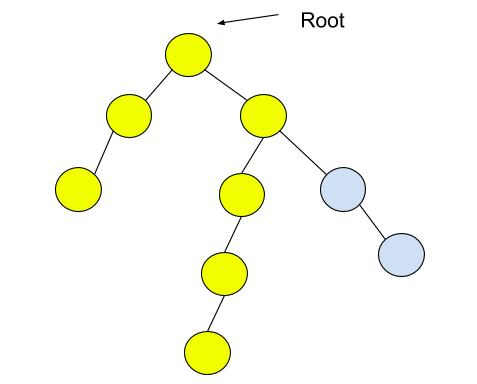
Output: 6

Explanation:
Nodes in the diameter are highlighted. The length of the diameter, i.e., the path length, is 6.
Problem approach
Approach 1 :
Steps :
1) If the ‘root’ node is NULL, return 0. The diameter of an empty tree is 0.
2) Recur for the left subtree and store the diameter of the left subtree in a variable ‘leftDiameter’, i.e.
‘leftDiameter’ = getDiameter(left child of the root node)
3) Similarly, recur for the right subtree and store the diameter of the right subtree in a variable
‘rightDiameter’ i.e. ‘rightDiameter’ = getDiameter(right child of the root node)
4) Now, get the height of the left subtree and right subtree and store it in a variable.
4.1) ‘leftHeight’ = getHeight(left child of the root node)
4.2) ‘rightHeight’ = getHeight(right child of the root node)
5) The diameter of the given tree will be the maximum of the following terms:
i) ‘leftDiameter’
ii) ‘rightDiameter’
iii) 1 + ‘leftHeight’ + ‘rightHeight’
6) Return the maximum of above terms i.e.max(leftDiameter, rightDiameter, 1 + leftHeight + rightHeight).
TC : O(N^2), where ‘N’ is the number of nodes in the given binary tree.
SC : O(N)
Approach 2 :
Steps :
1) If the root node is NULL, assign “height” = 0 and return 0 because the height and diameter of an empty
tree will be 0.
2) Initialize two variables, “leftHeight” and “rightHeight” to 0, which denotes the height of the left subtree
and right subtree, respectively.
3) Recur for the left subtree and store the diameter of the left subtree in a variable i.e. leftDiameter =
getDiameter(root->left, leftHeight)
4) Similarly, recur for the right subtree and store the diameter of the right subtree in a variable i.e.
rightDiamater = getDiamter(root->right, rightHeight)
5) Update the height of the tree i.e. height = max(leftHeight, rightHeight) + 1
6) The diameter of the given tree will be the maximum of the following terms:
i) “leftDiameter”
ii) “rightDiameter”
iii) “leftHeight” + “rightHeight”
7) Return the maximum of above terms i.e. max(leftDiameter, rightDiameter, leftHeight + rightHeight).
TC : O(N), where 'N' is the number of nodes in the binary tree.
SC : O(N)
2. Shortest Path in a Binary Matrix
Moderate
37m average time
65% success
0/80
Asked in companies
You have been given a binary matrix of size 'N' * 'M' where each element is either 0 or 1. You are also given a source and a destination cell, both of them lie within the matrix.
Your task is to find the length of the shortest path from the source cell to the destination cell only consisting of 1s. If there is no path from source to destination cell, return -1.
Note:
1. Coordinates of the cells are given in 0-based indexing.
2. You can move in 4 directions (Up, Down, Left, Right) from a cell.
3. The length of the path is the number of 1s lying in the path.
4. The source cell is always filled with 1.
For example -
1 0 1
1 1 1
1 1 1
For the given binary matrix and source cell(0,0) and destination cell(0,2). Few valid paths consisting of only 1s are

X 0 X     X 0 X
X X X     X 1 X
1 1 1     X X X
The length of the shortest path is 5.
Problem approach
Approach : I solved this problem using BFS.
Breadth-First-Search considers all the paths starting from the source and moves ahead one unit in all those paths at the same time. This makes sure that the first time when the destination is visited, it is the path with the shortest length.
Steps :
1) Create an empty queue and enqueue source cell and mark it as visited
2) Declare a ‘STEPS’ variable, to keep track of the length of the path so far
3) Loop in level order till the queue is not empty
3.1) Fetch the front cell from the queue
3.2) If the fetched cell is the destination cell, return ‘STEPS’
3.3) Else for each of the 4 adjacent cells of the current cell, we enqueue each valid cell into the queue
and mark them visited.
3.4) Increment ‘STEPS’ by 1 when all the cells in the current level are processed.
4) If all nodes in the queue are processed and the destination cell is not reached, we return -1.
TC : O(N*M), where ‘N’ and ‘M’ are the number of rows and columns in the Binary Matrix respectively.
SC : O(N*M)
3. OS Question
What is Real-Time Operating System? What are its pros and cons?
Problem approach
Answer :
Real-time operating system (RTOS) is an operating system intended to serve real time application that process data as it comes in, mostly without buffer delay.
In a RTOS, Processing time requirement are calculated in tenths of seconds increments of time. It is time-bound system that can be defined as fixed time constraints. In this type of system, processing must be done inside the specified constraints. Otherwise, the system will fail.
Advantages of Real-time operating system :
1) Easy to layout, develop and execute real-time applications under the real-time operating system.
2) The real-time working structures are extra compact, so those structures require much less memory
space.
3) In a Real-time operating system, the maximum utilization of devices and systems.
4) Focus on running applications and less importance to applications that are in the queue.
Disadvantages of Real-time operating system :
1) RTOS system can run minimal tasks together, and it concentrates only on those applications which
contain an error so that it can avoid them.
2) RTOS is the system that concentrates on a few tasks. Therefore, it is really hard for these systems to do
multi-tasking.
3) Specific drivers are required for the RTOS so that it can offer fast response time to interrupt signals,
which helps to maintain its speed.
4) Plenty of resources are used by RTOS, which makes this system expensive.
04
Round
Easy
HR Round
Duration30 Minutes
Interview date15 Jul 2021
Coding problem0
This was about 30 minutes long interview. First, she asked introduction, after that she was very interested in my internship that I did in summer and about my interests. She asked few common questions on that.
Tip : Please ask questions at the end of session when they ask you to do so. In the end, she asked if I had any questions for her and I asked how is life working in Samsung, how long she was working and in which domain. The interview went well in the end.


Here's your problem of the day 
Solving this problem will increase your chance to get selected in this company
Skill covered: Programming
What does the SQL function NOW() return?
Choose another skill to practice
Similar interview experiences
SDE - 1
4 rounds | 6 problems
Interviewed by Samsung
Selected 
2002 views

0 comments

0 upvotes
SDE - 1
3 rounds | 4 problems
Interviewed by Samsung
Selected 1292 views
0 comments
0 upvotes
SDE - 1
3 rounds | 6 problems
Interviewed by Samsung
Rejected
2308 views
0 comments
0 upvotes
SDE - 1
3 rounds | 5 problems
Interviewed by Samsung
Rejected
445 views
0 comments
0 upvotes
Companies with similar interview experiences
SDE - 1
5 rounds | 12 problems
Interviewed by Amazon
 Selected
 115740 views
24 comments
0 upvotes
SDE - 1
4 rounds | 5 problems
Interviewed by Microsoft
Selected 58752 views
5 comments
0 upvotes
SDE - 1
3 rounds | 7 problems
Interviewed by Amazon
 Selected
 35391 views
7 comments
0 upvotes