





Samsung interview experience Real time questions & tips from candidates to crack your interview

SDE - Intern
Samsung


2 rounds | 4 Coding
problems

Rejected
Interview preparation journey

Preparation
Duration: 4 months
Topics: Data Structures, Algorithms, OOPs, DBMS, SQL, Web Development

Tip 1 : Do not rush into things. Learning takes time. Focus should be on the concepts and not just on leaving topics half-prepared. Devote 70% of both time and effort to DSA. I solved a total of around 500 questions on sites like GFG and Leetcode. Do not repeat similar questions just to increase the count of the number of questions
Tip 2 : Competitive Programming is a bonus and not a necessity, rather focus on core DSA based problems before trying CP. Do not pursue CP if you do not like it. Devote that extra time to core CS subjects and aptitude preparation.
Tip 3 : Projects play an important role too, do no ignore them. Try to get your hands dirty with a little bit of every field i.e., frontend, backend, and database.
Application process
Where: Campus
Eligibility: Above 7 CGPA
Tip 1 : Have some projects on resume.
Tip 2 : Do not put false things on resume.

Interview rounds
01
Round
Easy
Video Call
Duration45 mins
Interview date26 Nov 2021
Coding problem2
1. Sort An Array According To The Count Of Set Bits
Moderate
25m average time
80% success

0/80
Asked in companies


You are given an array consisting of N positive integers, and your task is to sort the array in decreasing order of count of set bits in the binary representation of the integers present in the array.
In other words, you have to modify the array such that an integer with more number of set bits should appear before the integer which has lesser number of set bits in its binary representation.
The number of set bits is nothing but the number of 1s present in the binary representation of the integer. For example, the number of set bits in 5(0101) is equal to 2.
Note :
1. If any two numbers have the same count of set bits, then in the sorted array they will appear in the order in which they appear in the original array. For example, let the array be { 2, 4, 3}, in this case, both 2 and 4 have the same number of set bits so the answer will be {3, 2, 4} and not {3, 4, 2}, because in the original array 2 appears before 4.

2. The array may contain duplicate elements.
Problem approach
You are given an array consisting of N positive integers, and your task is to sort the array in decreasing order of count of set bits in the binary representation of the integers present in the array.
In other words, you have to modify the array such that an integer with more number of set bits should appear before the integer which has lesser number of set bits in its binary representation.
The number of set bits is nothing but the number of 1s present in the binary representation of the integer. For example, the number of set bits in 5(0101) is equal to 2.
2. Validate BST
Moderate
25m average time
0/80
Asked in companies


You have been given a binary tree of integers with N number of nodes. Your task is to check if that input tree is a BST (Binary Search Tree) or not.
A binary search tree (BST) is a binary tree data structure which has the following properties.
• The left subtree of a node contains only nodes with data less than the node’s data.
• The right subtree of a node contains only nodes with data greater than the node’s data.
• Both the left and right subtrees must also be binary search trees.
Example :
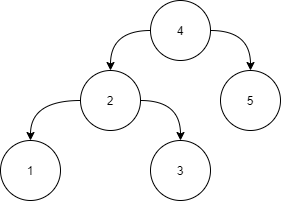
Answer :
Level 1:

All the nodes in the left subtree of 4 (2, 1, 3) are smaller
than 4, all the nodes in the right subtree of the 4 (5) are
larger than 4.

Level 2 :

For node 2:
All the nodes in the left subtree of 2 (1) are smaller than
2, all the nodes in the right subtree of the 2 (3) are larger than 2.
For node 5:
The left and right subtrees for node 5 are empty.

Level 3:

For node 1:
The left and right subtrees for node 1 are empty.
For node 3:
The left and right subtrees for node 3 are empty.

Because all the nodes follow the property of a binary search tree, the above tree is a binary search tree.
Problem approach
Given a binary tree with N number of nodes, check if that input tree is Partial BST (Binary Search Tree) or not. If yes, return true, return false otherwise.
A binary search tree (BST) is said to be a Partial BST if it follows the following properties.
• The left subtree of a node contains only nodes with data less than and equal to the node’s data.
• The right subtree of a node contains only nodes with data greater than and equal to the node’s data.
• Both the left and right subtrees must also be partial binary search trees
02
Round
Easy
Video Call
Duration45 mins
Interview date26 Nov 2021
Coding problem2
1. Reverse Linked List
Moderate
15m average time
85% success
0/80
Asked in companies



Given a singly linked list of integers. Your task is to return the head of the reversed linked list.
For example:
The given linked list is 1 -> 2 -> 3 -> 4-> NULL. Then the reverse linked list is 4 -> 3 -> 2 -> 1 -> NULL and the head of the reversed linked list will be 4.
Follow Up :
Can you solve this problem in O(N) time and O(1) space complexity?
Problem approach
Given a singly linked list of integers. Your task is to return the head of the reversed linked list.
For Example:
The given linked list is 1 -> 2 -> 3 -> 4-> NULL. Then the reverse linked list is 4 -> 3 -> 2 -> 1 -> NULL and the head of the reversed linked list will be 4.
2. Find the kth number with prime factors 3, 5 and 7
Easy
10m average time
90% success
0/40
Asked in companies
Ninjas are often known for their will to never give up no matter how fierce the challenge. One such ninja was challenged by another if they could solve a problem to find the Kth number in a list of given elements (array) comprising of only 3, 5 and 7 as their prime factors. Despite the ninja’s strong will to solve the problem, you know that it could be easily solved with the help of knowledge of programming. Since the ninja does not know that you’ll have to devise an algorithm for solving the problem. Your task is to complete the given function which returns that required Kth element from the array.
For Example:
Input: 'K' = 10
Output: 45

The array will contain elements that only have 3, 5 or 7 as their prime factors i.e. of  the following form:-  3,5,7,9,15,21,25,…. Therefore we can see from the above pattern of elements that 45 would be the 10th element in the array which is our  required answer.


Here's your problem of the day 
Solving this problem will increase your chance to get selected in this company
Skill covered: Programming
How do you remove whitespace from the start of a string?
Choose another skill to practice
Similar interview experiences
SDE - Intern
3 rounds | 4 problems
Interviewed by Samsung

 Selected
1352 views

0 comments

0 upvotes
SDE - Intern
2 rounds | 4 problems
Interviewed by Samsung
Selected 919 views
0 comments
0 upvotes
SDE - Intern
2 rounds | 8 problems
Interviewed by Samsung
Selected 1057 views
0 comments
0 upvotes
SDE - Intern
3 rounds | 5 problems
Interviewed by Samsung
 Selected
 1616 views
1 comments
0 upvotes
Companies with similar interview experiences
SDE - Intern
3 rounds | 6 problems
Interviewed by Amazon

Rejected
15606 views
4 comments
0 upvotes

SDE - Intern
4 rounds | 7 problems
Interviewed by Microsoft
 Selected
 15500 views
1 comments
0 upvotes
SDE - Intern
2 rounds | 4 problems
Interviewed by Amazon
Selected 10216 views
2 comments
0 upvotes