





Samsung interview experience Real time questions & tips from candidates to crack your interview

Software Engineer
Samsung


3 rounds | 5 Coding
problems

 Selected
 Interview preparation journey

Journey
I have a bachelor's degree in Software Engineering from DTU College, with a strong overall CGPA of 8.77, which I believe is a primary criterion for shortlisting students by Samsung, as they place importance on overall college performance. I started my coding journey in my second year, solving DSA problems mainly on online coding platforms, and later moved on to competitive programming.
Although Samsung does not ask very high-level competitive programming questions, the interview can be considered medium to hard in difficulty. I have also worked on projects related to web development and blockchain, which the interviewers appreciated. I would recommend my juniors to be well-prepared in both DSA and projects in advance, as Samsung's interview rounds typically last 30 to 40 minutes, during which they ask 2–3 DSA problems and expect quick solutions, covering all approaches from brute force to optimized.
Application story
I have my bachelor's degree in software engineering from DTU College and maintain a good overall CGPA of 8.77, which I think is one of the primary criteria for shortlisting students by Samsung, as they give importance to the overall percentage in college. I started my coding journey in the second year, where I solved DSA problems from online coding platforms primarily, and then switched to competitive programming. Although Samsung does not ask high-level competitive programming questions, I can say that the interview is of medium to hard level. I have also worked on projects related to web development and blockchain, and during the interview, they appreciated me for that. I would recommend my juniors to be well-prepared with DSA and projects in advance, as Samsung's interview rounds last between 30 to 40 minutes, during which they typically ask 2-3 DSA problems and expect us to provide solutions quickly, covering all approaches from brute force to optimized.
Why selected/rejected for the role?
I maintained a good CGPA of 8.77 overall. I have never had any backlogs in my course. I scored above 75% in 12th standard and a CGPA of 9.6 in 10th standard.
Preparation
Duration: 4 months
Topics: Data Structures: Graph, Trees, Linked List, Stack/Queue, Core Subjects: Operating System (Process/Memory Management), DBMS (ER Diagram, ACID Property), SQL (Writing Queries)

Tip 1: Practice 300 problems of medium difficulty from all data structure topics, such as graphs, trees, linked lists, stacks/queues, etc.
Tip 2: Be prepared with 3 projects (don’t copy them from anywhere). They can be from any area, such as web development, blockchain, or even ML. But whatever you have made, be thoroughly prepared with the tech stack you used, why you chose it, and any challenges you encountered while working on the project.
Tip 3: Be prepared with core computer science subjects like operating systems and DBMS, as small concepts will be asked. Also, puzzles will play a crucial role in the HR round.
Application process
Where: Campus
Eligibility: 1. Only students with a CGPA strictly above 7.5 were eligible for the online technical round. 2. A minimum of 75% in the 12th standard. 3. No backlogs allowed. (Salary:15 LPA)
Tip 1: Have some internship experience on the resume and prepare what all work you have done their with challenges faced.
Tip 2: Have at least 2 project any area like web dev, blockchain or even AI/ML.

Interview rounds
01
Round
Easy
Online Coding Interview
Duration210 minutes
Interview date10 Oct 2022
Coding problem1
- Timing: 10 AM to 1:30 PM
- The test was conducted on campus in the placement cell building with approximately 150 students on computers.
- 3-4 interviewers were present, roaming during the test to ensure no cheating.
- 30 minutes (MCQ test) + 3 hours (Advance test: 1-coding question)
1. Angler's Race
Hard

0/120
Asked in company
There are 'N' fishing spots arranged in a line, numbered 1 to N. Three gates are located at specific spots, and at each gate, a number of fishermen are waiting.
The process of assigning fishermen to spots follows strict rules:
1) You must decide on an order to open the three gates.
2) A gate is opened, and all the fishermen from that gate must occupy the nearest available (unoccupied) fishing spots.
3) Only after all fishermen from the current gate are settled can the next gate in the chosen order be opened.
The distance a fisherman travels is the absolute difference between their gate's position and their assigned fishing spot's position. Your task is to find an optimal order for opening the gates that minimizes the total distance traveled by all fishermen combined.
Problem approach
I followed the Recursive Gate Opening approach, where I opened each gate one by one, assigning fishermen to the nearest unoccupied spots. I minimized the distance for each gate by placing fishermen at the closest spots, checking both left and right for the minimum distance. If two spots were equally close, I assigned fishermen symmetrically. After each configuration, I reset the spots and tried a new gate-opening sequence to explore all possibilities using backtracking. Finally, by traversing, I tracked the smallest total walking distance across all possible ways to determine the answer.
02
Round
Medium
Face to Face
Duration50 minutes
Interview date12 Oct 2022
Coding problem3
- Timing: 50 minutes to 1 hour
- Closed room, one-on-one with the interviewer
1. Aggressive cows
Moderate
30m average time
70% success
0/80
Asked in companies


You are given an array 'arr' consisting of 'n' integers which denote the position of a stall.
You are also given an integer 'k' which denotes the number of aggressive cows.
You are given the task of assigning stalls to 'k' cows such that the minimum distance between any two of them is the maximum possible.
Print the maximum possible minimum distance.
Example:
Input: 'n' = 3, 'k' = 2 and 'arr' = {1, 2, 3}

Output: 2

Explanation: The maximum possible minimum distance will be 2 when 2 cows are placed at positions {1, 3}. Here distance between cows is 2.
Problem approach
I used binary search to solve this problem. We try to find the largest minimum distance between cows by performing binary search on the possible distances between cows (ranging from 0 to the largest gap between stalls).
- If placing the cows is possible, increase the lower bound (to try for a larger minimum distance).
- If it is not possible, decrease the upper bound (to try for a smaller distance).
- The largest distance where placement is possible is the solution.
2. Linked List Cycle II
Moderate
10m average time
90% success
0/80
Asked in companies


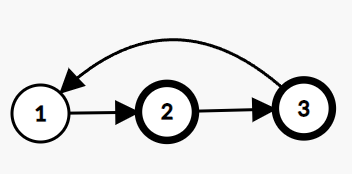
You are given a singly linked list that may or may not contain a cycle. You are supposed to return the node where the cycle begins, if a cycle exists, else return 'NULL'.
A cycle occurs when a node's next pointer returns to a previous node in the list.
Example:
In the given linked list, there is a cycle starting at position 0, hence we return 0.
Problem approach
I use two pointers: a slow pointer and a fast pointer. Initially, both pointers are set to the head of the linked list. The fast pointer moves twice as quickly as the slow pointer. If there is a cycle in the linked list, the fast pointer will eventually catch up to the slow pointer. If there is no cycle, the fast pointer will reach the end of the linked list.
3. Operating System Question
- Deadlocks.
- CPU Scheduling algorithms.
- Paging, Segmentation.
- They asked me to write the semaphore function code.
Problem approach
Tip 1: The operating system is the most important of all core subjects; prepare for it as your first priority.
Tip 2: Go through all the algorithms used in OS CPU scheduling.
03
Round
Easy
HR Round
Duration30 minutes
Interview date12 Oct 2022
Coding problem1
Timing: 30 minutes
Two HRs were present.
I was asked to bring a hard copy of my resume.
The interviewers were friendly.
1. Puzzle Questions
They asked me 2 puzzles:
- If I have 15 Rs and visit a store where each chocolate costs 1 Rs, and the shopkeeper allows you to exchange 3 wrappers for 1 extra chocolate, what is the maximum number of chocolates you can consume?
- If a man falls into a 100m deep well and climbs 4 meters up but slips 3 meters down each day, how many days would it take for him to get out of the well?
Problem approach
Tip 1: Be confident during the HR round.
Tip 2: If you get stuck, you can ask the HR for a hint; it is totally fine.


Here's your problem of the day 
Solving this problem will increase your chance to get selected in this company
Skill covered: Programming
How do you remove whitespace from the start of a string?
Choose another skill to practice
Similar interview experiences
Software Engineer
3 rounds | 4 problems
Interviewed by Samsung
Selected 
2936 views

0 comments

0 upvotes
Software Engineer
2 rounds | 3 problems
Interviewed by Samsung
Selected 1377 views
0 comments
0 upvotes
Software Engineer
2 rounds | 2 problems
Interviewed by Samsung
Rejected
1596 views
1 comments
0 upvotes
Software Engineer
3 rounds | 5 problems
Interviewed by Samsung
 Selected
 2278 views
1 comments
0 upvotes
Companies with similar interview experiences

Software Engineer
3 rounds | 7 problems
Interviewed by Optum
 Selected
 7976 views
1 comments
0 upvotes

Software Engineer
5 rounds | 5 problems
Interviewed by Microsoft
 Selected
 10147 views
1 comments
0 upvotes

Software Engineer
2 rounds | 4 problems
Interviewed by Amazon
Selected 4447 views
1 comments
0 upvotes