





SAP Labs interview experience Real time questions & tips from candidates to crack your interview

Associate Developer
SAP Labs


3 rounds | 6 Coding
problems
 Selected
 Interview preparation journey

Preparation
Duration: 6 Months
Topics: Data Structures , Algorithms, Operating System, OOPS, System Design

Tip 1 : Practise coding problems daily, consistency is the key.
Tip 2 : Be confident when answering questions in an interview. Attitude and confidence play a big part in hiring.
Tip 3 : Prepare your fundamentals first.
Application process
Where: Company Website
Eligibility: Depends on the job requirement.
Tip 1 : Keep it brief and concise.
Tip 2 : List your most recent experiences first.

Interview rounds
01
Round
Medium
Online Coding Interview
Duration90 Minutes
Interview date15 Aug 2020
Coding problem2
It was an online coding round hiring team shared the contest link. The round lasted for 1.5 hours. Additionally, it has two coding questions—one medium and the other hard. And there were 20 MCQs on basic aptitude, computer networking, and operating systems.
1. Maximum Product Subarray
Moderate
25m average time
75% success

0/80
Asked in companies



You are given an array “arr'' of integers. Your task is to find the contiguous subarray within the array which has the largest product of its elements. You have to report this maximum product.
An array c is a subarray of array d if c can be obtained from d by deletion of several elements from the beginning and several elements from the end.

For e.g.- The non-empty subarrays of an array [1,2,3] will be- [1],[2],[3],[1,2],[2,3],[1,2,3].
For Example:
If arr = {-3,4,5}.
All the possible non-empty contiguous subarrays of “arr” are {-3}, {4}, {5}, {-3,4}, {4,5} and {-3,4,5}.
The product of these subarrays are -3, 4, 5, -12, 20 and -60 respectively.
The maximum product is 20. Hence, the answer is 20.
Follow Up:
Can you solve this in linear time and constant space complexity?
Problem approach
The answer would unquestionably be the sum of the values in the entire array if there were no zeros or negative numbers.
Let's now assume there were only positive numbers, 0 (zero), and no negative numbers. Then, if 0s were encountered, we could maintain a current maximum product, which would be reset to A[i].
The situation slightly alters when the negative numbers are used. The maximum product in the positive and the maximum product in the negative must now be maintained. The maximum product in negative can be seen immediately when a negative number is encountered.
2. All Prime Numbers less than or equal to N
Moderate
10m average time
90% success
0/80
Asked in companies


You are given a positive integer 'N'. Your task is to return all the prime numbers less than or equal to the 'N'.
Note:
1) A prime number is a number that has only two factors: 1 and the number itself.

2) 1 is not a prime number.
Problem approach
Algorithm based approach - Sieve of Eratosthenes. The time complexity is O(N * loglog(N))
02
Round
Medium
Face to Face
Duration60 Minutes
Interview date20 Aug 2020
Coding problem3
There were two interviewers present for the interview round. OOPS concepts and problem solving were tested. The round lasted approximately one hour. There were also some project-related questions.
1. Leap Year
Easy
15m average time
80% success
0/40
Asked in companies

You are given a year in the form of an integer 'N', and your task is to check whether the given year is a leap year or not.
Note:
1) A year is said to be a leap year if it has 366 days. Normal years have 365 days.

2) The integer 'N' does not contain any leading zeros.
Problem approach
A leap year satisfies the following conditions:
The year is multiple of 400.
The year is multiple of 4 and not multiple of 100.
2. Zigzag Binary Tree Traversal
Easy
10m average time
90% success
0/40
Asked in companies


You are given a ‘Binary Tree’.
Return the level-order traversal of the Binary Tree.
Example:
Input: Consider the following Binary Tree:
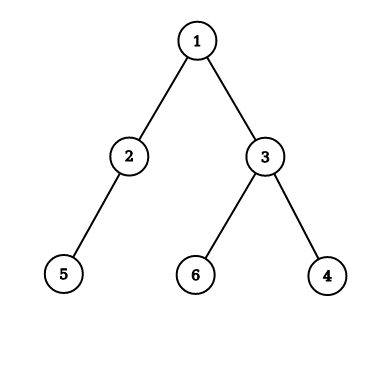
Output:
Following is the level-order traversal of the given Binary Tree: [1, 2, 3, 5, 6, 4]
Problem approach
The approach I used was very similar to the level order traversal.Added an extra parameter to keep a track of each level in left-right or right-left way.
3. Reverse String
Moderate
0/80
Asked in companies


You are given a string ‘S’. You are also given ‘M’ integers in an array ‘A’. You perform ‘M’ operations on this string. The operations are given in an array ‘A’ of size ‘M’.
You perform the operations in the order they appear in the array ‘A’. In the ‘i’th operation, you reverse the substring of ‘S’ from the position ‘A[i]’ to ‘len(S)’ - ‘A[i]’ - 1 (0 based).
Your task is to find the string after performing all the operations.
Example :
‘S’ = “aabcd”, ‘M’ = 2, ‘A’ = [0, 1]
After 1st operation i.e, reversing from [0, 4], ‘S’ = “dcbaa”.
After 2nd operation i.e, reversing from [1, 3], ‘S’ = “dabca”.
Hence, the answer is “dabca”.
Problem approach
Used simple iteration to solve these questions. While reversing a string iterate till half of the string length.
03
Round
Easy
HR Round
Duration45 minutes
Interview date30 Aug 2020
Coding problem1
It was a discussion based round. There were behavioural questions. There were also some mathematical and aptitude questions. There were some questions about SAP, its products and offerings. This round was more like a one-on-one conversation.
1. Basic HR questions
Some mathematical and aptitude questions. Behavioural questions: what are your strength and weakness, about leadership skills. General questions about SAP. Project discussion.
Problem approach
Tip 1 : Be confident.
Tip 2 : Give honest responses rather than ones you've prepared in advance.


Here's your problem of the day 
Solving this problem will increase your chance to get selected in this company
Skill covered: Programming
How do you remove whitespace from the start of a string?
Choose another skill to practice
Similar interview experiences
Associate Developer
3 rounds | 2 problems
Interviewed by SAP Labs
Selected 
2090 views

0 comments

0 upvotes
Associate Developer
4 rounds | 7 problems
Interviewed by SAP Labs
 Selected
 1620 views
0 comments
0 upvotes
Associate Developer
4 rounds | 7 problems
Interviewed by SAP Labs
Selected 1130 views
0 comments
0 upvotes
Associate Developer
5 rounds | 11 problems
Interviewed by SAP Labs
Selected 2503 views
0 comments
0 upvotes
Companies with similar interview experiences

Associate Developer
3 rounds | 5 problems
Interviewed by Oracle
Selected 1455 views
0 comments
0 upvotes