





Schrodinger interview experience Real time questions & tips from candidates to crack your interview
Backend Developer
Schrodinger


2 rounds | 3 Coding
problems

Rejected
Interview preparation journey

Journey
A recruiter from Schrödinger, Inc. reached out to me on LinkedIn after noticing my experience and skills in backend development. She asked me to email my resume, and 2–3 days later, I received a call informing me that my resume had been shortlisted and that they would be proceeding with further interview rounds.
Application story
I was approached by a recruiter who came across my profile on LinkedIn. (I have carefully curated my LinkedIn profile to highlight my technical skills, relevant work experience, and key achievements so that it remains visible in recruiter searches.)
The recruiter reached out to check my interest in the opportunity and requested my resume. Upon confirming my interest, I shared my updated resume via email. After 2–3 days, she contacted me again to inform me that my profile had been shortlisted.
During the call, she explained the overall interview process, mentioning that there would be approximately 4–5 rounds in total, with the final round scheduled as an on-site interview at the Hyderabad office.
Why selected/rejected for the role?
I was well prepared for the system design rounds, as my day-to-day responsibilities in my current organization involve extensively designing and developing scalable systems. However, my preparation for data structures and algorithms was not as thorough at that time. As a result, I was unable to fully solve the dynamic programming problem given by the interviewer, and a few test cases did not pass.
Preparation
Duration: 1 month
Topics: Dynamic Programming, System Design, OOPs, Database Transactions, Multithreading

Tip 1: Prepare dynamic programming well.
Tip 2: Prepare database isolation levels and locking concepts well (optimistic locking, pessimistic locking, etc.), and understand which to use in real-world use cases.
Tip 3: If you are interviewing for SDE-2 or above, prepare system design concepts well, such as trade-offs between NoSQL and SQL, Kafka vs. RabbitMQ, etc.
Application process
Where: Linkedin
Eligibility: No, only prior work experience is required (preferably in Java and Spring Boot). (Salary Package: 30-40 LPA)
Tip 1: Mention your projects on your resume in bullet points and quantify their impact with numbers (e.g., optimized system performance by 40%).
Tip 2: Mention only those skills you are confident in.

Interview rounds
01
Round
Medium
Video Call
Duration60 minutes
Interview date30 Oct 2025
Coding problem2
It was divided into two parts:
- Introduction and project discussion.
- In Part 2, the interviewer asked some questions from their side.
1. Project Discussion
Discussion of projects: The interviewer wanted to understand the tech stack I had used and the scale of the projects I had worked on. He then cross-questioned me on the tech stack and the design choices in the projects.
Cross Questions:
Why did I choose MongoDB in one project and PostgreSQL in another?
Why did I choose RabbitMQ in one project instead of Kafka or Amazon SQS?
Problem approach
Tip 1: Be structured and prepared with system design concepts and trade-offs.
Tip 2: You should thoroughly understand every project mentioned in your resume.
2. Database Concepts
In the second half of the interview, the interviewer asked the following questions:
- What are the various isolation levels in databases?
- For banking transactions, would you use optimistic locking or pessimistic locking, and why?
- What is a deadlock? Can you give a real-life example of a deadlock?
- What does the @Transactional annotation do?
Problem approach
Tip 1: You must be well versed with concepts like Multithreading, Concurrency, thready safety and database locking.
Tip 2: You should have good hands on with real time backend systems.
02
Round
Medium
Video Call
Duration60 minutes
Interview date30 Oct 2025
Coding problem1
1. Minimum Number Of Taps To Water Garden
Hard
15m average time
85% success

0/120
Asked in companies



The gardener wants to water the garden by opening the minimum number of taps. The garden is one-dimensional along the x-axis of length N i.e. the garden starts from point 0 and ends at point N. There are N + 1 tap located at points [0, 1, 2, …, N] in the garden.
You are given an integer N, and an array named “ranges” of size N + 1(0-indexed). The ith tap, if opened, can water the gardener from point (i - ranges[i]) to (i + ranges[i]) including both. The task is to find the minimum number of taps that should be open to water the whole garden, return -1 if the garden can not be watered.
Example :
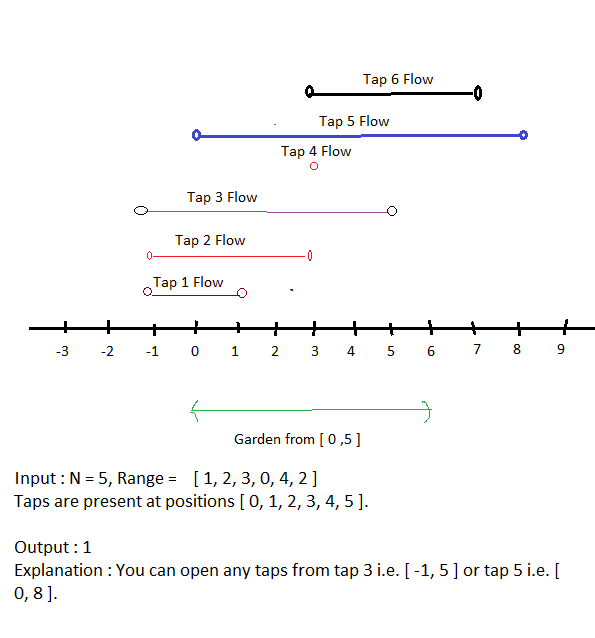
Follow Up:
Can you solve the problem in O(N) time?
Problem approach
Step 1: I converted all taps/sprinklers into intervals.
Step 2: I sorted the intervals by increasing end time.
I applied the Activity Selection logic (minimizing overlap). However, this problem is an interval covering problem, not a scheduling problem.
That’s why some test cases were failing. The interviewer also gave me some time to think, but unfortunately, we ran out of time.


Here's your problem of the day 
Solving this problem will increase your chance to get selected in this company
Skill covered: Programming
What is the correct syntax to inherit a class in Java?
Choose another skill to practice
Similar interview experiences

SDE - 1
4 rounds | 8 problems
Interviewed by Amazon

 Selected
11154 views

0 comments

0 upvotes
Analytics Consultant
3 rounds | 10 problems
Interviewed by ZS
Selected 1246 views
0 comments
0 upvotes
SDE - Intern
1 rounds | 3 problems
Interviewed by Amazon
Selected 4428 views
0 comments
0 upvotes

SDE - 2
4 rounds | 6 problems
Interviewed by Expedia Group
 Selected
 3351 views
0 comments
0 upvotes