





Seclore interview experience Real time questions & tips from candidates to crack your interview
Product Engineer
Seclore


2 rounds | 4 Coding
problems

Rejected
Interview preparation journey

Preparation
Duration: 3 Months
Topics: Data Structures, Pointers, OOPS, System Design, Algorithms, Dynamic Programming

Tip 1 : Stay focused
Tip 2 : Practice coding questions on gfg
Tip 3 : View previous interviews of the companies
Application process
Where: Campus
Eligibility: 7
Tip 1 : Don't lie on resume
Tip 2 : Just write in format that is catchy

Interview rounds
01
Round
Easy
Online Coding Interview
Duration30 Minutes
Interview date10 Feb 2022
Coding problem0
There will be 16 multiple choice questions and it is based on basic maths and logic. For every correct answer, you get +1 and for every wrong answer, -0.5 will be deducted from your total score. Note that the camera should be on throughout the test and navigating away from the test screen will shut your test.
02
Round
Easy
Online Coding Test
Duration60 Minutes
Interview date10 Feb 2022
Coding problem4
This round was quite different from what usually coding rounds look like. They had given a Binary Search Tree code with various common functions like inserting, deleting, searching node, etc. Also, there were various anonymous non-common functions whose working we had to understand and write about on the answer sheet. There were 5 such questions.
1. Path Sum
Easy
15m average time
80% success

0/40
Asked in companies



You are given the root node of a binary tree consisting of ‘N’ nodes and an integer value ‘TARGET’. Your task is to find the number of leaf nodes in the given binary tree such that the sum of all nodes from the root to leaf is equal to ‘TARGET’.
A leaf node is defined as a node having no child nodes.
You are given a root node ‘ROOT’.Your task is to return the number of leaf nodes satisfying the given condition.
Example:
Elements are in the level order form. The input consists of values of nodes separated by a single space in a single line. In case a node is null, we take -1 in its place.

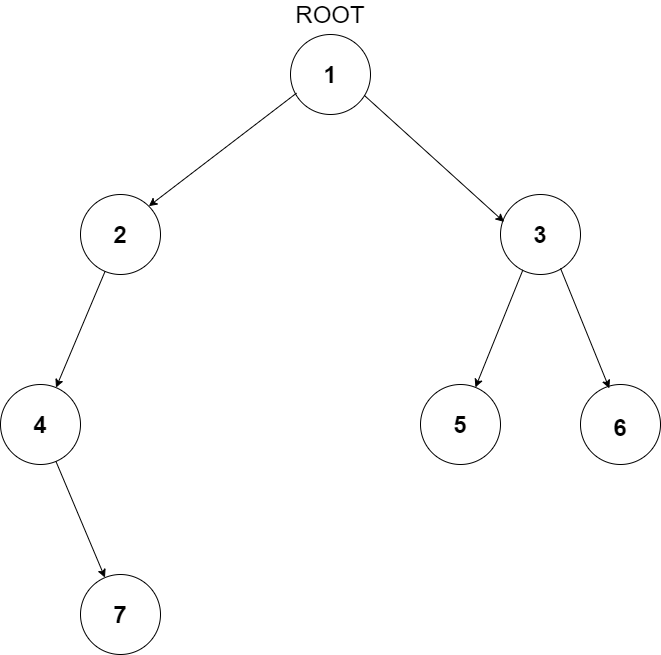
For example, the input for the tree depicted in the below image would be :
1
2 3
4 -1 5 6
-1 7 -1 -1 -1 -1
-1 -1

Explanation :
Level 1 :
The root node of the tree is 1

Level 2 :
Left child of 1 = 2
Right child of 1 = 3

Level 3 :
Left child of 2 = 4
Right child of 2 = null (-1)
Left child of 3 = 5
Right child of 3 = 6

Level 4 :
Left child of 4 = null (-1)
Right child of 4 = 7
Left child of 5 = null (-1)
Right child of 5 = null (-1)
Left child of 6 = null (-1)
Right child of 6 = null (-1)

Level 5 :
Left child of 7 = null (-1)
Right child of 7 = null (-1)

The first not-null node (of the previous level) is treated as the parent of the first two nodes of the current level.

The second not-null node (of the previous level) is treated as the parent node for the next two nodes of the current level and so on.

The input ends when all nodes at the last level are null (-1).
Note :
The above format was just to provide clarity on how the input is formed for a given tree.

The sequence will be put together in a single line separated by a single space. Hence, for the above-depicted tree, the input will be given as:

1 2 3 4 -1 5 6 -1 7 -1 -1 -1 -1 -1 -1
2. Swap Nodes in Pairs
Moderate
40m average time
60% success
0/80
Asked in companies



You are given a singly linked list of integers.
Your task is to swap every two adjacent nodes, and return the head of the modified, linked list.
For Example:
We have a linked list 1->2->3->4->5->6->7 and so on. You are supposed to swap pairs of a linked list like swap (1,2), (3,4), (5,6), and so on.
Note:
1. You may not modify the data in the list’s nodes; only nodes themselves may be changed. Because imagine a case where a node contains many fields, so there will be too much unnecessary swap.

2. If a pair of a node does not exist, then leave the node as it is.
3. Maximum Depth Of A Binary Tree
Easy
15m average time
85% success
0/40
Asked in companies

You are given the root node of a binary tree with N nodes, whose nodes have integer values. Your task is to find the maximum depth of the given Binary tree.
Depth of a binary tree is the same as its height. In simpler terms, you have to find the total number of nodes encountered while moving from the root node to the farthest leaf node, along the longest path of the binary tree.
Example:-
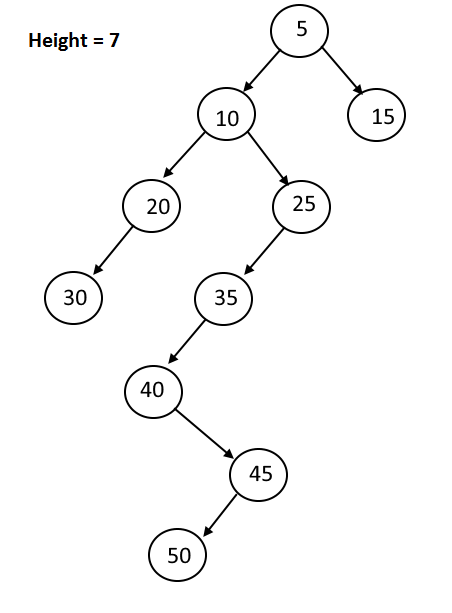
If we are given the above binary tree as input then moving from root node(5) to the farthest leaf node(50), the path formed will be [ 5->10->25->35->40->45->50 ]. The total number of nodes encountered is 7, therefore the maximum depth of the binary tree is 7.
4. Find The Sum Of The Left Leaves
Moderate
25m average time
75% success
0/80
Asked in companies



Given a binary tree with ‘root’. Your task is to find the sum of all the left leaf nodes.
Properties of leaf:-
In a binary tree, a leaf is a node such that it does not have any children. Node ‘1’ is always the root of the binary tree. Left leaves are those nodes that are the left child of their parent and a leaf node.
Example:
Let’s say you have a binary tree as follows:-
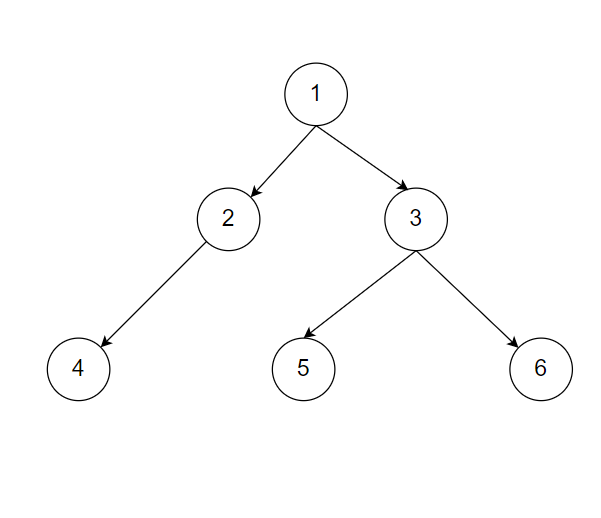
Node 4 and Node 5 are leaf nodes and left child of their parent. Node 6 is a leaf node but not the left child of its parent node 3. Therefore return ‘4+5= 9’ as the answer.
Note:
You do not need to print anything; it has already been taken care of. Just implement the function.


Here's your problem of the day 
Solving this problem will increase your chance to get selected in this company
Skill covered: Programming
How do you remove whitespace from the start of a string?
Choose another skill to practice
Similar interview experiences
SDE - 1
3 rounds | 7 problems
Interviewed by OYO
 Selected
6182 views

0 comments

0 upvotes

SDE - 1
2 rounds | 5 problems
Interviewed by Meesho
Rejected
7245 views
0 comments
0 upvotes

SDE - 1
3 rounds | 9 problems
Interviewed by Salesforce
 Selected
 4552 views
0 comments
0 upvotes
System Engineer Trainee
4 rounds | 15 problems
Interviewed by Seclore
Rejected
338 views
0 comments
0 upvotes
Companies with similar interview experiences

Product Engineer
3 rounds | 10 problems
Interviewed by Sprinklr
Selected 1950 views
0 comments
0 upvotes
Product Engineer
5 rounds | 10 problems
Interviewed by Sprinklr
Selected 1378 views
0 comments
0 upvotes
Product Engineer
3 rounds | 5 problems
Interviewed by Sprinklr
Selected 741 views
0 comments
0 upvotes