





SetuServ interview experience Real time questions & tips from candidates to crack your interview

GenAI Analyst
SetuServ


6 rounds | 5 Coding
problems

Rejected
Interview preparation journey

Journey
My journey began with learning the basics of programming and problem-solving. I practiced regularly, explored new technologies, and kept improving my logical thinking. Though I faced challenges and failures, each one taught me something valuable. Staying consistent, confident, and curious helped me reach this stage and crack the interviews, turning my hard work into success.
Application story
I applied for the SetuServ GenAI Analyst role through my college campus placement drive. After submitting my application and resume, I was shortlisted for further rounds. The process was well-organized, starting with assessments and aptitude tests, followed by group discussions and technical interviews, leading up to the final evaluation stage.
Why selected/rejected for the role?
I was rejected because, although I performed well in the earlier rounds and demonstrated strong problem-solving and communication skills, I couldn’t provide an optimized solution for one of the coding problems. This experience taught me the importance of focusing on time and space optimization, improving my coding efficiency, and staying calm under pressure during technical interviews.
Preparation
Duration: 4 months
Topics: Data Structures and Algorithms, OOPs, DBMS, Operating Systems, Computer Networks, Java, Python, Problem Solving, Generative AI Concepts

Tip 1: Build 2–3 real-time projects to strengthen your practical understanding.
Tip 2: Revise core subjects like DSA, OOPS, DBMS, and OS regularly before interviews.
Tip 3: Practice at least 250 coding questions focusing on logic building and optimization.
Application process
Where: Campus
Eligibility: No active backlogs, (Salary Package: 6 LPA)
Tip 1: Keep your resume clear, concise, and limited to one page highlighting key skills and achievements.
Tip 2: Include relevant projects, certifications, and measurable accomplishments to showcase your practical experience.

Interview rounds
01
Round
Medium
Online Coding Interview
Duration60 minutes
Interview date1 Sep 2025
Coding problem0
This was the first assessment test consisting of 70 MCQ questions based on Aptitude and Computer Fundamentals.
02
Round
Medium
Group Discussion
Duration15 minutes
Interview date6 Sep 2025
Coding problem0
The GD round was conducted in the afternoon in a well-organized and comfortable environment. The topic was “Is AI a job taker or a job creator?” All participants actively shared their views, and the discussion was engaging. The panel observed communication, confidence, and clarity of thought. The moderators were polite and maintained a positive atmosphere.
I began the group discussion by first understanding the topic and organizing my thoughts clearly. I started with a confident introduction, shared balanced points with real-world examples, and respected others’ opinions. I made sure to listen actively, support valid points, and added my insights at the right moments to keep the discussion meaningful and collaborative.
03
Round
Hard
Online Coding Test
Duration30 minutes
Interview date6 Sep 2025
Coding problem3
This consisted of two coding questions. I solved both, but the second one was done using a brute-force approach. The interviewer was polite and attentive, asking for an optimized solution and explaining certain test cases. Overall, the session was well-organized and professional.
1. Shortest Path in DAG
Moderate
30m average time
65% success

0/80
Asked in company
You are given a directed acyclic graph of 'N' vertices(0 to 'N' - 1) and 'M' weighted edges.
Return an array that stores the distance(sum of weights) of the shortest path from vertex 0 to all vertices, and if it is impossible to reach any vertex, then assign -1 as distance.
For Example:
'N' = 3, 'M' = 3, 'edges' = [0, 1, 2], [1, 2, 3], [0, 2, 6]].

Distance (0 to 0) = 0.
Distance (0 to 1) = 2.
Distance (0 to 2) = 0->1 + 1->2 = 2+3 = 5.
So our answer is [0, 2, 5].
Problem approach
I implemented Dijkstra’s algorithm using a priority queue (min-heap) to find the shortest paths efficiently.
2. Topological Sort
Moderate
30m average time
70% success
0/80
Asked in companies



A Directed Acyclic Graph (DAG) is a directed graph that contains no cycles.
Topological Sorting of DAG is a linear ordering of vertices such that for every directed edge from vertex ‘u’ to vertex ‘v’, vertex ‘u’ comes before ‘v’ in the ordering. Topological Sorting for a graph is not possible if the graph is not a DAG.
Given a DAG consisting of ‘V’ vertices and ‘E’ edges, you need to find out any topological sorting of this DAG. Return an array of size ‘V’ representing the topological sort of the vertices of the given DAG.
For example, Consider the DAG shown in the picture.
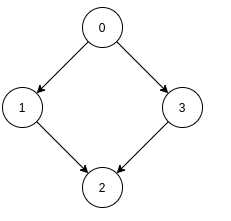
In this graph, there are directed edges from 0 to 1 and 0 to 3, so 0 should come before 1 and 3. Also, there are directed edges from 1 to 2 and 3 to 2 so 1 and 3 should come before 2.
So, The topological sorting of this DAG is {0 1 3 2}.
Note that there are multiple topological sortings possible for a DAG. For the graph given above one another topological sorting is: {0, 3, 1, 2}
Note:
1. It is guaranteed that the given graph is DAG.
2. There will be no multiple edges and self-loops in the given DAG.
3. There can be multiple correct solutions, you can find any one of them.
4. Don’t print anything, just return an array representing the topological sort of the vertices of the given DAG.
Problem approach
Step 1: For Topological Sort, I used a simple DFS-based approach which worked but wasn’t optimized.
Step 2: The interviewer asked for a more efficient Kahn’s Algorithm approach, but I couldn’t implement it correctly under time pressure.
3. Infix To Postfix
Easy
20m average time
80% success
0/40
Asked in companies



You are given a string 'exp' which is a valid infix expression.
Convert the given infix expression to postfix expression.
Note:
Infix notation is a method of writing mathematical expressions in which operators are placed between operands.

For example, "3 + 4" represents the addition of 3 and 4.

Postfix notation is a method of writing mathematical expressions in which operators are placed after the operands.

For example, "3 4 +" represents the addition of 3 and 4.

Expression contains digits, lower case English letters, ‘(’, ‘)’, ‘+’, ‘-’, ‘*’, ‘/’, ‘^’.
Example:
Input: exp = ‘3+4*8’

Output: 348*+

Explanation:
Here multiplication is performed first and then the addition operation. Hence postfix expression is  3 4 8 * +.
Problem approach
Step 1: Decide the method (I chose to use a stack because it helps manage operators and parentheses easily while converting infix to postfix).
Step 2: Set priority rules
I assigned precedence to operators:
^ > * / > + -
And noted that ^ is right-associative, others are left-associative.
Step 3: Scan the expression left to right
For each character:
If it is an operand, I directly add it to the postfix string.
Step 4: After completing the scan
I pop all remaining operators from the stack and append them to the postfix expression.
Step 5: Final output
The resulting string is the postfix expression.
04
Round
Medium
Coding Test - Pen and paper
Duration30 minutes
Interview date6 Sep 2025
Coding problem0
This round was another aptitude test consisting of 30 MCQ questions.
05
Round
Medium
Face to Face
Duration20 minutes
Interview date6 Sep 2025
Coding problem1
They focused on understanding my technical knowledge, problem-solving skills, and confidence. The overall interaction was positive and engaging, giving me a chance to express my thoughts clearly and confidently.
1. Operating System
Problem approach
Tip 1: Read Galvin’s Operating System Concepts thoroughly for synchronization, memory management, deadlocks, and virtual memory. Most interview OS questions directly relate to Galvin’s explanations.
Tip 2: Practice SQL queries (joins, group by, window functions) because OS + SQL are top technical rounds in most companies.
Tip 3: Refer to online OS articles for repeated conceptual questions on semaphores, deadlocks, paging, thrashing, page replacement algorithms, etc.
06
Round
Medium
HR Round
Duration30 minutes
Interview date6 Sep 2025
Coding problem1
The HR round was conducted in the afternoon in a pleasant and comfortable environment. The atmosphere was friendly, and the interviewer made me feel at ease. The discussion was smooth and professional, focusing more on personality and communication rather than technical aspects.
1. HR Questions
- Tell us about your background.
- What are your strengths and weaknesses?
- What are your career goals?


Here's your problem of the day 
Solving this problem will increase your chance to get selected in this company
Skill covered: Programming
How do you remove whitespace from the start of a string?
Choose another skill to practice
Similar interview experiences

SDE - 1
3 rounds | 7 problems
Interviewed by OYO
 Selected
6182 views

0 comments

0 upvotes

SDE - Intern
2 rounds | 3 problems
Interviewed by Amazon
Rejected
1566 views
0 comments
0 upvotes

SDE - 1
2 rounds | 5 problems
Interviewed by Meesho
Rejected
7246 views
0 comments
0 upvotes

SDE - 1
3 rounds | 9 problems
Interviewed by Salesforce
 Selected
 4552 views
0 comments
0 upvotes