





ShareChat interview experience Real time questions & tips from candidates to crack your interview

SDE - 1
ShareChat


3 rounds | 5 Coding
problems

 Selected
 Interview preparation journey

Preparation
Duration: 2 months
Topics: Data Structures & Algorithms, System Design (Basics), Resume Projects Revision

Tip 1 : Focus more on the problem-solving part, i.e. Data Structures & Algorithms and coding skills.
Tip 2 : You should be comfortable with Leetcode medium-level questions.
Tip 3 : Basic system design should be enough, basics of HLD (High-Level Design) & LLD (Low-Level Design)
Application process
Where: Referral
Eligibility: No Criteria
Tip 1 : Keep your resume one-pager, short, and concise. They will be more interested in your problem-solving skills.
Tip 2 : Do not include redundant projects in your resume. Do not write about skills you are not good at.
Tip 3 : Focus on your previous work experience in your resume. That is one section, from which you will be asked questions.

Interview rounds
01
Round
Hard
Online Coding Interview
Duration90 Minutes
Interview date17 Jul 2021
Coding problem3
It was a coding round of a duration of 90 minutes hosted on HackerEarth. There were 3 coding questions.
Question-1 Maximum Score: 20
Question-2 Maximum Score: 50
Question-3 Maximum Score: 100
Total Maximum Score: 170
Timing: You can take the test at your convenience. A deadline of 4-5 days was mentioned for that.
1. Increasing Subsegment
Moderate
15m average time
80% success

0/80
Asked in companies


Gary has a sequence 'ARR', consisting of 'N' integers.
We'll call a sequence ARR[i], ARR[i+1], ..., ARR[j] where 1 ≤ i ≤ j ≤ N a subsegment of the sequence ARR. The value (j - i + 1) denotes the length of the subsegment.
Your task is to find the longest subsegment of ARR, such that it is possible to change at most one number (change one number to any integer you want) from the subsegment to make the subsegment strictly increasing.
You need to return the length of the maximum subsegment that you can find by changing only one integer in the given sequence.
2. Subsequences of String
Moderate
15m average time
85% success
0/80
Asked in companies


You are given a string 'STR' containing lowercase English letters from a to z inclusive. Your task is to find all non-empty possible subsequences of 'STR'.
A Subsequence of a string is the one which is generated by deleting 0 or more letters from the string and keeping the rest of the letters in the same order.
3. Minimum Cost to Hire M Candidates
Hard
50m average time
50% success
0/120
Asked in companies


You are the HR of the Ninja team and planning to hire ‘M’ candidates out of ‘N’ candidates to form a paid group. The candidates have been evaluated on the basis of their skills and have been asked for their minimum salary expectations. So, you are given two arrays, ‘SKILL’ and ‘EXPECTED_SALARY’, where ‘SKILL[i]’ and ‘EXPECTED_SALARY[i]’ represent the skill and minimum salary expectation of ‘i-th’ candidate, respectively. You have to consider the following two rules for hiring a group of ‘M’ candidates:
1) Every candidate in the paid group should be paid in the ratio of their skill compared to other candidates in the paid group.
2) The minimum salary expectation of every candidate in the paid group should be fulfilled.
You have to return the minimum amount of money required to hire ‘M’ candidates as per the above-mentioned rules.
Note:
Answers which are within the range 10^-6 of the correct answer will be considered correct.
02
Round
Medium
Video Call
Duration60 Minutes
Interview date22 Jul 2021
Coding problem1
It was an online interview round. The round was based on problem-solving and DSA (Data Structures & Algorithms).
Timing: 4:00 PM - 5:00 PM
Environment: Google Meet
Interviewer was an SDE-2 at ShareChat was very helpful.
1. LCA In A BST
Moderate
15m average time
85% success
0/80
Asked in companies

You are given a binary search tree of integers with N nodes. You are also given references to two nodes 'P' and 'Q' from this BST.
Your task is to find the lowest common ancestor(LCA) of these two given nodes.
The lowest common ancestor for two nodes P and Q is defined as the lowest node that has both P and Q as descendants (where we allow a node to be a descendant of itself)
A binary search tree (BST) is a binary tree data structure which has the following properties.
• The left subtree of a node contains only nodes with data less than the node’s data.
• The right subtree of a node contains only nodes with data greater than the node’s data.
• Both the left and right subtrees must also be binary search trees.
For example:
'P' = 1, 'Q' = 3
tree = 2 1 4 -1 -1 3 -1 -1 -1,

The BST corresponding will be-
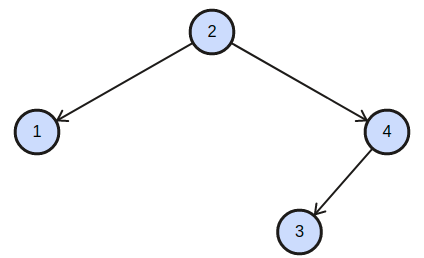
Here, we can clearly see that LCA of node 1 and node 3 is 2.
Problem approach
Approach:
Following is the simple approach for Least Common Ancestor for any number of nodes.
For every node calculate the matching number of nodes at that node and its sub-tree.
-> If root is also a matching node (matchingNodes = matchingNodes in left sub-tree + matchingNodes in right sub-tree + 1)
-> If root is not a matching node (matchingNodes = matchingNodes in left sub-tree + matchingNodes in right-subtree)
-> If matching Nodes count at any node is equal to number of keys then add that node into the Ancestors list.
-> The First node in the Ancestors List is the Least Common Ancestor of all the given keys.
03
Round
Medium
Video Call
Duration60 Minutes
Interview date28 Jul 2021
Coding problem1
This was the last hiring manager round.
Timing: 6:00 PM - 7:00 PM
Environment: Google meet
The interviewer was an Engineering Manager in ShareChat and was an experienced, guy.
1. URL Shortener
Easy
10m average time
90% success
0/40
Asked in companies



You have given a URL id – 'N' consisting of only digits. Your task is to generate a short URL for the given URL id.
To generate a short URL, you need to convert the given URL id to 62 base number where digits of the number are:[“0123456789abcdefghijklmnopqrstuvwxyzABCDEFGHIJKLMNOPQRSTUVWXYZ”] i.e “0” corresponds to 0, “a” corresponds to 10, “Z” corresponds to 61, and “10” corresponds to 62, “11” corresponds to 63, and so on….
Follow Up:
Can you solve this in logarithmic time and space complexity?
Problem approach
Approach:
1. We can use hashing to hash the long URL into a short URL. That's one approach.
2. We can also create a short URL with just 7 characters, and lowercase English characters. Corresponding to every
long URL, we can generate a short URL of length 7 with 7 randomly chosen characters. Since (26^7) is very high,
so the chances of the collision are very low and there can be a large pool of long URLs for which you will be able to
create short URLs.


Here's your problem of the day 
Solving this problem will increase your chance to get selected in this company
Skill covered: Programming
How do you remove whitespace from the start of a string?
Choose another skill to practice
Similar interview experiences
SDE - 1
4 rounds | 3 problems
Interviewed by ShareChat
 Selected
1968 views

0 comments

0 upvotes
SDE - 1
4 rounds | 6 problems
Interviewed by ShareChat
Selected 1391 views
0 comments
0 upvotes
SDE - 1
2 rounds | 4 problems
Interviewed by ShareChat
Rejected
1376 views
0 comments
0 upvotes
SDE - 1
2 rounds | 7 problems
Interviewed by ShareChat
Rejected
2433 views
0 comments
0 upvotes
Companies with similar interview experiences
SDE - 1
5 rounds | 12 problems
Interviewed by Amazon
 Selected
 117552 views
24 comments
0 upvotes

SDE - 1
4 rounds | 5 problems
Interviewed by Microsoft
Selected 60143 views
5 comments
0 upvotes
SDE - 1
3 rounds | 7 problems
Interviewed by Amazon
 Selected
 36138 views
7 comments
0 upvotes