





ShortHills Tech (Gold Microsoft Partner) interview experience Real time questions & tips from candidates to crack your interview
SDE - 1
ShortHills Tech (Gold Microsoft Partner)


3 rounds | 5 Coding
problems

 Selected
 Interview preparation journey

Journey
Navigating from BTech at NSUT to a software developer has been a dynamic progression. Starting with foundational programming languages, I delved into complex concepts through hands-on projects, refining my skills. Exploring diverse technologies and frameworks broadened my expertise while challenges became opportunities for growth and resilience. Networking with peers and mentors, engaging in open-source projects, and participating in hackathons enriched my understanding. Job interviews focused on technical proficiency, effective communication, and teamwork. A robust portfolio showcasing projects played a pivotal role in my job search. Reflecting on this journey, an insatiable thirst for knowledge and resilience have been pivotal in shaping a fulfilling career.
Application story
I applied for a software developer position when the company visited my campus for placements. After submitting my resume through the campus portal, I completed pre-interview assessments. These assessments focused on showcasing my technical skills.
Why selected/rejected for the role?
I was selected for this offer because I could perform well during all the rounds of the interview process.
Preparation
Duration: 8 months
Topics: Data Structures, Pointers, OOPS, System Design, Algorithms, Dynamic Programming

Tip 1: Practised topic-wise CodeStudio questions from basics
Tip 2: Watched so many system design mock interviews
Tip 3: I did mock interviews with friends for DSA and system design rounds.
Application process
Where: Campus
Eligibility: Above 6 CGPA
Tip 1 : Have some projects on resume.
Tip 2: Do not put false things on resume.

Interview rounds
01
Round
Medium
Video Call
Duration60 min
Interview date21 Aug 2023
Coding problem2
1. Chocolate Problem
Moderate
15m average time
85% success

0/80
Asked in companies



Given an array/list of integer numbers 'CHOCOLATES' of size 'N', where each value of the array/list represents the number of chocolates in the packet. There are ‘M’ number of students and the task is to distribute the chocolate to their students. Distribute chocolate in such a way that:
1. Each student gets at least one packet of chocolate.
2. The difference between the maximum number of chocolate in a packet and the minimum number of chocolate in a packet given to the students is minimum.
Example :
Given 'N' : 5 (number of packets) and 'M' : 3 (number of students)
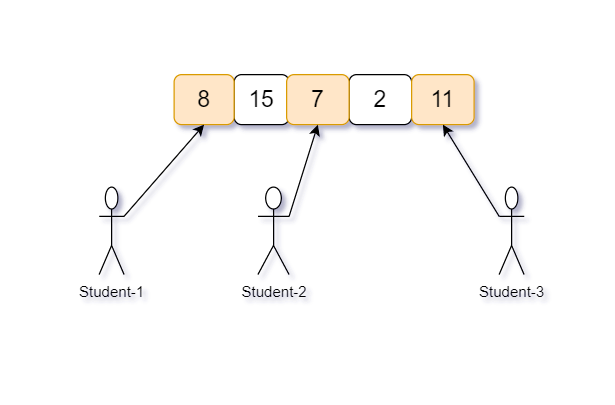
And chocolates in each packet is : {8, 11, 7, 15, 2}

All possible way to distribute 5 packets of chocolates among 3 students are -

( 8,15, 7 ) difference of maximum-minimum is ‘15 - 7’ = ‘8’
( 8, 15, 2 ) difference of maximum-minimum is ‘15 - 2’ = ‘13’
( 8, 15, 11 ) difference of maximum-minimum is ‘15 - 8’ = ‘7’
( 8, 7, 2 ) difference of maximum-minimum is ‘8 - 2’ = ‘6’
( 8, 7, 11 ) difference of maximum-minimum is ‘11 - 7’ = ‘4’
( 8, 2, 11 ) difference of maximum-minimum is ‘11 - 2’ = ‘9’
( 15, 7, 2 ) difference of maximum-minimum is ‘15 - 2’ = 13’
( 15, 7, 11 ) difference of maximum-minimum is ‘15 - 7’ = ‘8’
( 15, 2, 11 ) difference of maximum-minimum is ‘15 - 2’ = ‘13’
( 7, 2, 11 ) difference of maximum-minimum is ‘11 - 2’ = ‘9’

Hence there are 10 possible ways to distribute ‘5’ packets of chocolate among the ‘3’ students and difference of combination (8, 7, 11) is ‘maximum - minimum’ = ‘11 - 7’ = ‘4’ is minimum in all of the above.
Problem approach
Given an array/list of integer numbers 'CHOCOLATES' of size 'N', where each value of the array/list represents the number of chocolates in the packet. There are ‘M’ number of students and the task is to distribute the chocolate to their students. Distribute chocolate in such a way that:
1. Each student gets at least one packet of chocolate.
2. The difference between the maximum number of chocolate in a packet and the minimum number of chocolate in a packet given to the students is minimum.
2. Merge Strings
Moderate
20m average time
55% success
0/80
Asked in companies


You are given two strings ‘A’ and ‘B’ of length ‘N’ and ‘M’ respectively. You need to construct a new string ‘C’ by merging both strings in such a way that the relative order of characters in ‘A’ and ‘B’ is the same in string ‘C’.
For example, if the string ‘A’ is of length 3 then the first character of string ‘A’ should be placed before the second and third characters of string ‘A’ in string ‘C’. Similarly, the second character of string ‘A’ should be placed after the first character and before the third character of string ‘A’ in string ‘C’.
The cost of merging the strings is given by the number of consecutive characters in string ‘C’ that are not equal + 1, i.e. ‘C[ i ] != ‘C[ i + 1]’.
Find the minimum cost of merging both strings.
Example:
Input: ‘N’ = 3, ‘M’ = 3, ‘A’ = aba, ‘B’ = aab

Output: 3

One of the valid strings with minimum cost after merging ‘A’ and ‘B’ is ‘aaabba’. The order of characters of string ‘A’ as well as ‘B’ is maintained in the string ‘aaabba’ and the cost of this string is (1 + 2) = 3.
Problem approach
You are given two strings ‘A’ and ‘B’ of length ‘N’ and ‘M’ respectively. You need to construct a new string ‘C’ by merging both strings in such a way that the relative order of characters in ‘A’ and ‘B’ is the same in string ‘C’.
For example, if the string ‘A’ is of length 3 then the first character of string ‘A’ should be placed before the second and third characters of string ‘A’ in string ‘C’. Similarly, the second character of string ‘A’ should be placed after the first character and before the third character of string ‘A’ in string ‘C’.
The cost of merging the strings is given by the number of consecutive characters in string ‘C’ that are not equal + 1, i.e. ‘C[ i ] != ‘C[ i + 1]’.
Find the minimum cost of merging both strings.
02
Round
Medium
Video Call
Duration60 minutes
Interview date23 Aug 2023
Coding problem2
1. Find prime numbers
Easy
15m average time
80% success
0/40
Asked in companies



You are given a positive integer ‘N’. Your task is to print all prime numbers less than or equal to N.
Note: A prime number is a natural number that is divisible only by 1 and itself. Example - 2, 3, 17, etc.
You can assume that the value of N will always be greater than 1. So, the answer will always exist.
Problem approach
You are given a positive integer ‘N’. Your task is to print all prime numbers less than or equal to N.
Note: A prime number is a natural number that is divisible only by 1 and itself. Example - 2, 3, 17, etc.
You can assume that the value of N will always be greater than 1. So, the answer will always exist.
2. Reverse Words In A String
Easy
10m average time
90% success
0/40
Asked in companies


You are given a string 'str' of length 'N'.
Your task is to reverse the original string word by word.
There can be multiple spaces between two words and there can be leading or trailing spaces but in the output reversed string you need to put a single space between two words, and your reversed string should not contain leading or trailing spaces.
Example :
If the given input string is "Welcome to Coding Ninjas", then you should return "Ninjas Coding to Welcome" as the reversed string has only a single space between two words and there is no leading or trailing space.
Problem approach
Your task is to reverse the original string word by word.There can be multiple spaces between two words and there can be leading or trailing spaces but in the output reversed string you need to put a single space between two words, and your reversed string should not contain leading or trailing spaces.
03
Round
Easy
HR Round
Duration20 minutes
Interview date25 Aug 2023
Coding problem1
1. HR Round
Why Shorthills?
List your weaknesses and Strengths.
Are you willing to relocate to Noida or Gurugram?
Are you a team player?


Here's your problem of the day 
Solving this problem will increase your chance to get selected in this company
Skill covered: Programming
How do you remove whitespace from the start of a string?
Choose another skill to practice
Similar interview experiences

SDE - 1
3 rounds | 7 problems
Interviewed by OYO
Selected 
6182 views

0 comments

0 upvotes
SDE - Intern
2 rounds | 3 problems
Interviewed by Amazon
Rejected
1565 views
0 comments
0 upvotes

SDE - 1
2 rounds | 5 problems
Interviewed by Meesho
Rejected
7245 views
0 comments
0 upvotes

SDE - 1
3 rounds | 9 problems
Interviewed by Salesforce
 Selected
 4552 views
0 comments
0 upvotes
Companies with similar interview experiences
SDE - 1
5 rounds | 12 problems
Interviewed by Amazon
 Selected
 117552 views
24 comments
0 upvotes
SDE - 1
4 rounds | 5 problems
Interviewed by Microsoft
Selected 60142 views
5 comments
0 upvotes
SDE - 1
3 rounds | 7 problems
Interviewed by Amazon
 Selected
 36138 views
7 comments
0 upvotes