





Spinny interview experience Real time questions & tips from candidates to crack your interview
SDE - 1
Spinny


5 rounds | 5 Coding
problems

 Selected
 Interview preparation journey

Preparation
Duration: 6 Months
Topics: Data Structures, Algorithms, LLD, SQL, OOPS

Tip 1 : Practice as many medium/hard questions as you can.
Tip 2 : Listen to the questions being asked carefully since, a wrongly understood question can lead to a straight rejection!
Tip 3 : For coding questions, try out all possibilities. Don't give up. When you feel you're not on the right track, ask for hints(Don't be shy about it).
Tip 4 : Think out loud! (Share all your stupid thoughts with your interviewers). Walk the interviewer through your thought process.
Application process
Where: Other
Eligibility: 1+ Years of experience
Tip 1 : Make your resume crisp and clear. Don't use bad font/font size. Make it look very professional.
Tip 2 : Avoid mentioning irrelevant achievements (e.g - Got 1st position in badminton match)
Tip 3 : Add at least 1 good project which you have made with all your efforts and which you are damn confident of!
Tip 4 : Add all the core technical achievements. E.G, Coding Contents Ranks, Certifications (Not Required, But it can add values), etc.

Interview rounds
01
Round
Medium
Online Coding Interview
Duration90 minutes
Interview date18 Nov 2021
Coding problem1
Online Assessment consisted of coding and SQL queries. Coding questions were of a medium-hard type and SQL query was an easy type.
1. Two Sum
Easy
10m average time
90% success

0/40
Asked in companies



You are given an array of integers 'ARR' of length 'N' and an integer Target. Your task is to return all pairs of elements such that they add up to Target.
Note:
We cannot use the element at a given index twice.
Follow Up:
Try to do this problem in O(N) time complexity.
02
Round
Easy
Video Call
Duration60 Minutes
Interview date23 Nov 2021
Coding problem1
It was the F2F coding round. The interviewer was super friendly and asked coding questions.
1. BST to greater tree
Moderate
25m average time
65% success
0/80
Asked in companies



Given a binary tree with 'N' number of nodes, convert it to a Greater Tree such that data of every node of the original BST is changed to the original node’s data plus the sum of all node’s data greater than or equal to the original data of the node in the BST.
A binary search tree (BST) is a binary tree data structure that has the following properties.
• The left subtree of a node contains only nodes with data less than the node’s data.

• The right subtree of a node contains only nodes with data greater than the node’s data.

• Both the left and right subtrees must also be binary search trees.
Example:
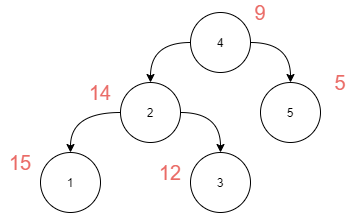
Answer:
Because only 5 is greater than 4 in the above BST, node 4 will be updated to 9 (4 + 5 = 9).

Nodes 3, 4, and 5 are greater than 2, hence node 2 will be modified to 14 (2 + 3 + 4 + 5 = 14).

Node with data 5 will remain the same because there is no node in the BST with data greater than 5.

Nodes 2,3, 4, and 5 are greater than 1, hence node 1 will be modified to 15 (1 + 2 + 3 + 4 + 5 = 15).

Nodes 4 and 5 are greater than 3, hence node 3 will be modified to 12 (3 + 4 + 5 = 12).
03
Round
Medium
Video Call
Duration90 Minutes
Interview date29 Nov 2021
Coding problem1
This was the F2F Coding Round and a little harder than the prev round. The first one is from a game theory (Recursion, Med-Hard), and the second one was from DP.
1. Reverse Stack Using Recursion
Easy
21m average time
80% success
0/40
Asked in companies


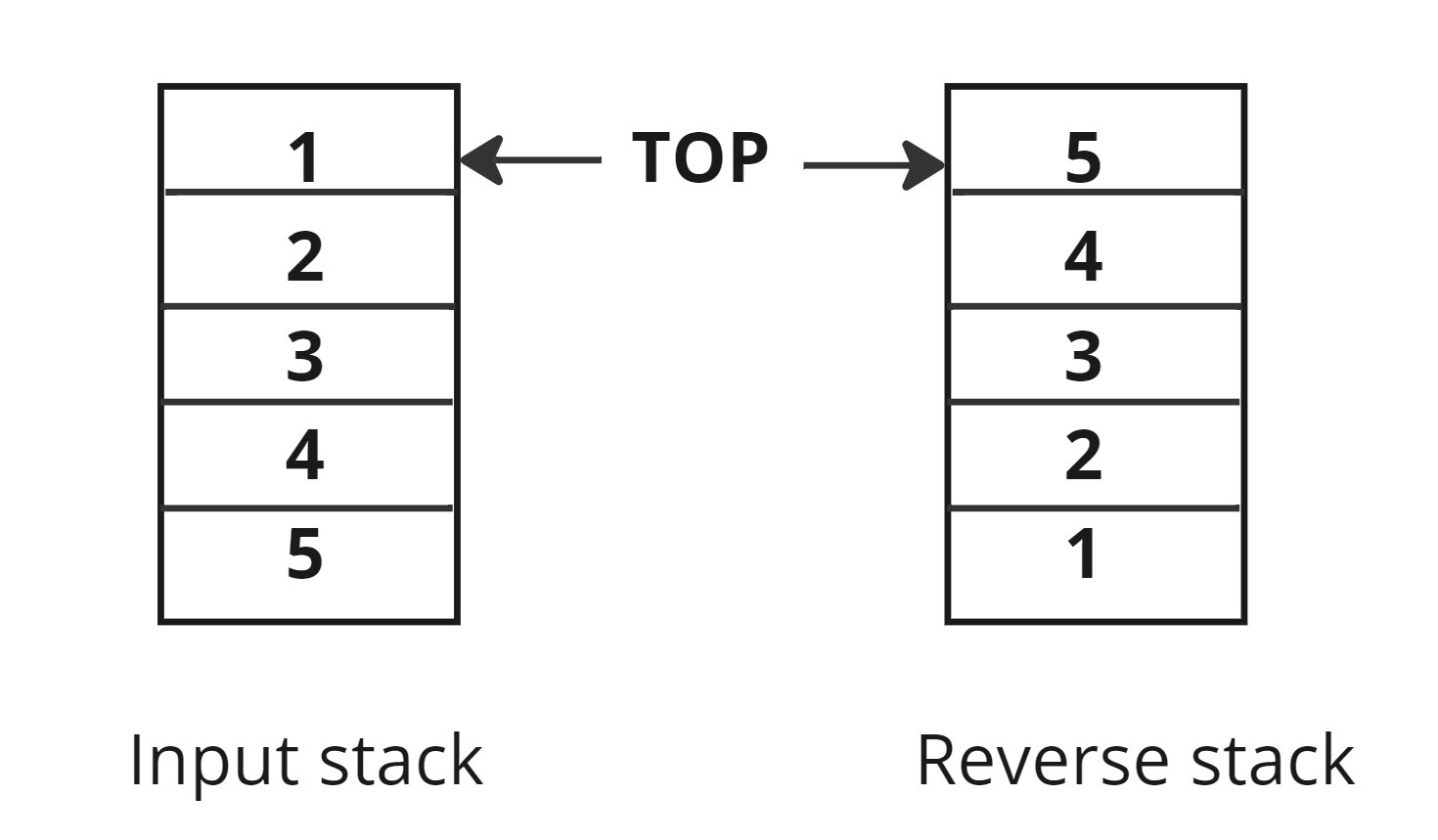
Reverse a given stack of 'N' integers using recursion. You are required to make changes in the input parameter itself.
Note: You are not allowed to use any extra space other than the internal stack space used due to recursion.
Example:
Input: [1,2,3,4,5]
Output: [5,4,3,2,1]
04
Round
Hard
Video Call
Duration90 Minutes
Interview date3 Dec 2021
Coding problem1
This was F2F LLD + SQL round. This was the toughest round. Although I wasn’t able to reach the final solution but tried all possible ways to deliver my thoughts/approach to the interviewer.
1. System Design Question
Design an app like swiggy.
05
Round
Easy
Video Call
Duration30 Minutes
Interview date6 Dec 2021
Coding problem1
It was the CTO round. Well, it was more of a cultural round. He asked me a lot of questions about my previous experience, projects, etc.
1. Basic HR Questions
Where do you see yourself in 5 years?
How do you manage time?


Here's your problem of the day 
Solving this problem will increase your chance to get selected in this company
Skill covered: Programming
What is the correct way to declare a variable in JavaScript?
Choose another skill to practice
Similar interview experiences
SDE - 1
3 rounds | 4 problems
Interviewed by Spinny
 Selected
1894 views

0 comments

0 upvotes
SDE - 1
3 rounds | 6 problems
Interviewed by Spinny
 Selected
 3475 views
7 comments
0 upvotes
SDE - 1
3 rounds | 4 problems
Interviewed by Spinny

Rejected
1738 views
0 comments
0 upvotes
SDE - 1
3 rounds | 6 problems
Interviewed by Spinny
Selected 909 views
0 comments
0 upvotes
Companies with similar interview experiences
SDE - 1
5 rounds | 12 problems
Interviewed by Amazon
 Selected
 116715 views
24 comments
0 upvotes

SDE - 1
4 rounds | 5 problems
Interviewed by Microsoft
Selected 59448 views
5 comments
0 upvotes
SDE - 1
3 rounds | 7 problems
Interviewed by Amazon
 Selected
 35773 views
7 comments
0 upvotes