





Squadstack interview experience Real time questions & tips from candidates to crack your interview
Product Engineer
Squadstack


3 rounds | 5 Coding
problems

 Selected
 Interview preparation journey

Journey
I was very new to coding when I joined college, but the seniors at our college helped me a lot to learn it. I was fortunate to receive some good offers, but I also faced my fair share of rejections. My parents supported me a lot during that time.
Application story
There was an off-campus drive conducted by the Squadstack Recruitment Team. I reached out to one of the employees of the company for a referral. After that, I received the test link, followed by interviews.
Why selected/rejected for the role?
Selected: The interview questions asked were pretty standard, and I was well-prepared for them, as I had prepared all the questions previously asked by this company.
Preparation
Duration: 5 months
Topics: OOPS, System Design, Algorithms, Data Structures, DBMS

Tip 1 : Prepare System Design
Tip 2 : Practice DSA Questions properly
Tip 3 : Practice OOPS and DBMS Concepts
Application process
Where: Referral
Eligibility: 7 & above CGPA
Tip 1: Include at least 4 projects on your resume.
Tip 2: Do not write false information. You will always get caught. Be genuine.

Interview rounds
01
Round
Easy
Video Call
Duration60 minutes
Interview date19 Jul 2021
Coding problem2
The interview started with a formal introduction. He asked a lot of questions about the projects I have worked on, then moved the focus to my past experience. In the end, he just asked 2 simple DSA questions.
1. Min Cost To Buy N Items
Easy
10m average time
90% success

0/40
Asked in companies



Ninja Yuki is in the mood of shopping ninja blades today, and why should he not be, its finally the time for the Spring Fair in his Village. Initially, he has 0 number of blades and aims to buy ‘N’ of them from the fair. But the blade shopkeeper being a cunning man himself, presents a weird way of pricing the number of ninja blades Yuki can buy.
Suppose at any instance Yuki has ‘K’ number of blades, then:
1) Yuki can buy 1 more blade with cost 'A.’ He now has ‘K+1’ Ninja blades.
2) Yuki could buy a ‘K’ number of blades with cost 'B.’ He now has ‘2*K’ blades.
where 'A' and 'B' are predefined and constant.
Yuki does not want to get robbed in the fair. Being his nerd friend can you tell him the minimum price he needs to pay to buy exactly ‘N’ ninja blades, considering he has 0 blades initially?
Note:
There can be two or more ways with the exact cost. You can consider any one of them, but the overall cost to reach from 0 to 'N' must be minimized.
For example:
Consider Yuki need to buy 5 blades, the cost of adding 1 blade is 2, and the cost of doubling the blades is 1 then you have to perform the following operations:
1) Doubling 0 will result in 0 only, so add 1 blade to 0 blades with cost 2. Total cost becomes 2.

2) Next, you can either double 1 to reach 2 or add 1 blade. But since the cost of doubling is less than that of adding, so double 1 with cost 1. Total cost becomes 3.

3) Doubling 2 will result in 4 with a cost of 1. Total becomes 4.

4) Adding 1 in 4 will result in 5 (which is the desired number) with a cost of 2. The total cost to reach 5 becomes 6.
2. Delete Kth Node From End
Moderate
15m average time
95% success
0/80
Asked in companies


You have been given a singly Linked List of 'N' nodes with integer data and an integer 'K'.
Your task is to remove the 'K'th node from the end of the given Linked List and return the head of the modified linked list.
Example:
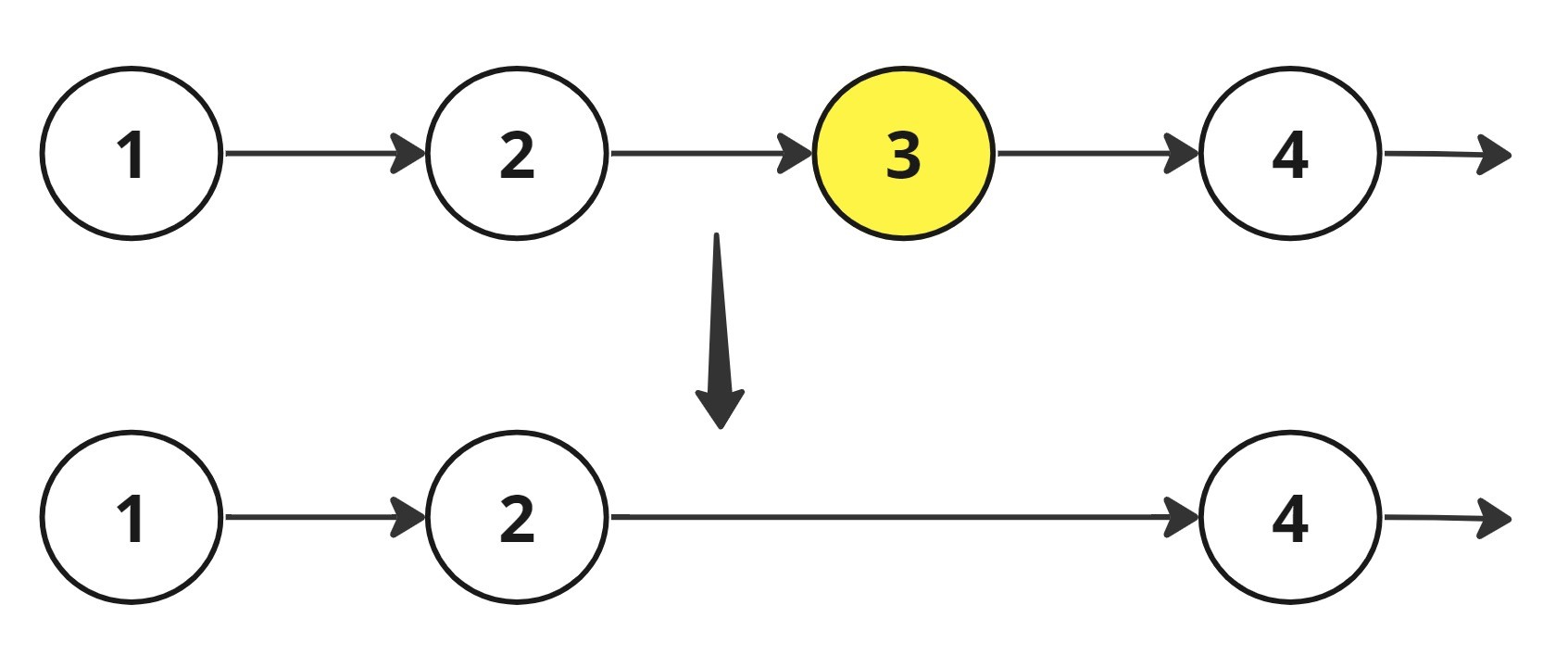
Input : 1 -> 2 -> 3 -> 4 -> 'NULL'  and  'K' = 2
Output: 1 -> 2 -> 4 -> 'NULL'
Explanation:
After removing the second node from the end, the linked list become 1 -> 2 -> 4 -> 'NULL'.
Problem approach
Take two nodes, slowPtr and fastPtr, such that next points to the head. Take one node to store the head; initially, it’s a dummy node (start), and the next of this node will point to the head. The dummy node is used to handle the edge case where B=NB = NB=N (size of the LinkedList). Start traversing until the fast pointer reaches the nnn-th node. Then, start traversing one step at a time with both pointers until the fast pointer reaches the end. When the traversal is complete, delete the node next to slowPtr. Return the next of the start node.
02
Round
Easy
Video Call
Duration60 minutes
Interview date20 Jul 2021
Coding problem2
This round was taken by the Engineering Manager on Google meet, Questions on API, DSA question and 1 Puzzle were asked.
1. Search In A Grid
Moderate
15m average time
85% success
0/80
Asked in companies


You are given a grid ‘MAT’ of ‘N’ rows and ‘M’ columns with positive integers written in each cell.
The grid has the following properties-
• Integers in each row are sorted in ascending order from left to right.
• Integers in each column are sorted in ascending order from top to bottom.
You are also given a positive integer ‘target’. Your task is to find whether ‘target’ is present inside the grid or not.
Problem approach
The code implements a solution class that takes a board of characters and a list of words as input. It then performs a depth-first search to determine if the words are present on the board. If a word is found, it is added to the output along with its position on the board. The code uses a visited array to keep track of the cells that have been visited during the search. Finally, the function returns a vector of strings, where each string is a word followed by its position on the board.
2. Puzzle Question
Given 2 eggs and k floors, find the minimum number of trials needed in worst case. (Learn)
Problem approach
Tip 1 : Practice Previously asked questions.
Tip 2 : Speak your thought process.
0
Round
Easy
HR Round
Duration20 minutes
Interview date18 Aug 2023
Coding problem1
Managerial round with behavioural questions.
1. Basic HR Questions
Tell me about yourself.
What motivated you to pursue a career in software engineering?
Walk me through your academic projects or internships related to software development.
What are your greatest strengths and weaknesses?


Here's your problem of the day 
Solving this problem will increase your chance to get selected in this company
Skill covered: Programming
How do you remove whitespace from the start of a string?
Choose another skill to practice
Similar interview experiences
Product Intern
6 rounds | 9 problems
Interviewed by Squadstack
 Selected
0 views

0 comments

0 upvotes
Product Engineer
4 rounds | 4 problems
Interviewed by Squadstack
Selected 3663 views
0 comments
0 upvotes
Product Engineer
8 rounds | 14 problems
Interviewed by Squadstack
Selected 2030 views
0 comments
0 upvotes
Business Technology Analyst
4 rounds | 5 problems
Interviewed by Squadstack
Selected 2874 views
0 comments
0 upvotes